25 Fun Facts
25 Proboscis Monkey Facts: Borneo's Big-Nosed Swimmers
With a huge drooping nose, a round pot belly and a habit of belly-flopping into rivers, the proboscis monkey is one of the most unusual primates on the planet. It lives only on the island of Borneo, deep in mangroves and swamp forests.
Here are 25 fascinating facts about proboscis monkeys, from why the males have such big noses to the blue-faced babies and the dangers lurking in their rivers.
Proboscis Monkey Facts
Proboscis monkeys are found only on the island of Borneo, which is shared by Malaysia, Brunei and Indonesia.
Their scientific name is Nasalis larvatus, and "proboscis" means a long nose or snout.
Adult males have the largest noses of any primate. The nose can grow more than 10 centimetres long and droop down over the mouth.
Females and young monkeys have much smaller, slightly upturned noses.
In Malaysia and Indonesia, the proboscis monkey has sometimes been nicknamed the "Dutch monkey", as locals joked that it looked like the big-nosed, pot-bellied European colonists.
Proboscis monkeys are among the largest monkeys in Asia. Males weigh around 20 kilograms, about twice as much as females.
They have orange-brown fur, grey arms and legs and a long whitish tail that can be as long as their body.
Proboscis monkey babies are born with bright blue faces, which slowly turn pinkish-grey as they grow.
A male's nose can swell and turn redder when he is excited or angry.
A bigger nose means a louder voice
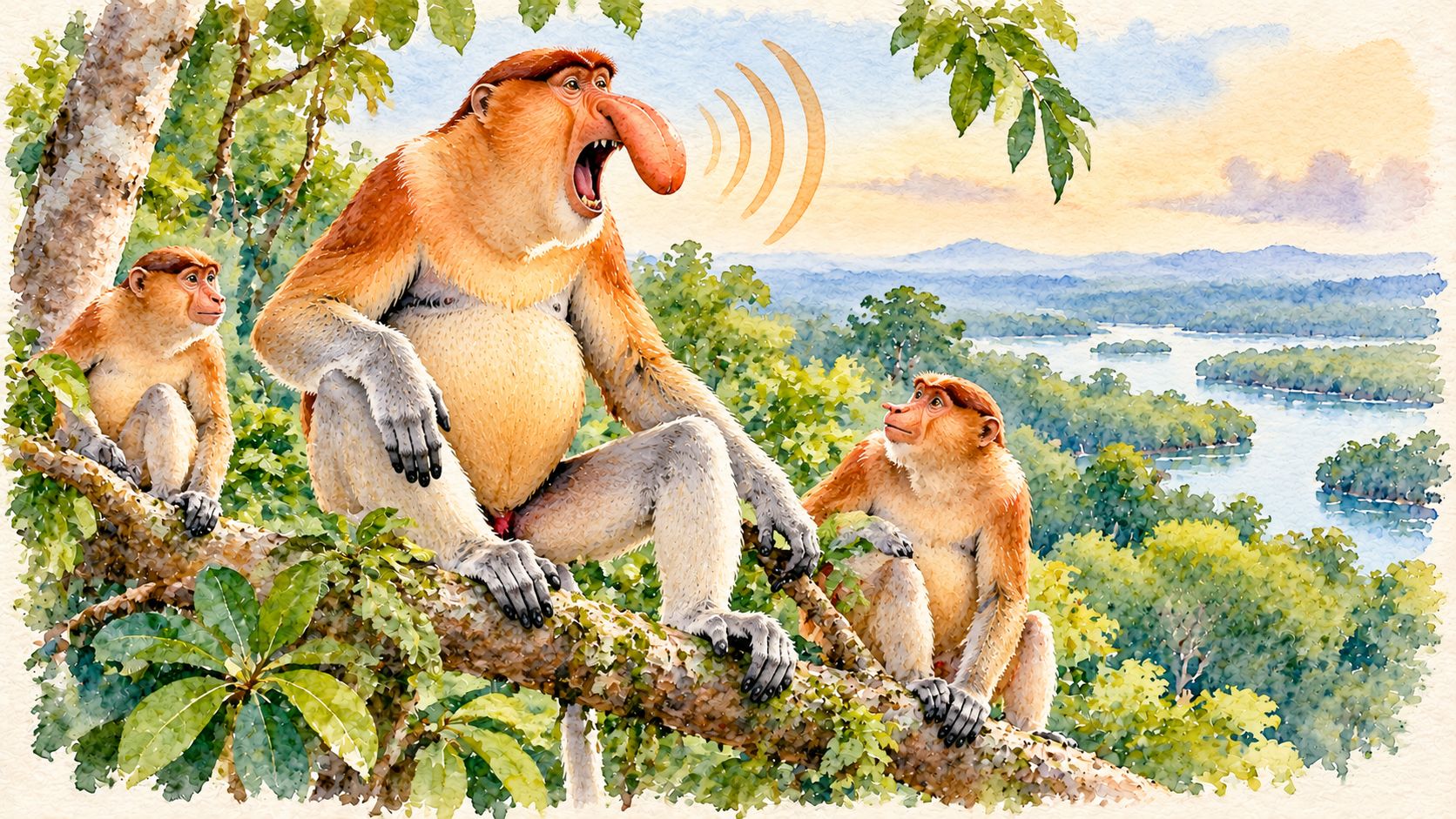
A male proboscis monkey's enormous nose isn't just for show. It works like an echo chamber, making his honking calls louder and deeper. A 2018 study found that males with bigger noses made deeper, more powerful calls, were larger in body size and tended to have more females in their groups. To female proboscis monkeys, a big nose is a sign of a strong, healthy partner.
Their round pot bellies hold a large, multi-chambered stomach full of helpful bacteria that break down tough leaves.
Proboscis monkeys mostly eat young leaves, seeds and unripe fruit.
They avoid ripe, sugary fruit, because it can ferment in their stomachs and cause dangerous bloating.
In 2011, scientists discovered that proboscis monkeys sometimes bring up their food and chew it again, a bit like cows chewing the cud.
They live in mangrove forests, swamp forests and forests along rivers, and are rarely found far from water.
At night, they sleep in tall trees at the river's edge, which helps them watch for danger.
Most groups are made up of one adult male with several females and their young. Young males often form separate bachelor groups.
Females have a single baby after a pregnancy of about five and a half months.
Proboscis monkeys can live for around 20 years.
Proboscis monkeys are champion swimmers
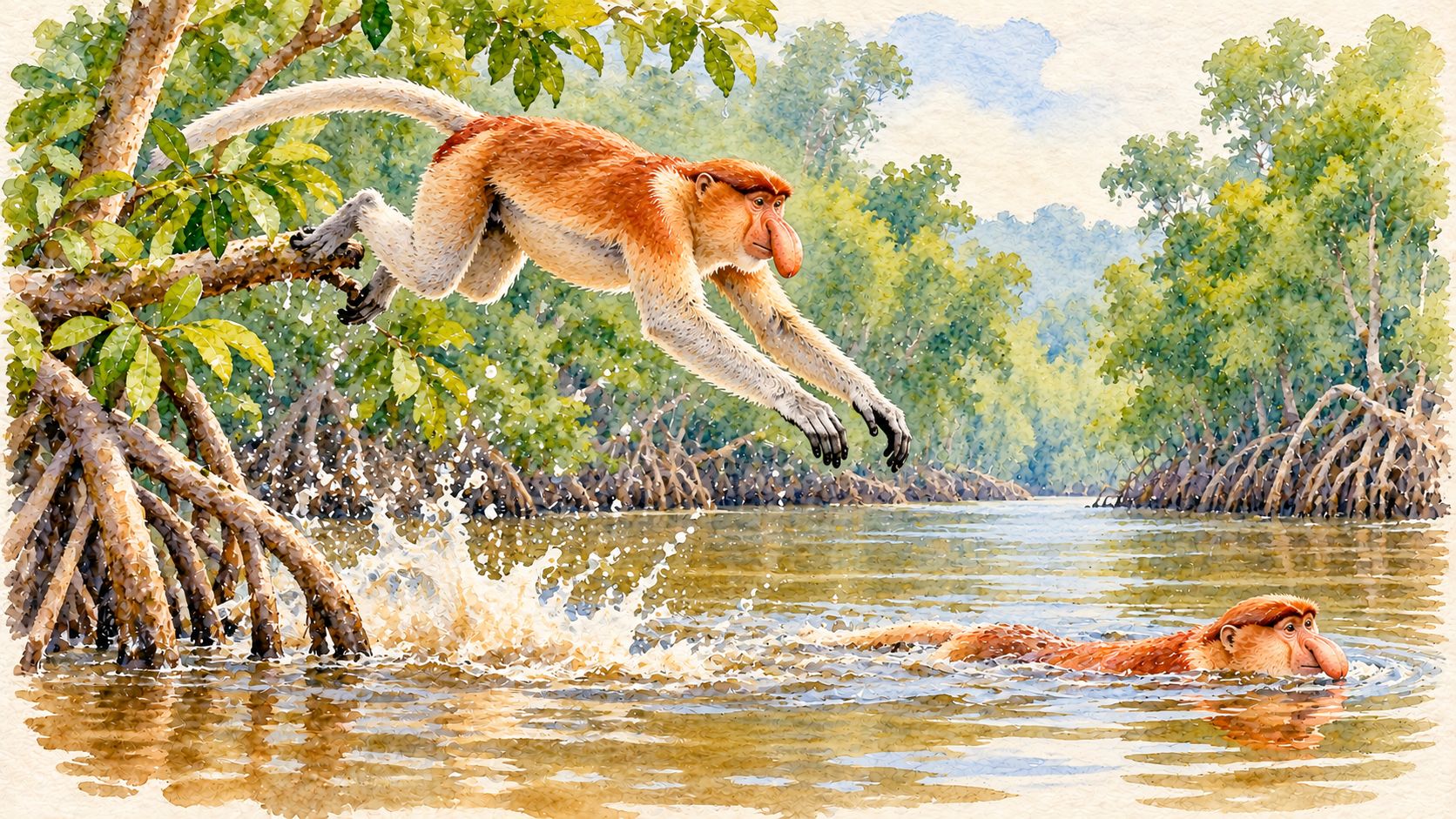
Few monkeys enjoy water, but proboscis monkeys are excellent swimmers. Their feet and hands are partly webbed, which helps them paddle across rivers and swamps. They often leap from high branches straight into the water with a loud belly-flop. They can even swim short distances underwater. Rivers in Borneo are home to crocodiles, so these monkeys often cross at the narrowest points to spend as little time in the water as possible.
Crocodiles are one of their biggest threats when they swim, and clouded leopards and large snakes hunt them in the trees.
Proboscis monkeys are listed as endangered, and their numbers have fallen sharply in recent decades.
Their biggest threat is habitat loss, as mangroves and forests are cleared for farming, logging and oil palm plantations.
Because of their special leafy diet, proboscis monkeys are very difficult to keep in zoos, and very few are found in captivity.
Protected areas and sanctuaries in Sabah, Sarawak and Indonesian Borneo are helping to protect proboscis monkeys and the mangroves they depend on.
Sources and Further Reading
- IUCN Red List of Threatened Species
- WWF
- Science Advances
- New England Primate Conservancy
- Encyclopaedia Britannica
- National Geographic
Frequently asked questions
Why do proboscis monkeys have big noses?
Males have huge noses that make their calls louder and deeper. Studies suggest females prefer males with bigger noses, as they tend to be larger and stronger.
Where do proboscis monkeys live?
Proboscis monkeys live only on the island of Borneo, in mangroves, swamp forests and forests along rivers in Malaysia, Brunei and Indonesia.
What do proboscis monkeys eat?
They mainly eat young leaves, seeds and unripe fruit. They avoid ripe, sugary fruit because it can cause dangerous bloating in their stomachs.
Why do proboscis monkeys have big bellies?
Their pot bellies hold a large stomach full of bacteria that help them digest tough leaves, which makes their bellies look round and full.
Can proboscis monkeys swim?
Yes. Proboscis monkeys are excellent swimmers, with partly webbed feet and hands. They often jump from trees into rivers and can even swim underwater for short distances.
Are proboscis monkeys endangered?
Yes. Proboscis monkeys are listed as endangered, mainly because their mangrove and forest homes are being cleared.
More Fun Facts