25 Fun Facts
25 Turtle Facts: Ancient Shell-Backed Survivors of Land and Sea
Turtles have been around since the age of the early dinosaurs, and they have hardly needed to change. With a built-in suit of armour and an amazing sense of direction, they have survived for more than 200 million years.
Here are 25 fascinating facts about turtles, from giant leatherbacks that dive deeper than submarines to the hatchlings racing across India's beaches.
Turtle Facts
There are around 360 species of turtles and tortoises in the world.
Turtles first appeared more than 200 million years ago, around the same time as the earliest dinosaurs.
A turtle's shell is part of its skeleton, made from its ribs and backbone fused together, so a turtle can never crawl out of its shell.
The top of the shell is called the carapace and the bottom is called the plastron. The plates covering it, called scutes, are made of keratin, the same material as your fingernails.
Turtles have no teeth. Instead, they have a hard, sharp beak for biting and tearing food.
Tortoises are turtles that live entirely on land, with sturdy, elephant-like legs, and most of them eat plants.
Turtles live on every continent except Antarctica.
Every turtle lays its eggs on land, even sea turtles that spend almost their whole lives in the ocean.
There are seven species of sea turtle, and six of them are listed as threatened with extinction.
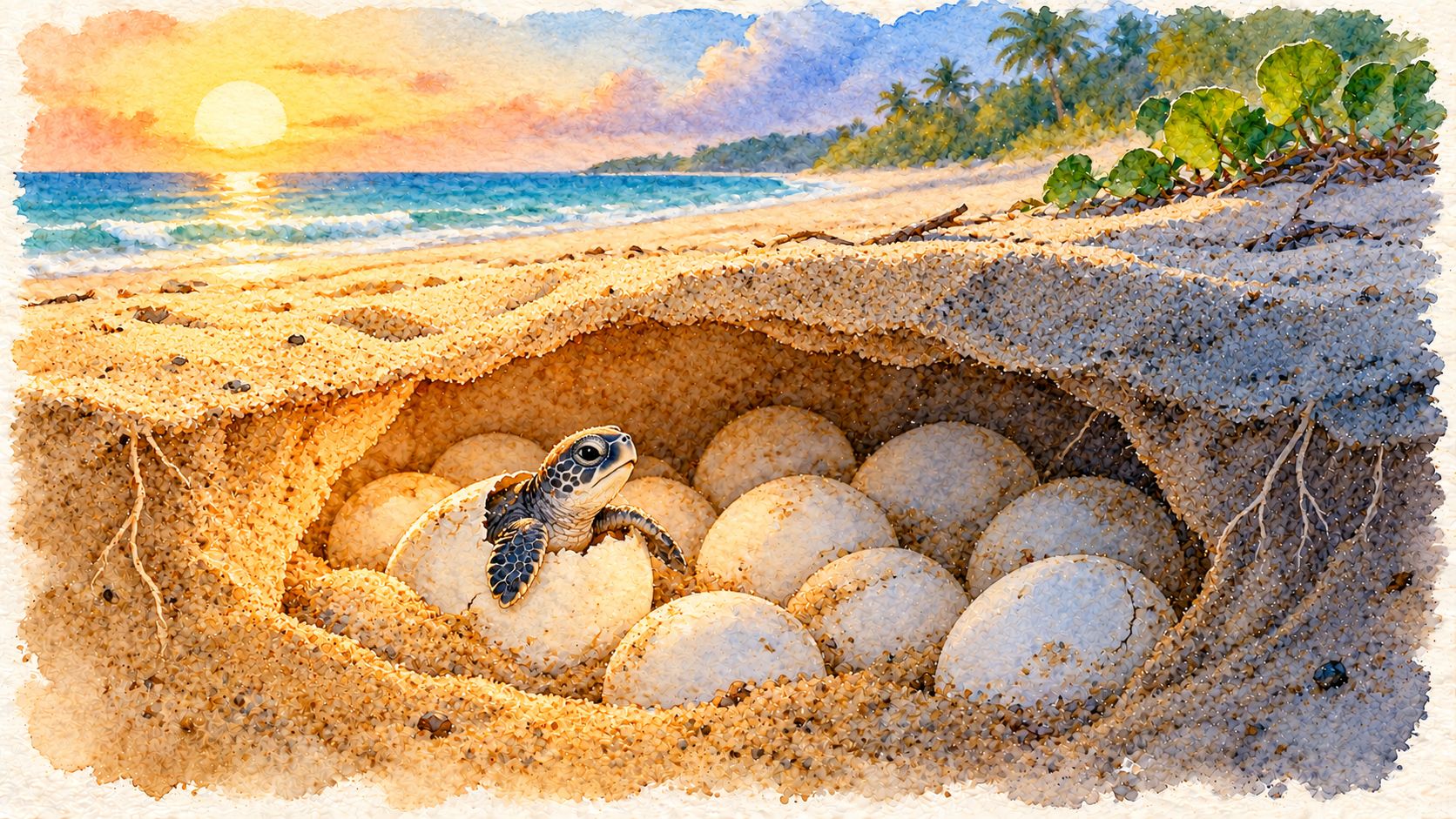
Sand temperature decides whether a baby turtle is male or female
For most turtles, a hatchling's sex isn't set by genes but by the temperature of the sand around the egg. In sea turtles, warmer nests produce mostly females and cooler nests produce mostly males, which scientists sum up as "hot chicks and cool dudes". Because of this, rising temperatures are a real worry. A 2018 study found that over 99% of young green turtles from the warmest beaches of Australia's northern Great Barrier Reef were female.
The leatherback is the largest turtle in the world. It can grow up to about 2 metres long and weigh more than 600 kilograms.
Instead of a hard shell, the leatherback has a tough, leathery skin stretched over small bony plates.
Leatherbacks can dive more than 1,000 metres deep, deeper than most submarines go.
Leatherbacks feed mainly on jellyfish, and their throats are lined with backward-pointing spines that stop slippery prey from escaping.
Leatherbacks travel farther than any other turtle, swimming from tropical beaches to cold waters near the Arctic.
Green turtles are named not after their shell but after the greenish colour of their body fat, which comes from their seagrass diet.
Hawksbill turtles feed mainly on sea sponges, which helps keep coral reefs healthy.
Sea turtles use Earth's magnetic field like a map, and many females return to nest on the same beach where they hatched, decades later.
Sea turtles cry salty "tears". Special glands near their eyes remove extra salt from the seawater they swallow.
Hundreds of thousands of olive ridley turtles nest together in Odisha
On a few beaches in the world, olive ridley sea turtles come ashore together in huge numbers to lay their eggs, an event known as an arribada, which means "arrival" in Spanish. Odisha in India has some of the biggest of all, at Gahirmatha and Rushikulya. In some years, hundreds of thousands of turtles crawl up the beach over just a few nights. About 45 to 60 days later, the beaches fill with tiny hatchlings scrambling toward the sea.
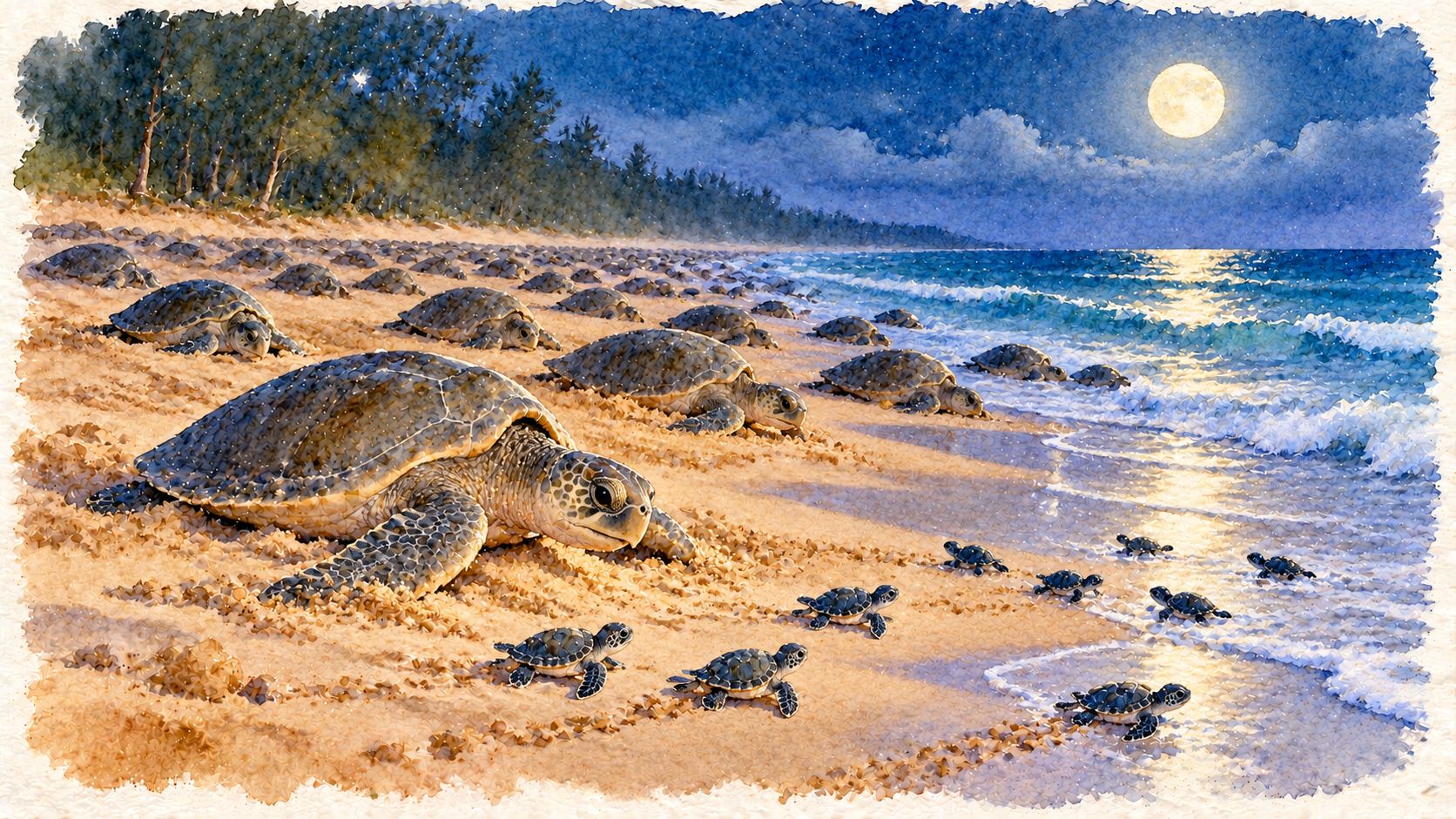
Hatchlings find the sea by heading toward the brightest horizon, which is usually moonlight on the water. Bright lights from buildings can confuse them and lead them the wrong way.
Only around 1 in 1,000 sea turtle hatchlings is thought to survive to adulthood.
Some freshwater turtles, such as Australia's Fitzroy River turtle, can absorb oxygen through their rear end, which lets them stay underwater for long periods.
The alligator snapping turtle lures fish by wiggling a pink, worm-shaped flap on its tongue, then snapping its jaws shut.
Giant tortoises can live for well over 100 years. The Galápagos Islands are even named after them, as galápago is an old Spanish word for tortoise.
Sources and Further Reading
- IUCN Red List of Threatened Species
- NOAA Fisheries
- Wildlife Institute of India
- WWF India
- Encyclopaedia Britannica
- National Geographic
Frequently asked questions
What is the difference between a turtle and a tortoise?
All tortoises are turtles, but not all turtles are tortoises. Tortoises live only on land, have sturdy, elephant-like legs and mostly eat plants. Many other turtles live in or near water and have webbed feet or flippers.
Can a turtle come out of its shell?
No. A turtle's shell is part of its skeleton, made from its ribs and backbone, so it can never leave its shell.
How long do turtles live?
It depends on the species. Many turtles live for several decades, and giant tortoises can live for well over 100 years.
How is a baby turtle's sex decided?
In most turtles, the temperature of the nest decides it. In sea turtles, warmer sand produces mostly females and cooler sand produces mostly males.
What is the largest turtle in the world?
The leatherback sea turtle is the largest. It can reach about 2 metres in length and weigh more than 600 kilograms.
Where do turtles nest in India?
Olive ridley sea turtles nest in huge numbers on the beaches of Odisha, especially at Gahirmatha and Rushikulya. Other sea turtles also nest along parts of India's coasts and islands.
More Fun Facts