25 Fun Facts
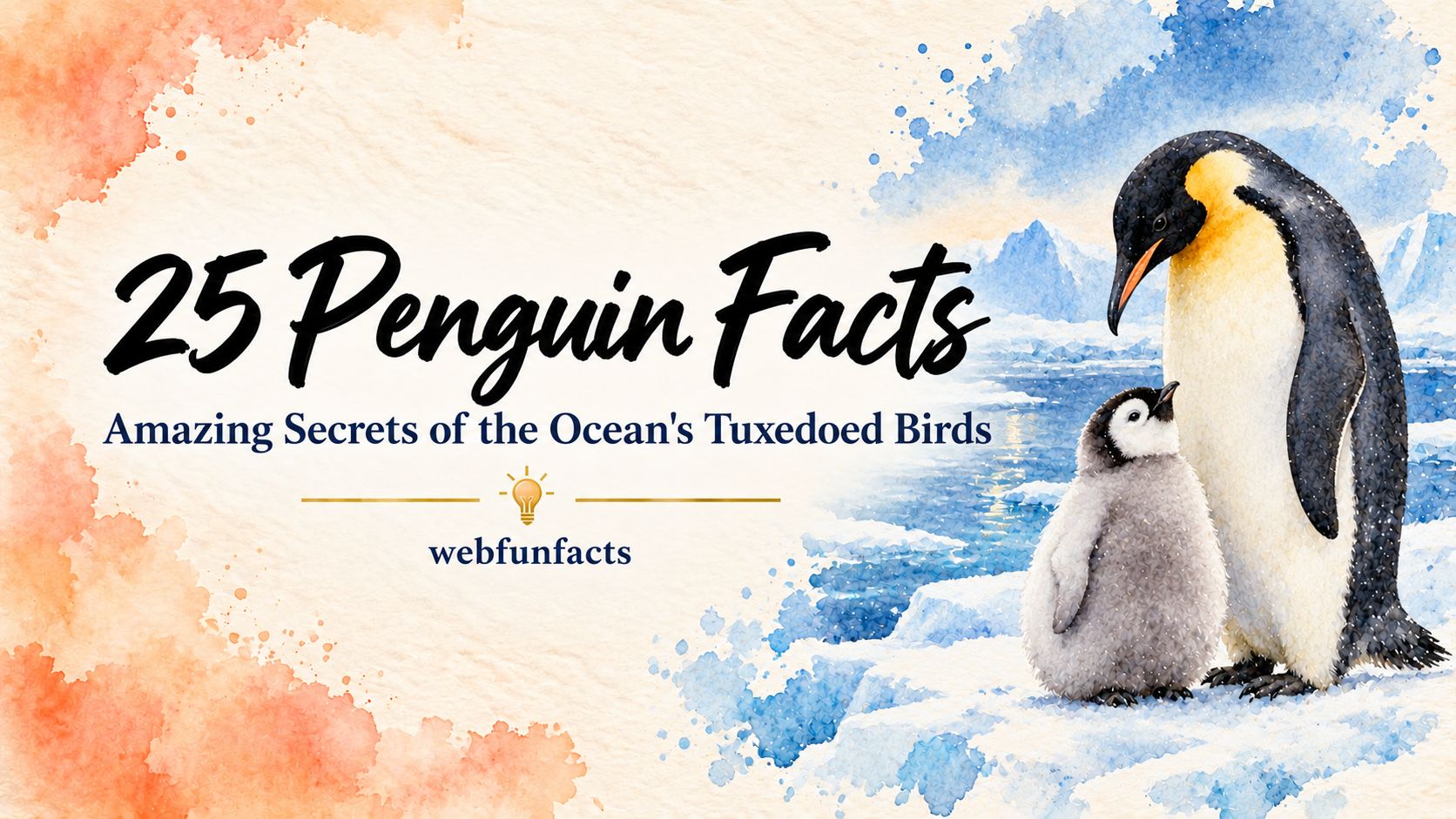
25 Penguin Facts: Amazing Secrets of the Ocean's Tuxedoed Birds
Penguins waddle on land, slide on their bellies across the ice and then turn into torpedo-fast swimmers the moment they hit the water. These charming birds have adapted to some of the toughest places on Earth.
Here are 25 amazing facts about penguins, from caring emperor dads to pebble-collecting romantics and giant ancient penguins as tall as a person.
Penguin Facts
There are 18 species of penguin, although scientists still debate the exact number.
Almost all penguins live in the Southern Hemisphere, but the Galápagos penguin lives so close to the equator that some cross into the Northern Hemisphere.
Not all penguins live in icy places. African penguins live on the beaches of South Africa and Namibia, and Humboldt penguins live along the deserts of Peru and Chile.
The emperor penguin is the largest penguin, standing about 1.1 metres tall and weighing up to around 40 kilograms.
The little penguin of Australia and New Zealand is the smallest, at only about 30 centimetres tall and around 1 kilogram.
Penguins can't fly through the air, but their stiff, flipper-like wings let them "fly" underwater.
The gentoo penguin is the fastest swimming bird, reaching speeds of about 36 kilometres per hour.
Emperor penguins can dive deeper than any other bird, to more than 500 metres, and can stay underwater for over 20 minutes.
Penguins can drink seawater. A special gland above their eyes filters out the salt, which they sneeze or shake out through their beaks.
Emperor penguin dads keep the egg warm all winter
After an emperor penguin mother lays her single egg, she passes it carefully to the father and heads out to sea to feed. The father balances the egg on his feet, tucked under a warm fold of skin called a brood pouch, for about two months through the dark Antarctic winter. During that time he eats nothing at all and loses a large part of his body weight. He huddles with thousands of other fathers against freezing winds until the chick hatches and the mother returns.
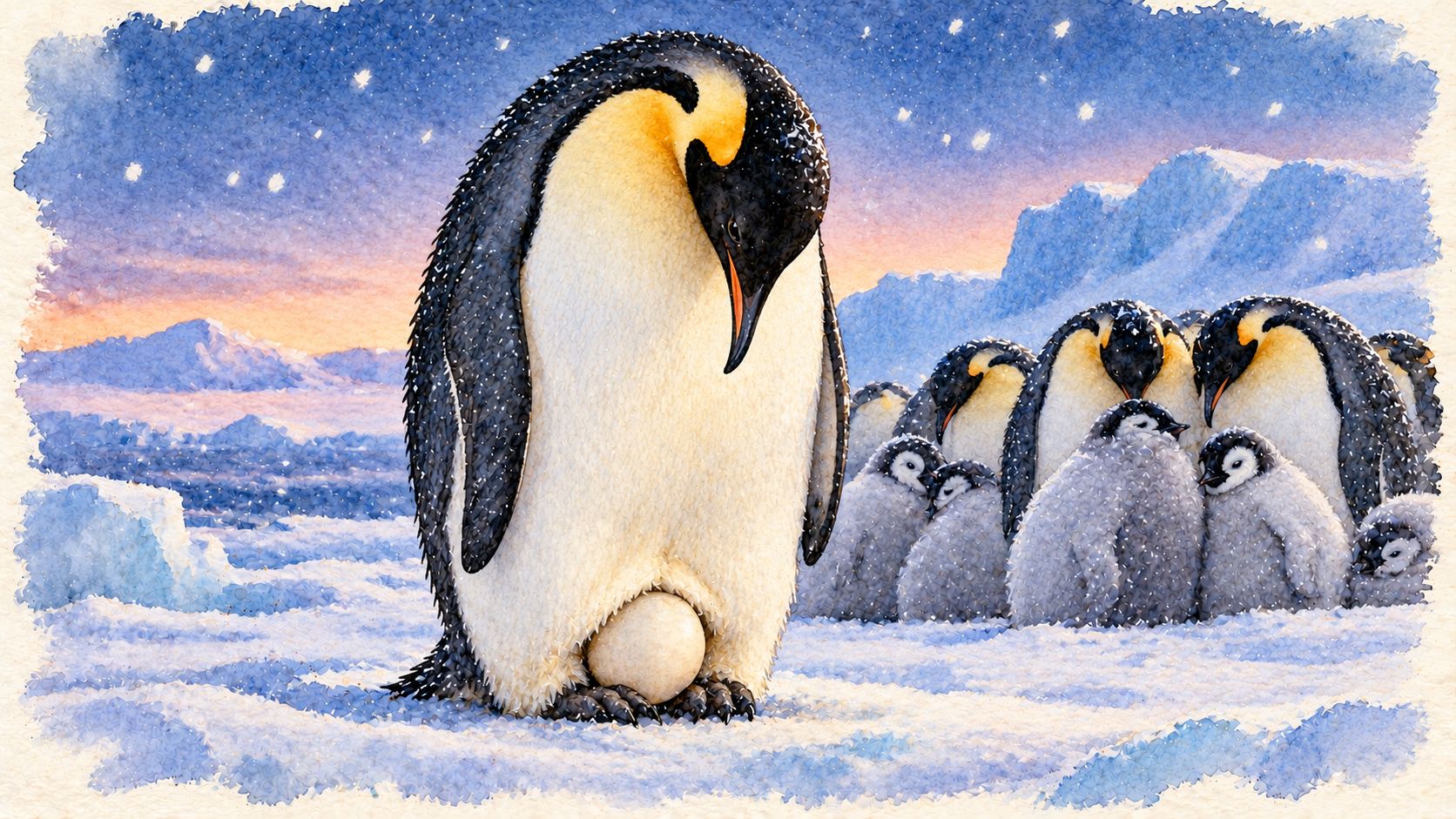
Huddling emperor penguins take turns moving between the cold outer edge and the warm centre, where the temperature can climb above 30°C.
A penguin's black back and white belly work as camouflage. From above it blends into the dark sea, and from below it blends into the bright surface.
Penguins have tightly packed, waterproof feathers and a layer of fat under their skin to keep warm in icy water.
Penguins have no teeth. Instead, their tongues and mouths are lined with backward-pointing spines that help them grip slippery fish.
Every penguin chick has a unique call, and parents can find their own chick among thousands of others just by its voice.
Fluffy brown king penguin chicks look so different from their parents that early explorers thought they were a separate species.
Once a year, penguins go through a "catastrophic moult", losing and replacing all their feathers at once. Until the new feathers grow in, they can't swim, so they can't feed for two to three weeks.
Penguins often slide across snow and ice on their bellies, pushing with their feet. This is called tobogganing.
Rockhopper penguins get their name from the way they hop from rock to rock with both feet together instead of waddling.
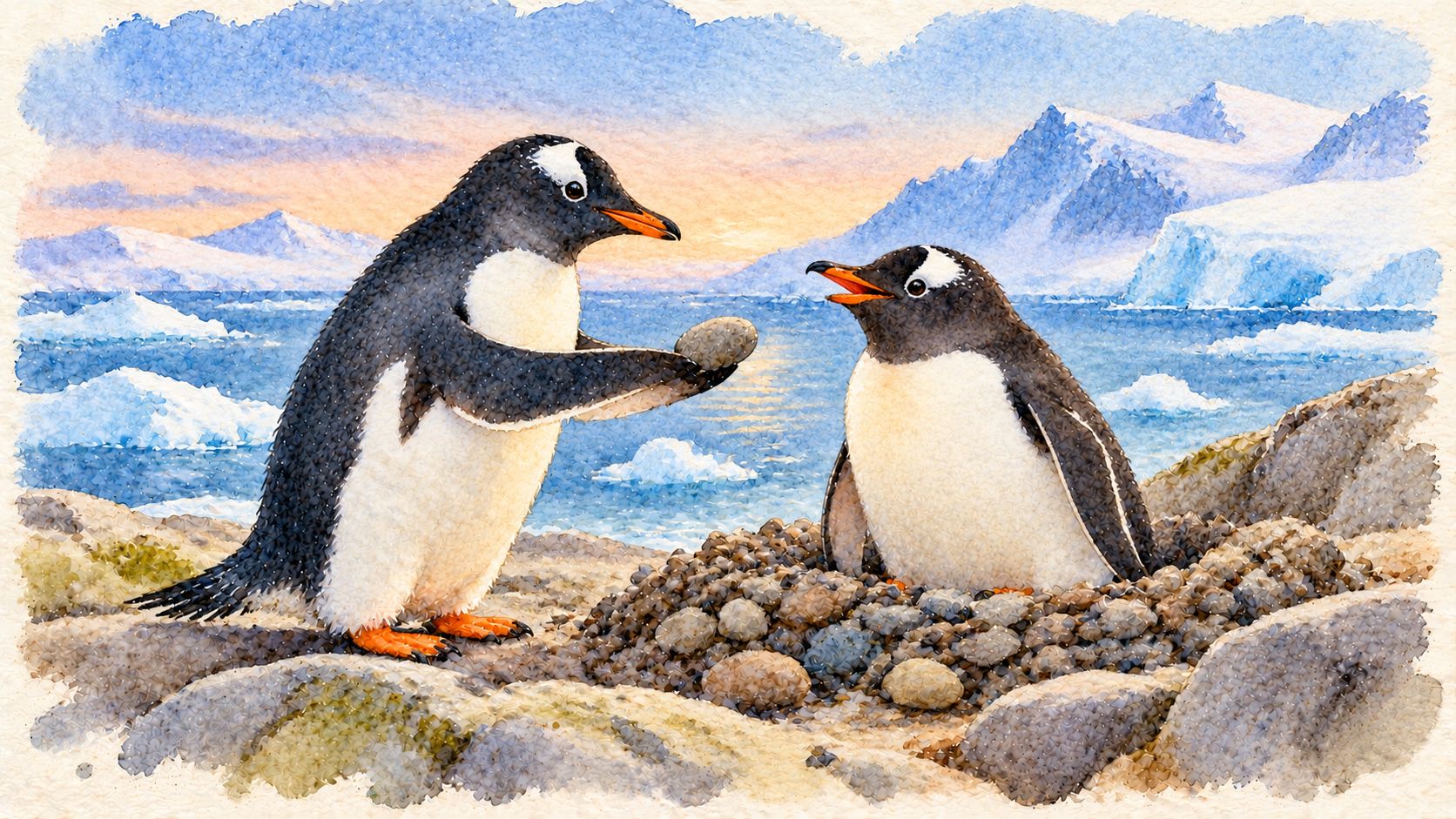
Some penguins give pebbles as gifts
Gentoo and Adélie penguins build their nests from small stones on bare, rocky ground, and good pebbles are in short supply. A male will search for the smoothest, best pebble he can find and present it to a female. If she accepts, the pair use the stones to build a nest that keeps their eggs above icy meltwater. Pebbles are so valuable that penguins often sneak over and steal them from their neighbours' nests.
Some penguins can leap out of the water onto ice ledges nearly 2 metres high.
The name "penguin" was first given to the great auk, a flightless bird of the North Atlantic that went extinct in 1844. Sailors later used the name for the black-and-white birds they found in the south.
The oldest known penguin fossils, from New Zealand, are around 60 million years old.
Some ancient penguins were giants. Fossils show that a few species stood about as tall as an adult human and weighed well over 100 kilograms.
Scientists can find emperor penguin colonies from space, by spotting the brown stains of their droppings on the white ice in satellite images.
Sources and Further Reading
- British Antarctic Survey
- Encyclopaedia Britannica
- IUCN Red List of Threatened Species
- Australian Antarctic Division
- National Geographic
- Smithsonian Institution
Frequently asked questions
How many species of penguins are there?
There are 18 species of penguin, though scientists still debate the exact number. They range from the tiny little penguin to the large emperor penguin.
Do all penguins live in Antarctica?
No. Only a few species live on Antarctica itself. Others live in South America, South Africa, Australia, New Zealand and the Galápagos Islands, near the equator.
What is the largest penguin?
The emperor penguin is the largest living penguin. It stands about 1.1 metres tall and can weigh up to around 40 kilograms.
How fast can penguins swim?
The gentoo penguin is the fastest, reaching about 36 kilometres per hour underwater. Most penguins swim at slower but still impressive speeds.
Can penguins drink salt water?
Yes. A special gland above their eyes removes salt from their blood, and they get rid of it by sneezing or shaking their heads.
How long do penguins live?
Many penguins live for about 15 to 20 years in the wild, depending on the species, and some live longer in protected settings.
More Fun Facts