25 Fun Facts
25 Ladybug Facts: The Spotted Beetles That Protect Our Gardens
With their shiny red shells and neat black spots, ladybugs are among the best-loved insects in the world. But behind that cute look is a hungry hunter, a gardener's best friend and a beetle with some very strange tricks.
Here are 25 fascinating facts about ladybugs, from their spiky alligator-like babies to the tiny ladybugs that saved California's orange groves.
Ladybug Facts
Ladybugs aren't true bugs. They are beetles, which is why scientists often call them lady beetles.
In Britain, India and many other countries, they are known as ladybirds.
There are around 6,000 species of ladybug around the world.
The name comes from medieval Europe, where the beetles were linked to the Virgin Mary, "Our Lady". The red was said to stand for her cloak.
Not all ladybugs are red with black spots. Some are yellow, orange, pink or black with red spots, and some have stripes or no spots at all.
A ladybug's spots don't tell you its age. The number and pattern of spots depend on the species.
Their bright colours act as a warning, telling birds and other predators that they taste horrible.
When threatened, a ladybug can ooze a smelly, bitter yellow fluid from its knee joints. This trick is called reflex bleeding.
Ladybugs may also play dead, tucking in their legs and falling still until danger passes.
Ladybugs are aphid-eating machines
Aphids are tiny sap-sucking insects that damage crops and garden plants, and ladybugs love to eat them. A single adult ladybug can eat dozens of aphids in a day and thousands over its lifetime. Their larvae are just as hungry. This is why farmers and gardeners welcome ladybugs, and why some people buy them to release onto plants as a natural alternative to chemical pesticides.
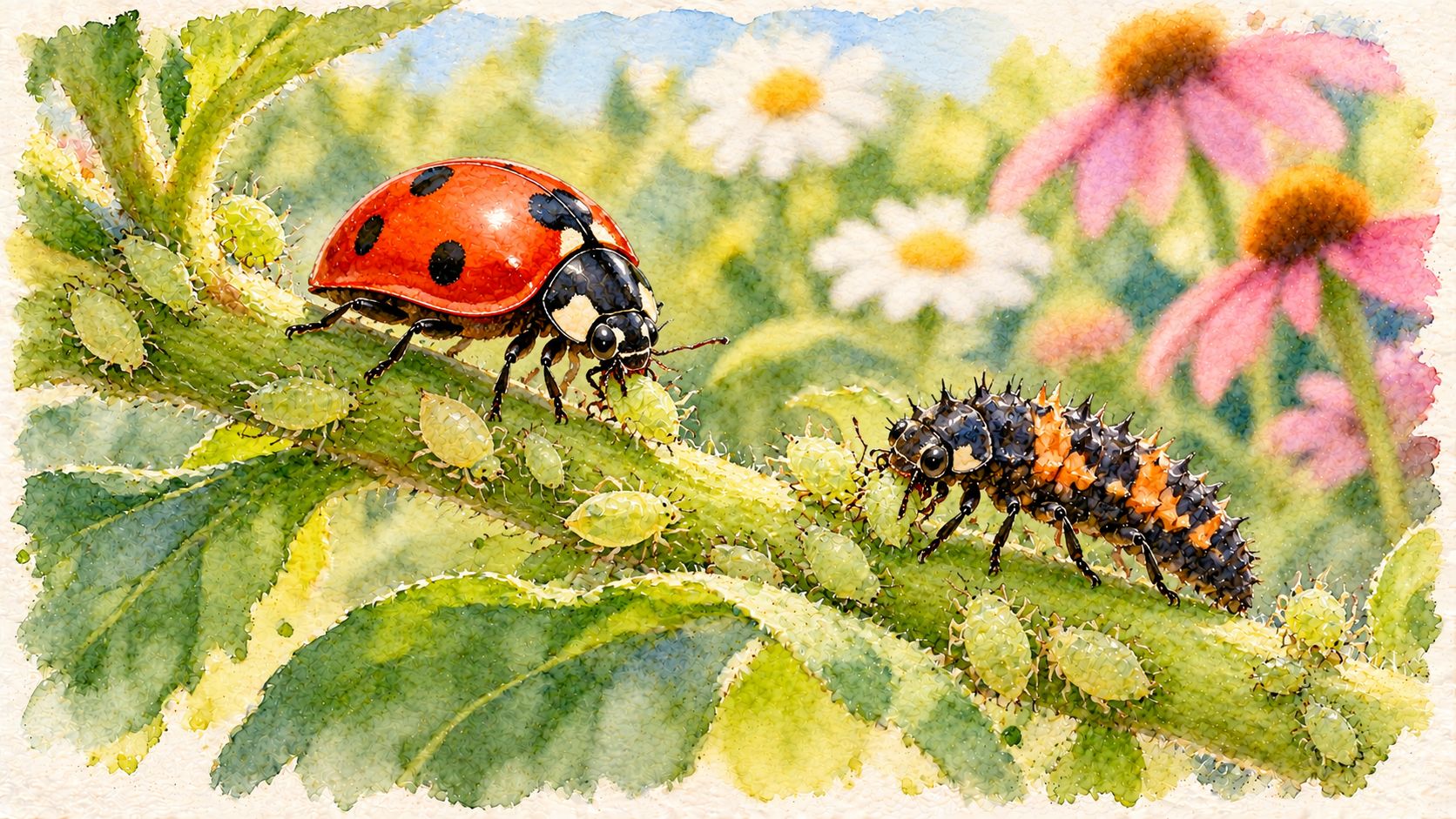
Ladybug larvae look nothing like their parents. They are long, spiky and dark, a bit like tiny alligators.
Ladybugs go through four life stages: egg, larva, pupa and adult. The whole change can take about a month.
Females lay clusters of small yellow eggs on leaves, usually close to a colony of aphids so their young will have food right away.
Some ladybugs lay extra eggs that never hatch, which give their newly hatched larvae a ready-made first meal.
A ladybug's hard, colourful wing covers are called elytra. Delicate flying wings are folded neatly underneath them.
Ladybugs can fold and unfold their wings in seconds, a design that has inspired engineers working on foldable structures.
In cold weather, ladybugs gather in big clusters, sometimes thousands together, to sleep through the winter in sheltered spots.
Not all ladybugs eat insects. The 22-spot ladybird feeds on mildew growing on leaves.
In India, some plant-eating ladybugs, often called epilachna beetles, are pests that chew the leaves of brinjal, potato and other crops.
Tiny ladybugs saved California's orange groves
In the 1880s, a pest called the cottony cushion scale was destroying citrus orchards in California. Scientists brought over a small ladybug from Australia called the vedalia beetle, which feeds on this pest. Within a few years, the beetles had brought the outbreak under control and saved the state's orange industry. It is remembered as one of the first great successes of biological pest control, using natural enemies instead of chemicals.

The harlequin ladybird, originally from Asia, has spread across Europe and North America, where it competes with and even eats native ladybugs.
Ladybugs can occasionally give a small nip, but they are harmless to people.
Most ladybugs live for around a year, and some live longer.
In 1999, ladybugs flew into space aboard the Space Shuttle Columbia as part of a student experiment on how they would hunt aphids in zero gravity.
In many cultures, a ladybug landing on you is thought to bring good luck, perhaps because farmers long saw them as protectors of their crops.
Sources and Further Reading
- Encyclopaedia Britannica
- Natural History Museum, London
- University of California Agriculture and Natural Resources
- Royal Horticultural Society
- NASA
- National Geographic
Frequently asked questions
Are ladybugs actually bugs?
No. Ladybugs are beetles. Scientists often call them lady beetles, and in Britain and India they are called ladybirds.
Do a ladybug's spots show its age?
No. The number and pattern of spots depend on the species, not on how old the ladybug is.
What do ladybugs eat?
Most ladybugs eat aphids and other small, soft insects. A few species eat mildew, and some feed on plants and can damage crops.
Are ladybugs harmful to humans?
No. Ladybugs are harmless. Some may give a tiny nip, and they can release a smelly yellow fluid if handled, but they don't cause any real harm.
How long do ladybugs live?
Most ladybugs live for about a year. They go through egg, larva, pupa and adult stages, often in about a month.
Why are ladybugs considered lucky?
In many cultures, ladybugs are seen as a sign of good luck, probably because they protect crops and gardens by eating harmful pests.
More Fun Facts