25 Velociraptor Facts: Meet the Real Feathered Raptor
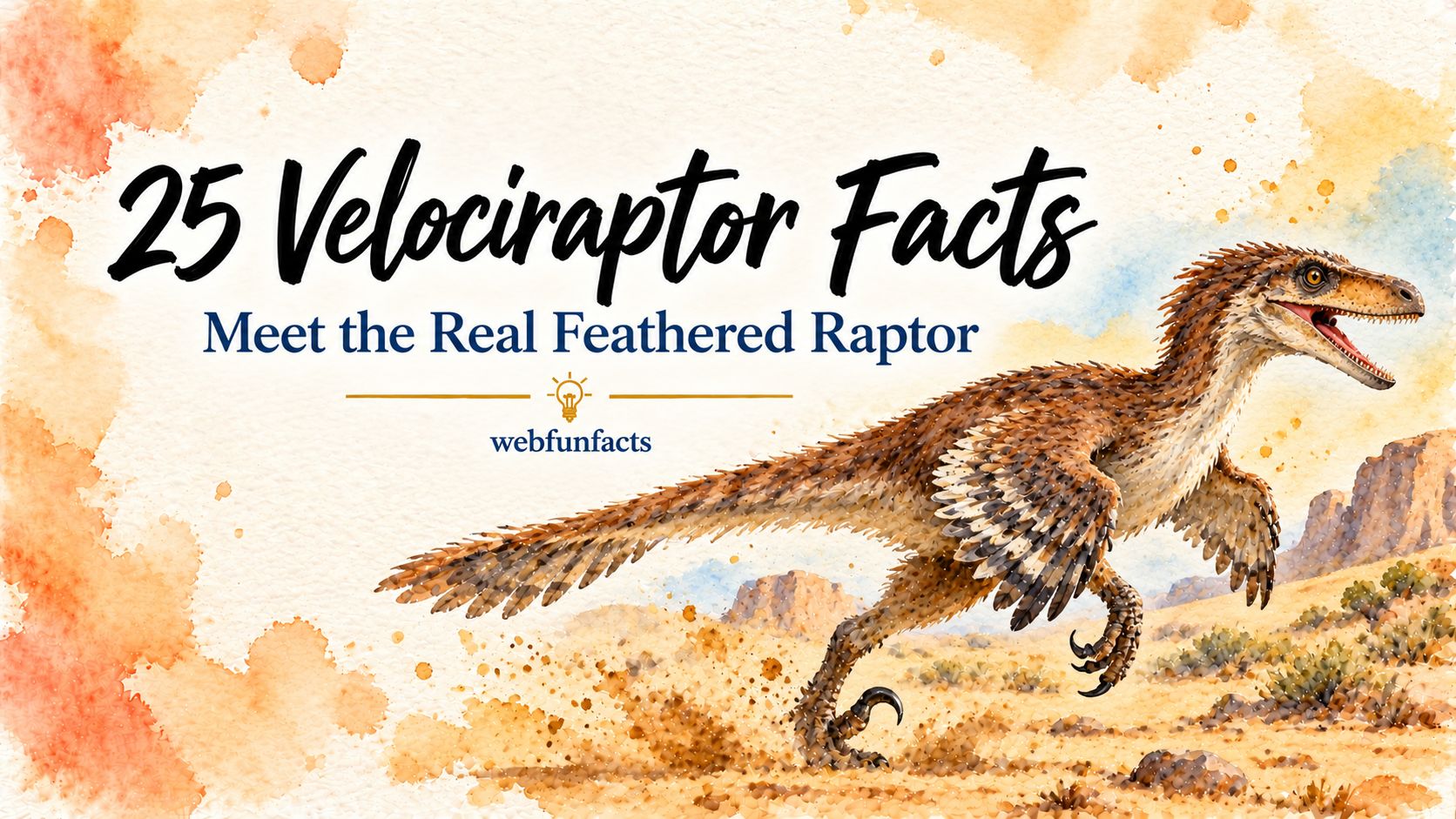
Forget the human-sized monsters of the movies. The real Velociraptor was a lightly built, feathered hunter roughly the size of a turkey, darting across the sand dunes of what is now Mongolia some 75 to 71 million years ago, close to the end of the age of dinosaurs.
Thanks to some remarkably well-preserved fossils, including one caught in the middle of a fight, scientists know a surprising amount about this small predator. Here are 25 facts about its size, feathers, killer toe claw and lifestyle, along with a few popular myths that the fossils firmly put to rest.
Velociraptor Facts
Velociraptor lived during the Late Cretaceous period, roughly 75 to 71 million years ago, in what is now Mongolia and northern China.
An adult was about 2 metres long from snout to tail tip, but stood only around half a metre tall at the hip and probably weighed about 15 kg, similar to a large turkey.
Much of that length was tail. The tail was stiffened by long, thin bony rods, which probably helped the animal balance and change direction while running.
The name Velociraptor comes from Latin and is usually translated as "swift seizer" or "swift thief".
Its first fossils, a crushed skull and a toe claw, were found in 1923 in the Gobi Desert of Mongolia by Peter Kaisen, a member of an American Museum of Natural History expedition.
The genus was named in 1924 by Henry Fairfield Osborn, president of that museum, with the type species Velociraptor mongoliensis.
Velociraptor belonged to the dromaeosaurids, a family of small to medium-sized feathered predators that were among the closest non-bird relatives of birds.
Each foot had an enlarged, curved "sickle claw" on the second toe, about 6.5 cm long along its outer curve, which was held raised off the ground as the animal walked.
It walked on two legs, and each arm ended in three long, clawed fingers. A half-moon-shaped wrist bone let it fold its hands sideways, much as birds fold their wings.
Velociraptor Had Feathers
In 2007, palaeontologists studying a Velociraptor forearm bone from Mongolia spotted a row of small bumps called quill knobs. In living birds, these knobs are where the large wing feathers anchor to the bone through ligaments, so their presence is strong evidence that Velociraptor carried long, vaned feathers on its arms. Close relatives preserved in China show full coats of feathers, so it was probably feathered over much of its body too. It still could not fly, because its arms were far too short to lift its body. The feathers may instead have been used for display, warmth or shielding eggs.
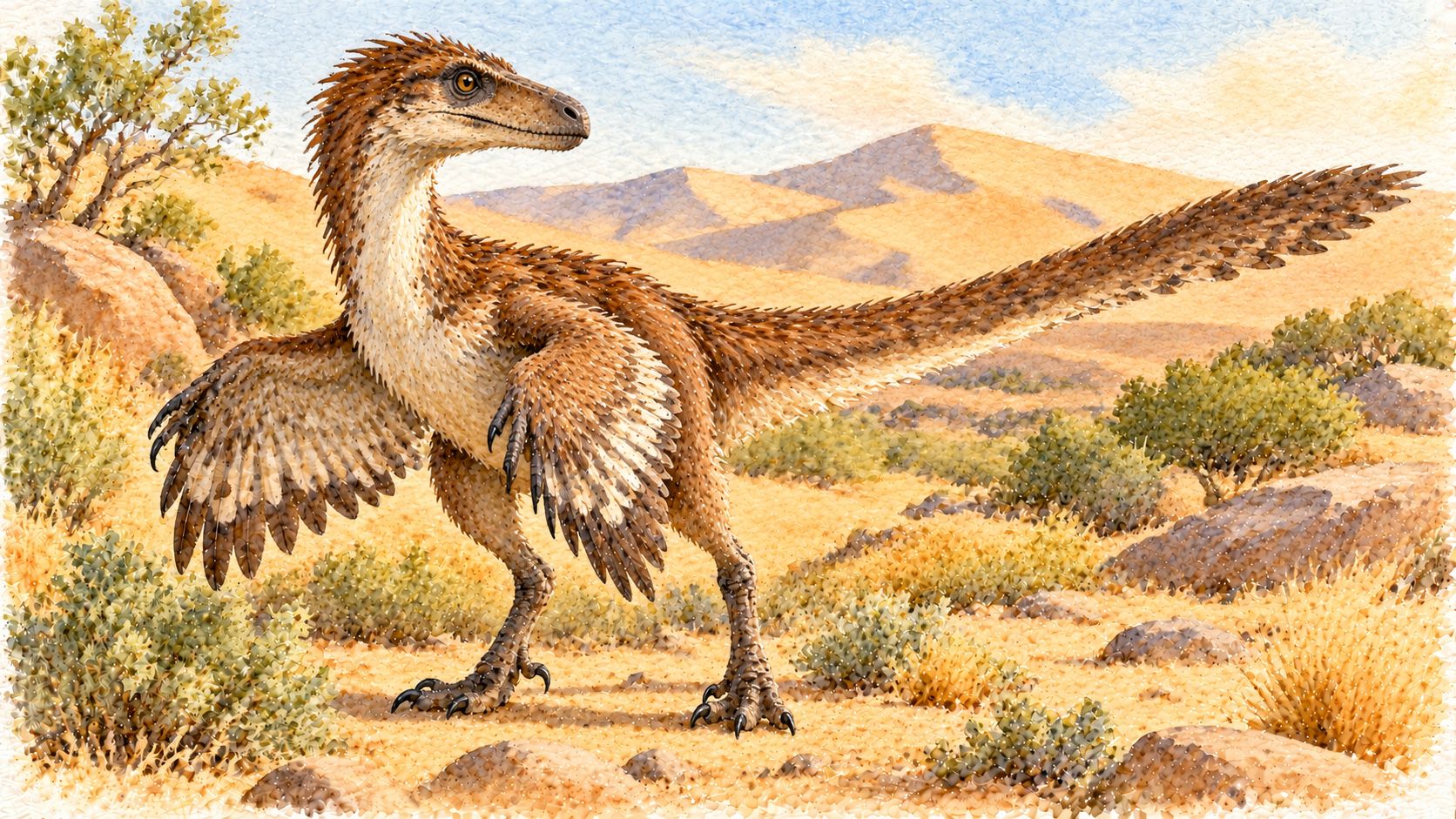
The tall, scaly "raptors" of Hollywood's dinosaur films are far bigger than the real animal; their look was largely based on Deinonychus, a larger North American cousin about 3 metres long.
Deinonychus lived roughly 115 to 108 million years ago, some 35 to 40 million years before Velociraptor, so the two never met.
There is no evidence that Velociraptor was the door-opening genius of the movies. Its brain was fairly large for a dinosaur of its size, but comparing its intelligence with modern animals is guesswork.
Its skull was long, low and narrow, with a slightly upturned snout, and its jaws held dozens of serrated, backward-curving teeth suited to slicing flesh.
Velociraptor lived in a hot, dry landscape of sand dunes and scrub with only seasonal streams. The Djadokhta Formation rocks that preserve it formed in this desert-like setting.
One of its likely prey animals was Protoceratops, a sheep-sized, plant-eating horned dinosaur that was common in the same dunes.
Protoceratops bones bearing tooth marks and broken teeth from Velociraptor or a close relative have been found, suggesting it also fed on carcasses, possibly as a scavenger.
Some scientists think it hunted rather like a hawk, pinning small prey under its feet with its sickle claws while flapping its arms for balance. This idea remains a hypothesis.
There is no direct fossil evidence that Velociraptor hunted in packs; most of its fossils are of single animals.
The Famous "Fighting Dinosaurs" Fossil
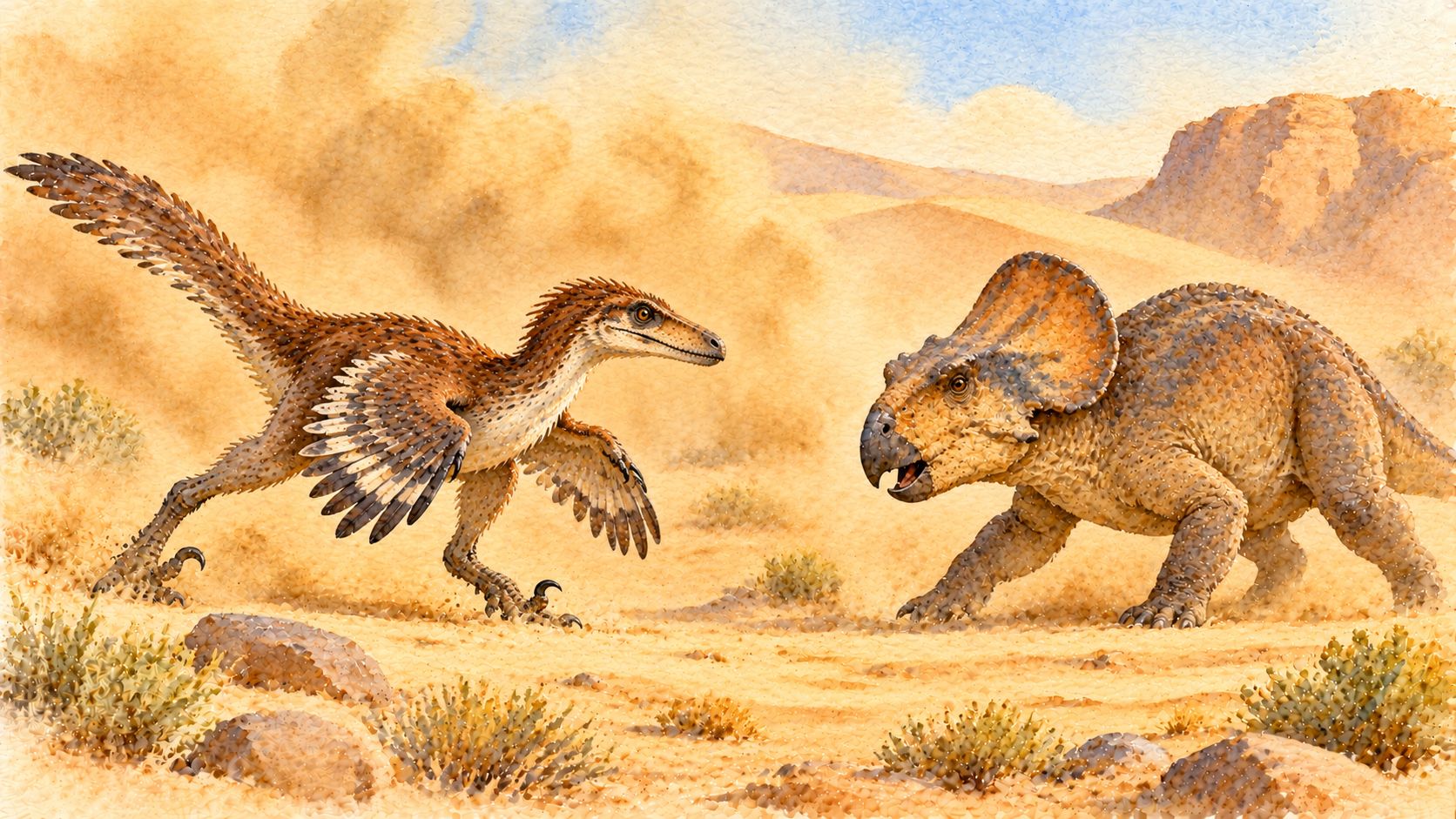
In 1971, a Polish–Mongolian expedition in the Gobi Desert uncovered one of the most remarkable fossils ever found: a Velociraptor and a Protoceratops locked together in combat. The Velociraptor's sickle claw is lodged near the Protoceratops's throat, while the Protoceratops appears to be biting down on the predator's right arm. Both animals were probably buried suddenly, perhaps when a sand dune collapsed or during a sandstorm, freezing the struggle in place. Known as the "Fighting Dinosaurs", the specimen is treasured in Mongolia and offers rare, direct evidence that Velociraptor attacked live prey.
A second species, Velociraptor osmolskae, was described from Inner Mongolia, China, in 2008 and named after Polish palaeontologist Halszka Osmólska, though some experts question whether it truly belongs in the same genus.
Dromaeosaurids varied hugely in size. Velociraptor was one of the smaller ones, while its North American relative Utahraptor may have reached about 6 metres long.
Its top speed is uncertain. Some estimates suggest it could sprint at around 40 km/h in short bursts, but figures vary widely between studies and are best treated as rough guesses.
No Velociraptor fossils are known from India. At the time, the subcontinent was an island drifting northwards, and its top predators were abelisaurids such as Rajasaurus and Indosuchus, found in the Narmada valley region.
Velociraptor itself vanished millions of years before the asteroid impact about 66 million years ago that ended the age of non-bird dinosaurs, but its living cousins, the birds, are all around us today.
Sources and Further Reading
- American Museum of Natural History
- Natural History Museum London
- Smithsonian National Museum of Natural History
- Encyclopaedia Britannica
- National Geographic
- University of California Museum of Paleontology
Frequently asked questions
How big was a Velociraptor really?
An adult was about 2 metres long including its tail, roughly half a metre tall at the hip and around 15 kg in weight, about the size of a large turkey.
Did Velociraptor have feathers?
Yes. Quill knobs on a Velociraptor forearm bone, described in 2007, show it had long feathers on its arms, and it was probably feathered over much of its body.
Could Velociraptor fly?
No. Although it had feathered arms, they were too short to lift its body, so it lived entirely on the ground.
Where did Velociraptor live?
It lived in dry, desert-like dune country in what is now Mongolia and northern China, about 75 to 71 million years ago.
What did Velociraptor eat?
It ate meat, probably hunting small animals and attacking Protoceratops at times, and fossil tooth marks suggest it also fed on carcasses.
Were Velociraptors as smart as they are shown in films?
There is no evidence for that. Its brain was fairly large for a dinosaur of its size, but claims about door-opening or out-thinking humans are fiction.