Amargasaurus is one of the strangest dinosaurs ever discovered. Most long-necked sauropods are remembered for being enormous, but this Argentine giant earned its fame for something else: a double row of tall, sharp spines rising from its neck like a pair of mysterious blades. Scientists have debated for decades what those spines were for, and the debate is still alive today.
Amargasaurus lived roughly 129 to 122 million years ago, in the Early Cretaceous, in what is now Patagonia. It was smaller than famous sauropods such as Diplodocus or Argentinosaurus, but it was far more unusual in shape. In this complete guide, you will learn what Amargasaurus was, what it looked like, where it lived, what it ate, how its spines may have worked, how scientists study it and what its story tells us about the age of dinosaurs.
Quick answer: Amargasaurus (Amargasaurus cazaui) was a medium-sized, plant-eating sauropod dinosaur that lived in Argentina about 129 to 122 million years ago. It grew roughly 9 to 10 meters (30 to 33 feet) long and had a short neck topped by two parallel rows of tall spines. It belongs to the family Dicraeosauridae and is known from a single well-preserved skeleton discovered in 1984 and described in 1991.

Amargasaurus at a Glance
| Feature | Details |
|---|---|
| Scientific name | Amargasaurus cazaui |
| Class | Reptilia (dinosaur) |
| Order | Saurischia (sauropod lineage) |
| Family | Dicraeosauridae |
| Length | About 30 to 33 feet (9 to 10 m) |
| Height | Roughly 5 feet (1.5 m) at the hip; neck spines raised it higher |
| Weight | Roughly 2 to 5 tons (about 2 to 4.5 tonnes); estimates vary |
| Lived | About 129 to 122 million years ago |
| Period | Early Cretaceous (Barremian stage) |
| Diet | Herbivore; low-growing plants such as ferns, horsetails and conifers |
| Fossils found | La Amarga Formation, Neuquen Province, Argentina |
| Named by | Leonardo Salgado and Jose Bonaparte, 1991 |
| Conservation status | Extinct |
What Was Amargasaurus?
Amargasaurus was a sauropod, a member of the group of enormous, long-necked, four-legged plant-eaters that includes Brachiosaurus, Apatosaurus and Diplodocus. Within that group, it belongs to a smaller family called Dicraeosauridae. Dicraeosaurids are known for having shorter necks than most other sauropods and for having tall, forked spines on their neck and back bones. Amargasaurus took this feature to the extreme.
The dinosaur was named in 1991 by Argentine paleontologists Leonardo Salgado and Jose Bonaparte. The genus name refers to the La Amarga Formation, the rock layer where the fossil was found, plus the Greek word for lizard. The species name, cazaui, honors Luis Cazau, a geologist who worked in the region and was involved in its petroleum exploration.
How Do You Say Amargasaurus?
It is usually pronounced "uh-MAR-guh-SAW-rus." The name sounds long, but it is easy to remember once you picture the sail-like neck spines.
Is Amargasaurus a Dinosaur?
Yes. Amargasaurus is a true dinosaur, and more specifically a saurischian ("lizard-hipped") dinosaur from the sauropod branch. It was not a flying reptile, a marine reptile or a lizard.
What Did Amargasaurus Look Like?
Amargasaurus was built differently from most of its giant cousins. It was smaller, lighter and shorter-necked, with a body plan that suggests it spent its time feeding close to the ground.
Size and Body Shape
Adults measured about 9 to 10 meters (30 to 33 feet) from snout to tail tip, which is much shorter than the largest sauropods, some of which exceeded 25 meters (80 feet). Its weight is estimated at a few tonnes, though estimates vary because the skeleton is not complete. Its body was barrel-shaped, supported by four sturdy, pillar-like legs, with the hind legs a little taller than the front pair.
The Neck
Compared with Diplodocus or Mamenchisaurus, Amargasaurus had a short neck. It was still long compared with most animals, but it was held fairly low, close to the horizontal. This posture fits a dinosaur that browsed on plants near the ground rather than reaching into treetops.
The Famous Spines
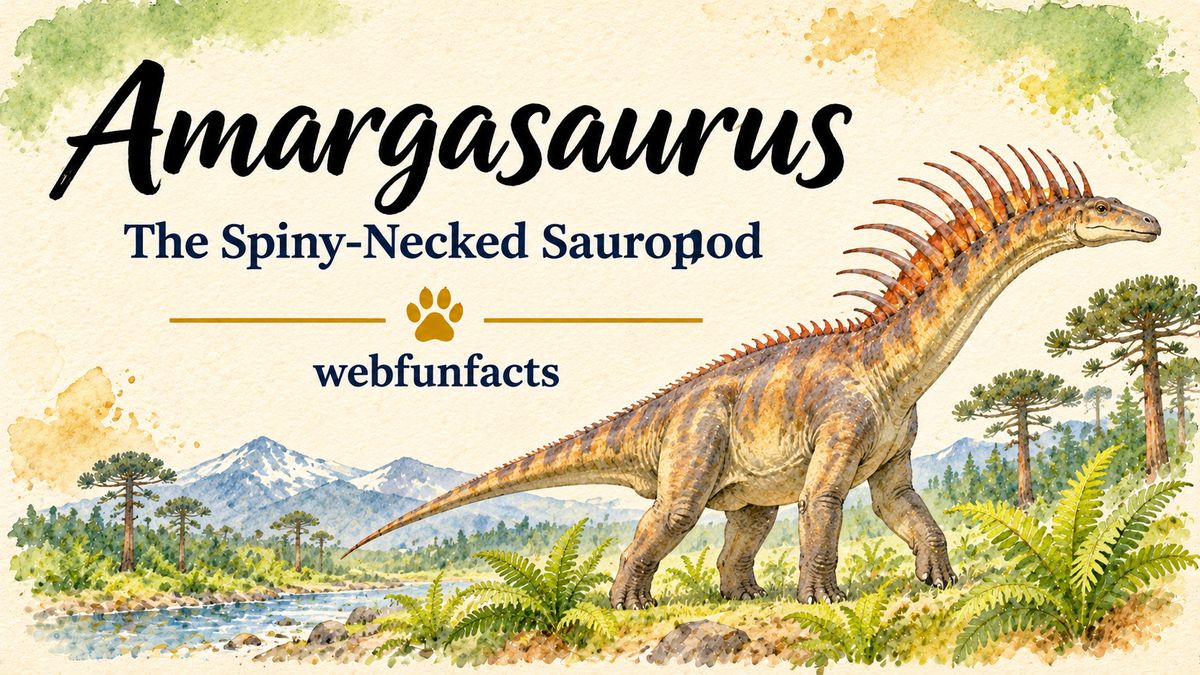
The most striking feature of Amargasaurus is the double row of tall neural spines that rise from the vertebrae of its neck and the front of its back. The spines are paired, so there are two parallel rows side by side, separated by a groove. The longest ones, near the base of the neck, could be more than half a meter (about 2 feet) long. They taper to a point and curve slightly, and the spines grow shorter toward the head and along the back.
The Head and Teeth
Only parts of the skull are known, but they show a relatively small, low head. The teeth were slender and peg-like, well suited to stripping leaves and soft plants rather than chewing tough wood.
The Tail
The tail was long and tapered, and it likely helped balance the neck and body. Like other sauropods, Amargasaurus may have used its tail for balance and perhaps as a defensive tool.

What Were the Spines For?
The spines are the biggest mystery about Amargasaurus. Researchers have proposed several ideas, and each one has strengths and weaknesses.
- A skin sail: Some scientists suggested a thin sheet of skin stretched between the spines to form a sail, perhaps for display or temperature control. Many experts doubt this, because there is no direct evidence for such skin.
- Horn-covered blades: Another idea is that the spines were covered with a tough, horn-like sheath, like the horns of a cow, which would make them longer and sharper.
- A fatty hump: A third idea is that the spines supported a ridge or hump of fat and soft tissue, similar to a camel's hump, as an energy store.
- Defense: Pointed spines could have made it harder for a predator to bite the neck.
- Display: Bright colors or large shapes could have helped individuals recognize each other, attract mates or look more impressive to rivals.
- Sound or vibration: A few researchers have even wondered whether the spine structure played some role in communication.
At the moment, no single answer is proven. The truth may be a combination, and the function may have changed as the animal grew from juvenile to adult. Because we do not have soft tissue, scientists rely on comparisons with living animals and on careful study of the bone surfaces.
Where Did Amargasaurus Live?
Amargasaurus lived in what is now Neuquen Province in northwestern Patagonia, Argentina. During the Early Cretaceous this region looked very different from today's dry steppe. It was a warm landscape with rivers, floodplains and lakes, and the climate was seasonal, with wetter and drier periods.
The La Amarga Formation
The fossils come from the La Amarga Formation, a sequence of sedimentary rocks that preserved animals buried by river and lake deposits. The place gave the dinosaur its name. Besides Amargasaurus, the formation has produced other fossils from the same time, including other dinosaurs, crocodile relatives and small animals, which help scientists reconstruct the ecosystem.
The World of Gondwana
At that time, South America was still joined to other southern landmasses as part of the supercontinent Gondwana, which was slowly breaking apart. Many of the dinosaurs of this region were different from those found in the northern continents, and Amargasaurus is part of a rich southern fauna that included other sauropods and meat-eating dinosaurs.
What Did Amargasaurus Eat?
Amargasaurus was a herbivore. Its low head, slender teeth and short neck suggest it fed on plants near the ground.
Likely Foods
- Ferns and horsetails: Soft, abundant plants that grew along rivers and in damp areas.
- Cycads and conifers: Low branches and young shoots from needle-leaved trees and palm-like plants.
- Other low vegetation: Early flowering plants were beginning to spread during the Cretaceous, though they were still uncommon in many places.
How It Ate
Like other sauropods, Amargasaurus probably did not chew its food much. Its teeth worked like a rake to strip leaves from branches, and the plants were swallowed and broken down in a large digestive system. Some sauropods swallowed stones, called gastroliths, to help grind food, although this is still debated.

Amargasaurus Behavior and Lifestyle
Because we only have fossils, much of what we say about behavior is educated inference, drawn from the bones and from comparisons with related dinosaurs.
Feeding Height
A short, low-held neck suggests Amargasaurus grazed and browsed on ground-level vegetation. This might have helped it share habitat with taller sauropods that fed higher up, reducing competition.
Movement
With four strong legs and a heavy body, Amargasaurus probably walked slowly and steadily. Like most sauropods, it would not have been built for speed.
Social Life
No fossil proves that Amargasaurus lived in herds. Many sauropods are known from trackways and bone beds showing group movement, so it is possible, but for this species it remains unconfirmed. Treat any statement about herding as a reasonable guess, not a fact.
Using the Spines
If the spines were used for display, Amargasaurus might have raised or turned its neck to show them to rivals or mates. If they were defensive, the dinosaur might have lowered its head and presented the spiny neck to an attacker. Both ideas fit the way many modern animals behave.
Amargasaurus Reproduction and Babies
All sauropods laid eggs, and Amargasaurus almost certainly did too. No eggs have been definitely linked to this species, but nests of other sauropods, such as those from the Auca Mahuevo site in Argentina, show that females laid many small eggs in shallow nests. Babies hatched small and independent and probably grew quickly. Young Amargasaurus may have had proportionally shorter spines that grew longer as the animal matured, a pattern seen in some other animals with display structures.

How Long Did Amargasaurus Live?
Nobody knows exactly. Scientists estimate sauropod ages by studying growth lines in their bones, similar to tree rings. Many large sauropods probably lived several decades, and some may have reached 50 years or more. For Amargasaurus, which is smaller, a lifespan of a few decades is a reasonable guess, but no precise figure is available.
Predators and Threats
Large meat-eating dinosaurs lived in Patagonia during the Early Cretaceous. They included abelisaurids, a group of short-faced predators common in southern continents, and other theropods such as carcharodontosaurs in nearby regions. Adult Amargasaurus may have been hard targets, but the young and weak were certainly at risk.
Possible defenses included:
- Neck spines: Sharp, projecting spines may have discouraged bites to the neck.
- Whip-like tail: A strong tail could swing at attackers.
- Group living: If the species did gather in groups, there was safety in numbers.
- Size: A body of several tonnes was hard for most predators to bring down.
Why Amargasaurus Is Important
Amargasaurus is more than a curiosity. It helps scientists answer big questions.
- Sauropod diversity: It shows that sauropods did not all look alike and that some were small and strangely decorated.
- Gondwana ecosystems: It adds a piece to the puzzle of life on southern continents in the Early Cretaceous.
- Evolution of display structures: It gives researchers a case study for how spines, sails and crests might evolve.
- Public interest: Its odd look makes it a popular museum star that draws people toward science.
A cast skeleton is displayed in museums, and the dinosaur appears in documentaries, books and toys, where it is often shown with its signature spiny neck.
How Did Amargasaurus Go Extinct?
Amargasaurus lived tens of millions of years before the end of the dinosaur age, so it was not wiped out by the asteroid impact that ended the Cretaceous. Its particular family, Dicraeosauridae, is mostly known from the Jurassic and Early Cretaceous, and later fossils are rare.
Scientists are not sure why this lineage faded. Possible factors include:
- Changing climate and plant life: The Cretaceous brought changes in vegetation, including the spread of flowering plants.
- Competition: Other herbivores, including other sauropod groups such as titanosaurs, became dominant in South America.
- Environmental shifts: Changes in rivers, lakes and sea levels altered habitats.
Because the fossil record is incomplete, any single cause is a hypothesis, not a proven answer.
How Was Amargasaurus Discovered?
The skeleton was discovered in 1984 by an expedition led by Jose Bonaparte and was described in 1991. It is one of the most complete sauropod skeletons from South America, preserving much of the neck, body and tail, though parts of the skull and limbs are missing. Its good preservation is the reason scientists can say so much about its spines.

Fun Facts About Amargasaurus
- Double spines: Its neck spines grew in two parallel rows, a feature almost unique among dinosaurs.
- Spiky but small: It was much smaller than famous sauropods, at about 30 feet (9 m) long.
- Named for a rock layer: The name comes from the La Amarga Formation, not from the animal's appearance.
- Short neck for a sauropod: Its neck was held low, suiting a ground-level diet.
- Mystery sail: Scientists still debate whether skin, horn or fat covered the spines.
- Close relatives abroad: Its relative Dicraeosaurus lived in Tanzania, in Africa, showing the link between the southern continents.
- A strange cousin: Another Argentine dicraeosaurid, Brachytrachelopan, had an even shorter neck.
- Found by a famous team: Jose Bonaparte was one of South America's greatest dinosaur hunters.
- Pop culture star: It appears in many documentaries, museum displays and dinosaur books.
- Not a Cretaceous survivor: It lived long before the asteroid struck.
Frequently Asked Questions
How big was Amargasaurus? Amargasaurus was about 9 to 10 meters (30 to 33 feet) long and weighed roughly a few tonnes. It was small for a sauropod but sturdy and heavily built.
What did Amargasaurus eat? It was a plant-eater that fed mainly on low-growing vegetation such as ferns, horsetails, cycads and conifer shoots, which it stripped with slender, peg-like teeth.
When did Amargasaurus live? It lived during the Early Cretaceous, about 129 to 122 million years ago, in what is now Patagonia, Argentina.
What were the spines on Amargasaurus for? Nobody knows for certain. Ideas include display, defense, a skin sail, horn-covered blades or a fatty hump, and the real purpose may have combined several of these.
Was Amargasaurus a carnivore? No. Amargasaurus was a herbivore. Like other sauropods, it ate only plants, and its teeth and body were shaped for that diet.
Did Amargasaurus live with T. rex? No. T. rex lived in North America, around 68 to 66 million years ago, tens of millions of years after Amargasaurus. They lived on different continents and in different eras.
Final Thoughts
Amargasaurus proves that even among giants there is room for the bizarre. With its short neck, its twin rows of towering spines and its home in the ancient forests and floodplains of Patagonia, this dinosaur still sparks questions more than 30 years after its description. We may never know exactly what the spines were for, but each new study brings us a little closer. Until then, Amargasaurus remains one of the most distinctive and memorable dinosaurs ever to walk the Earth.