25 Sloth Facts: Life in the Slow Lane
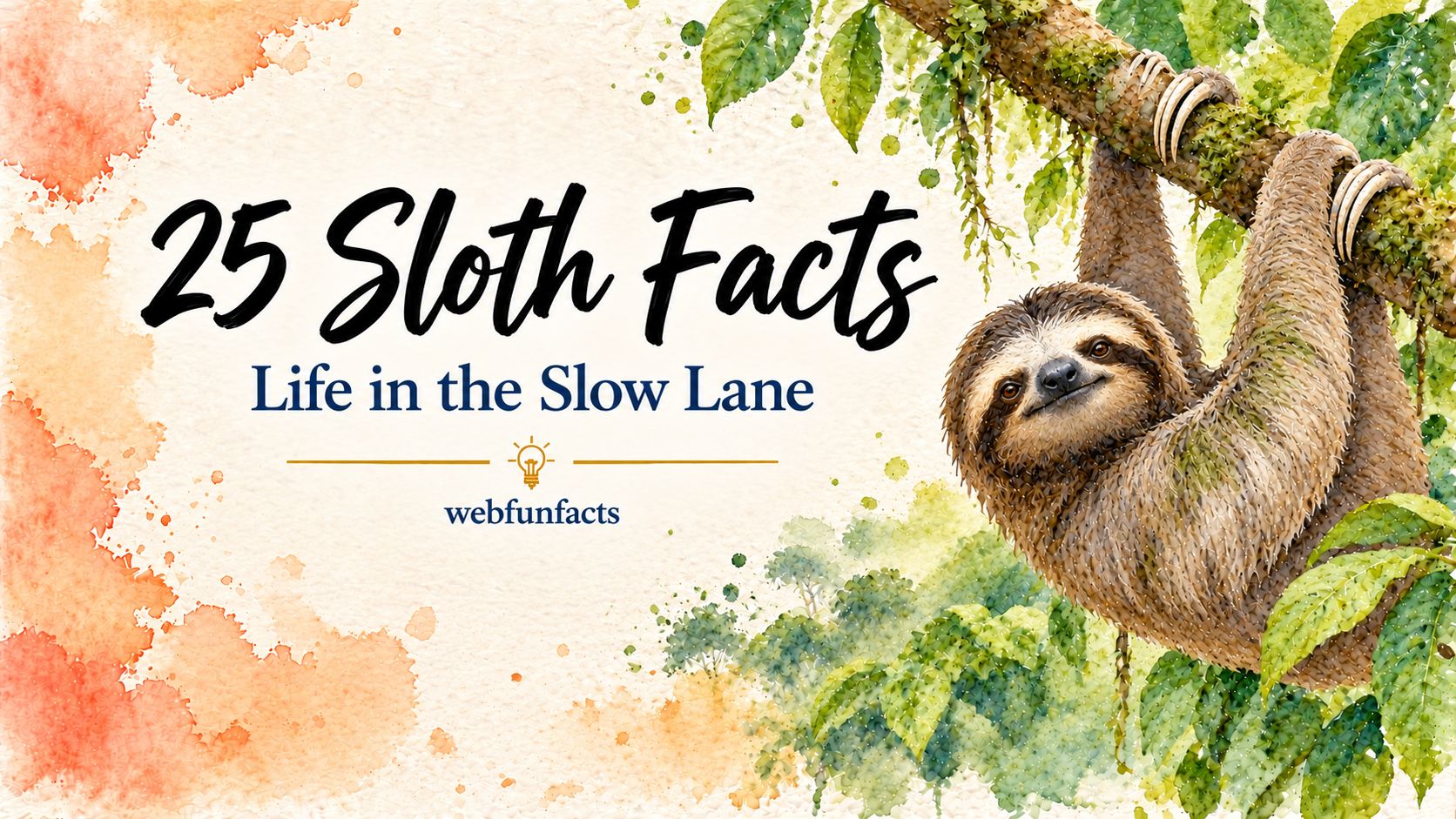
Sloths are the rainforest's champions of slow living. Found in the tropical forests of Central and South America, these shaggy tree-dwellers spend most of their lives hanging beneath branches, munching leaves and moving so gently that predators often fail to notice them at all.
But slowness is a clever survival strategy, not laziness. Sloths have unusual bodies built for hanging, fur that doubles as a tiny ecosystem and digestive systems that work at a remarkably relaxed pace. Here are 25 facts about these unhurried mammals, plus a surprising Indian animal that shares their name.
Sloth Facts
There are six living sloth species: two species of two-toed sloth and four species of three-toed sloth.
Two-toed and three-toed sloths are only distantly related. Scientists think they adopted their tree-hanging lifestyle separately, a striking case of similar evolution in different lineages.
The names are misleading: all sloths have three toes on their hind feet. The difference is in the front limbs, which carry either two or three long claws.
Sloths belong to a group of mammals called xenarthrans, and their closest living relatives are anteaters and armadillos.
They live in tropical forests from southern Central America through much of northern South America.
A sloth's diet of leaves is low in energy, so its metabolism runs unusually slowly. Food can take days, and reportedly up to several weeks, to pass through the gut.
Most sloths climb down to the ground only about once a week to go to the toilet, usually at the base of a tree. This trip is one of the riskiest moments in their lives.
Sloth fur can host green algae, moths, beetles and fungi. The algae gives the coat a greenish tint that may help with camouflage among the leaves.
Unlike most mammals, a sloth's hair parts along the belly and grows towards the back, so rain runs off naturally while it hangs upside down.
A Sloth's Body Is Built for Hanging Upside Down
Sloths eat, sleep, mate and even give birth while suspended beneath branches, and their anatomy is adapted for it. Their long, curved claws act like hooks, and their grip is so secure that holding on takes very little muscular effort. Researchers have found that some of their internal organs, such as the liver and stomach, are anchored to the lower ribs by fibrous tissue. This stops the heavy organs from pressing on the lungs when the sloth hangs upside down, making breathing easier. Their muscles are also built for strength and endurance rather than speed, which suits a life of slow, steady clinging.
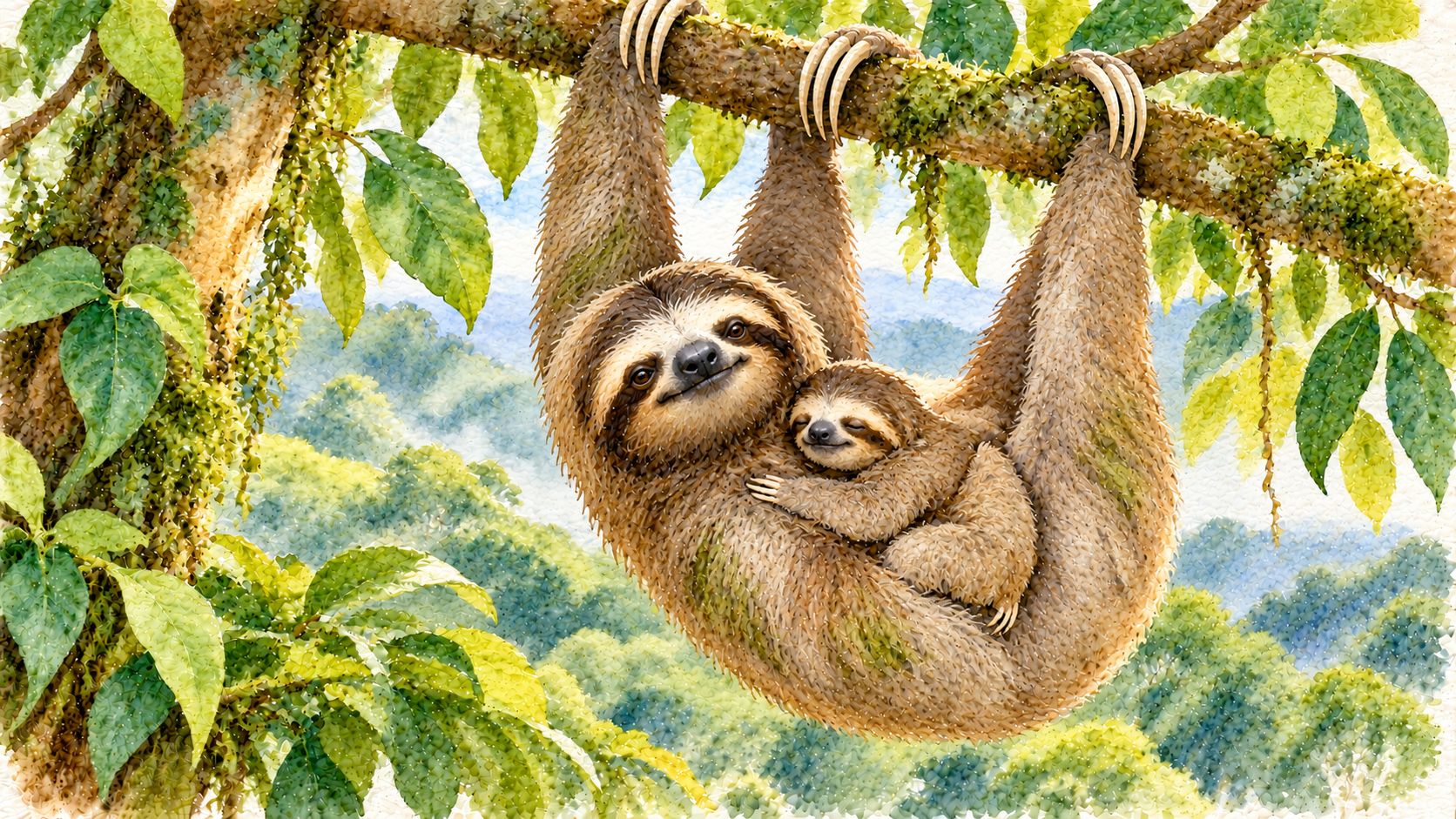
Most mammals, from mice to giraffes, have seven neck bones. Three-toed sloths usually have eight or nine, letting them turn their heads around roughly 270 degrees.
Sloths rarely move faster than a few metres a minute in the trees and are even clumsier on the ground, where they drag themselves along with their front claws.
Despite this, sloths are good swimmers and have been seen crossing rivers using a breaststroke-like motion. Claims that they can hold their breath for 40 minutes are widely repeated but poorly documented.
Captive sloths can sleep 15 hours or more a day, but a 2008 study of wild brown-throated three-toed sloths in Panama recorded only about 9 to 10 hours.
A sloth's body temperature is lower and more variable than that of most mammals, so it often basks in the sun to warm up.
Their large, multi-chambered stomach relies on gut bacteria to break down tough leaves, and when full it can account for a big share of the sloth's weight.
Harpy eagles, jaguars and ocelots are among their main predators. Staying still and blending in is the sloth's main defence, though it can also swipe with its claws.
Two-toed sloths are mostly active at night, while three-toed sloths may be active at any time of day or night.
The pygmy three-toed sloth lives only on Isla Escudo de Veraguas, a small island off Panama, and is listed as Critically Endangered on the IUCN Red List.
India's Sloth Bear Is Not a Sloth at All
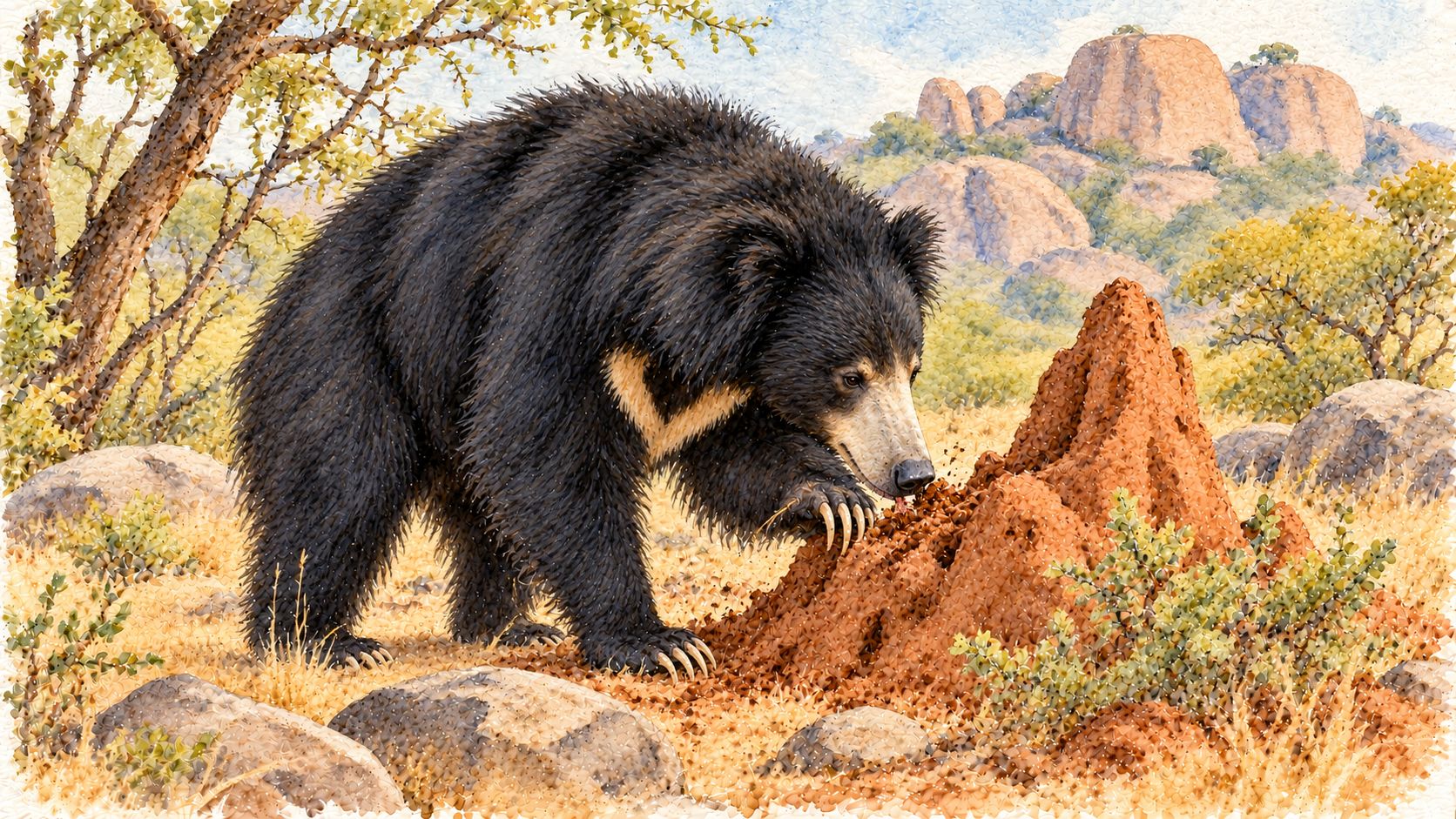
India's sloth bear is a true bear with a misleading name. When European naturalists first described it in the late 1700s from preserved specimens, its long curved claws, shaggy coat and unusual teeth led them to believe it was a kind of sloth, and it was even placed in the sloth genus. The name stuck after it was correctly identified as a bear. Sloth bears specialise in eating termites and ants: they rip open mounds with their claws, close their nostrils, and use a gap in their front teeth and mobile lips to suck insects up noisily. Karnataka's Daroji Sloth Bear Sanctuary protects one important population.
Modern tree sloths had huge extinct cousins, the giant ground sloths. The largest, such as Megatherium, were roughly elephant-sized, with some estimates of around 6 metres long and several tonnes.
Giant ground sloths were relatives, not direct ancestors, of today's sloths. Most disappeared around 10,000 years ago, and scientists still debate how much humans and climate change were to blame.
Sloths usually have one baby at a time after a pregnancy lasting roughly six months to almost a year, depending on the species. The baby clings to its mother's belly for several months.
The dark fur markings around the eyes of three-toed sloths make them look as if they are always smiling, but this is simply a fur pattern, not a sign of mood.
The English word "sloth" comes from an old word meaning slowness, and in Spanish the animal is called "perezoso", meaning lazy.
Sources and Further Reading
- IUCN Red List
- Encyclopaedia Britannica
- Smithsonian's National Zoo
- Natural History Museum, London
- National Geographic
- Wildlife Institute of India
Frequently asked questions
How many species of sloth are there?
There are six living species: two two-toed sloths and four three-toed sloths.
Why do sloths come down from trees?
They mainly climb down about once a week to go to the toilet, usually at the base of their tree.
Why is sloth fur green?
Algae can grow in the grooves of sloth hair, giving the coat a greenish tint that may help camouflage.
Can sloths swim?
Yes. Despite being slow on land, sloths are capable swimmers and can cross rivers.
Is the sloth bear related to sloths?
No. The sloth bear is a true bear. Early naturalists mistook it for a sloth, and the name stuck.
How long do sloths sleep?
A study of wild three-toed sloths found about 9 to 10 hours a day, much less than many captive sloths sleep.
More Fun Facts