25 Fun Facts
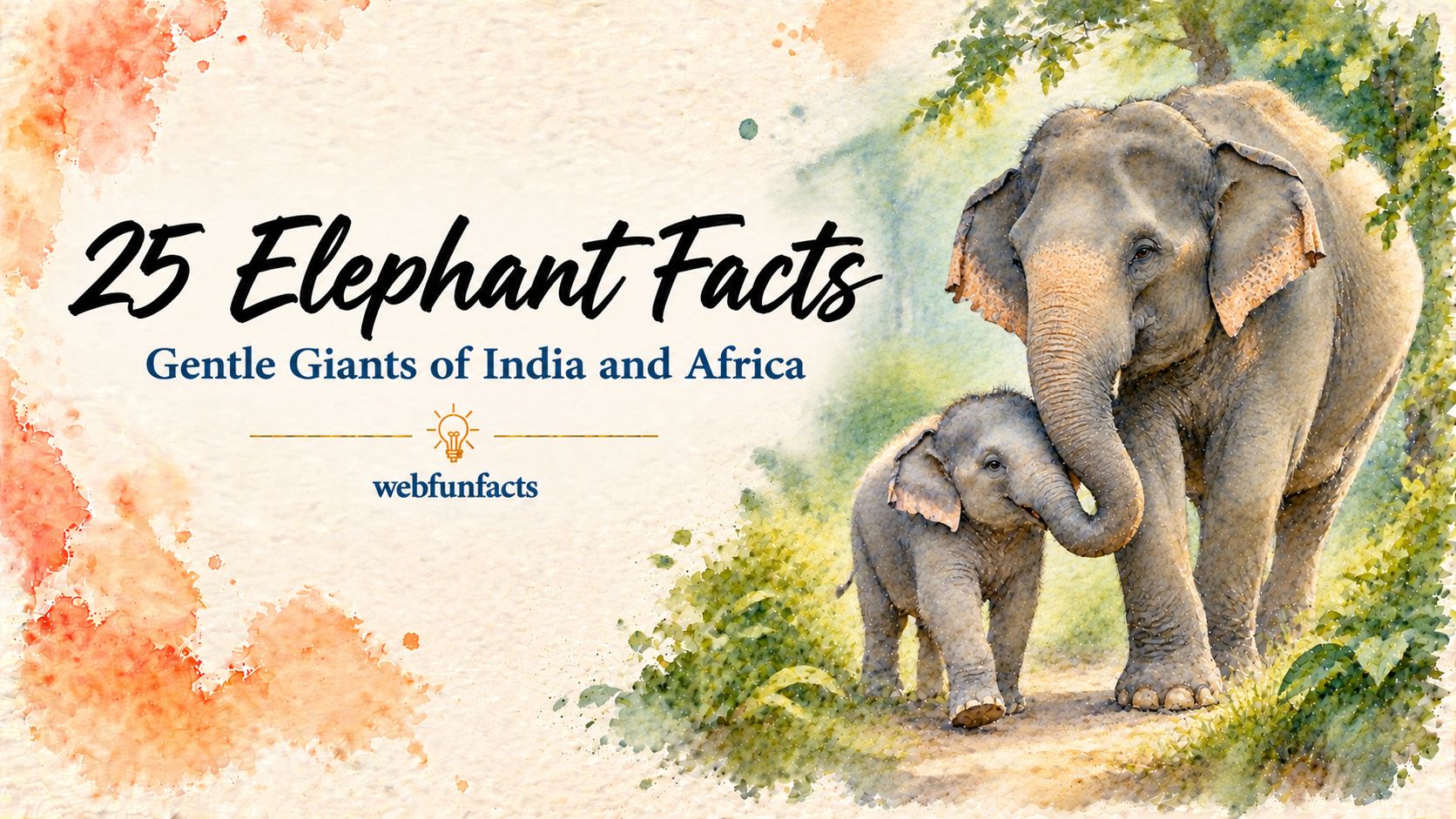
25 Elephant Facts: Gentle Giants of India and Africa
Elephants are the largest land animals on Earth, but they are also some of the most intelligent, caring and emotional. They remember old friends, comfort each other when they are upset and even seem to mourn their dead.
Here are 25 amazing facts about elephants, from their incredible trunks to the elephants of India, home to more than half of the world's wild Asian elephants.
Elephant Facts
There are three species of elephant: the African savanna elephant, the African forest elephant and the Asian elephant.
The African savanna elephant is the largest land animal on Earth. Big males can weigh around 6,000 kilograms and stand up to about 4 metres tall at the shoulder.
Asian elephants are smaller than African elephants, with smaller rounded ears, a rounded back and a head with two bumps on top.
African elephants have huge ears, which they flap to cool their blood and help keep their whole body cool.
An elephant's trunk is its nose and upper lip joined together. It has no bones but contains tens of thousands of muscle units.
Elephants use their trunks to breathe, smell, drink, grab food, greet each other and even snorkel while swimming.
An elephant's trunk can hold several litres of water, which it then squirts into its mouth or sprays over its back.
An elephant's trunk is so precise that it can pick up a single blade of grass or a small, delicate object without breaking it.
An elephant's tusks are actually extra-long front teeth that keep growing throughout its life.
Elephants in India have been seen burying their calves
Elephants are known to linger beside their dead, touching the body with their trunks as if mourning. But in 2024, scientists in India reported something even more remarkable. In the tea gardens of North Bengal, Asian elephant herds were found to have carefully buried calves that had died, placing them legs-up in drainage ditches and covering them with soil. Some herds also made loud trumpeting calls nearby. It was the first time such burials had been recorded in Asian elephants, showing just how deep their family bonds may run.

In India, many male Asian elephants have no tusks at all. These tuskless males are called makhnas.
Elephants grow six sets of large molar teeth during their lives, one set replacing another as they wear down.
Elephants spend up to 18 hours a day eating, and an adult can eat around 150 kilograms of plants daily.
An adult elephant can drink more than 100 litres of water in a day.
Elephants walk on their tiptoes. A thick pad of fatty tissue under each heel cushions their huge weight.
Elephants have excellent hearing and also feel deep, rumbling calls through their feet, sending messages to other elephants several kilometres away.
Elephant herds are led by the oldest and most experienced female, called the matriarch.
Elephants are pregnant for about 22 months, the longest pregnancy of any mammal.
A newborn elephant calf weighs around 100 kilograms and can stand within about an hour of being born.
The elephant is India's National Heritage Animal
India is home to more than half of all wild Asian elephants on Earth, living in forests from the Western Ghats to the foothills of the Himalayas. In 2010, the Government of India declared the elephant the country's National Heritage Animal, recognising its importance to India's nature, history and culture. India launched Project Elephant in 1992 to protect elephants and their forest corridors. Elephants also hold a special place in Indian culture, from the elephant-headed god Ganesha to the grand temple festivals of Kerala.

In 2024, scientists found that African elephants call each other with name-like rumbles, something very few animals are known to do.
Elephants can recognise themselves in a mirror, a sign of self-awareness.
Wild elephants may sleep for only about two hours a day, one of the shortest sleep times of any mammal.
Elephants usually live for around 60 to 70 years.
All three elephant species are now endangered. The African forest elephant is critically endangered, mainly because of habitat loss and poaching for ivory.
Sources and Further Reading
- Ministry of Environment, Forest and Climate Change (Project Elephant)
- Wildlife Institute of India
- Wildlife Trust of India
- IUCN Red List of Threatened Species
- Journal of Threatened Taxa
- Encyclopaedia Britannica
Frequently asked questions
What is the largest elephant?
The African savanna elephant is the largest. Big males can weigh around 6,000 kilograms and stand up to about 4 metres tall at the shoulder.
What is the difference between African and Asian elephants?
Asian elephants are smaller, with smaller rounded ears, a rounded back and a two-domed head. African elephants are larger, with huge ears, and both males and females usually have tusks.
How many elephants live in India?
India is home to more than half of all wild Asian elephants in the world, living mainly in the Western Ghats, central India, the northeast and the Himalayan foothills.
Do elephants really mourn their dead?
Elephants often stay beside their dead and touch them gently with their trunks. In India, Asian elephants have even been recorded burying dead calves.
How long do elephants live?
Elephants usually live for around 60 to 70 years.
Why is the elephant India's National Heritage Animal?
In 2010, India declared the elephant its National Heritage Animal to recognise its importance to the country's nature, culture and history, and to support its protection.
More Fun Facts