25 Fun Facts
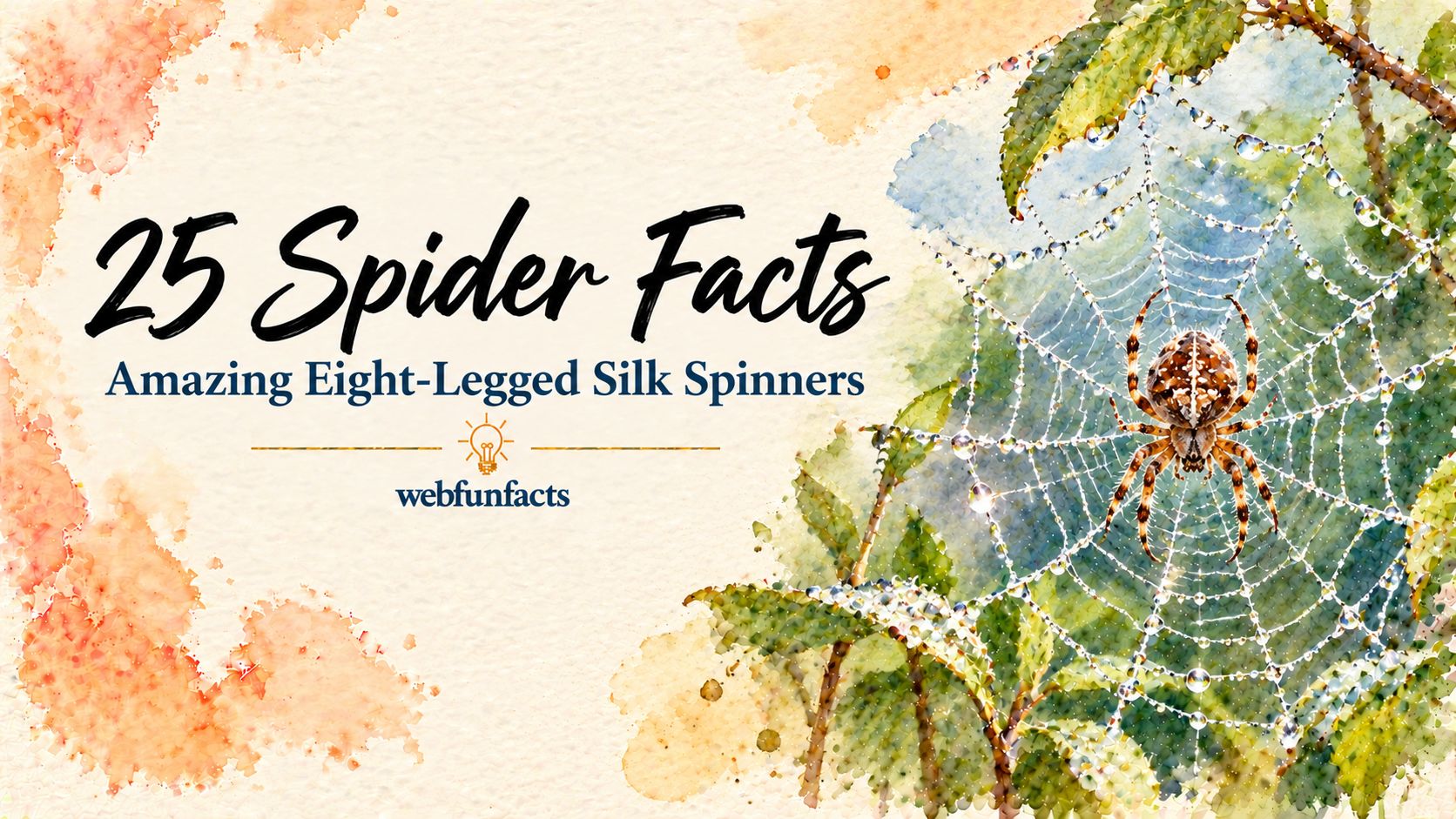
25 Spider Facts: Amazing Eight-Legged Silk Spinners
Spiders might give some people the shivers, but they are some of the most fascinating creatures on Earth. They spin silk stronger than steel, eat huge numbers of pests and can even float through the sky on silk threads.
Here are 25 amazing facts about spiders, from their unusual blue blood to the stunning blue tarantula found only in India.
Spider Facts
Spiders are not insects. They are arachnids, with eight legs, two main body parts and no antennae.
More than 50,000 species of spider have been discovered, and many more are still unnamed.
Spiders live on every continent except Antarctica.
Most spiders have eight eyes, but some have fewer, and some cave spiders have none at all.
All spiders can make silk, but not all of them spin webs. Some hunt by chasing, jumping or ambushing their prey.
Spider silk starts as a liquid inside the spider and hardens into a thread as it's pulled out through organs called spinnerets.
Many spiders eat their old webs to recycle the valuable silk protein before building a new one.
Spiders don't have bones. They have a hard outer skeleton, which they shed several times as they grow.
Spiders have blue "blood", called haemolymph, which carries oxygen using copper instead of iron.
Some spider silk is stronger than steel
Weight for weight, the silk that some spiders use for their safety lines is stronger than steel and tougher than Kevlar, the material used in bulletproof vests. It can also stretch a long way without snapping. The silk of Darwin's bark spider from Madagascar is one of the toughest natural materials known, and this spider can stretch webs across rivers up to 25 metres wide. Scientists are studying spider silk to make new materials for medicine, clothing and engineering.

Spiders straighten their legs by pumping fluid into them. That's why a dead spider's legs curl up underneath it.
Spiders can't chew. They inject digestive juices into their prey and then suck up the liquid.
Almost all spiders have venom, but only a tiny number are dangerous to humans.
Spiders around the world eat hundreds of millions of tonnes of insects every year, making them important natural pest controllers.
Young spiders can travel long distances by "ballooning". They release silk threads that catch the wind and the Earth's electric field, carrying them high into the sky and even far out to sea.
The diving bell spider lives almost entirely underwater, breathing air from a silk "bubble" it fills and attaches to water plants.
Jumping spiders have excellent eyesight and can leap many times their own body length to pounce on prey.
Male peacock spiders from Australia raise colourful flaps on their bodies and perform dances to impress females.
Bagheera kiplingi, named after the panther in Rudyard Kipling's The Jungle Book, is a jumping spider that eats mostly plant buds, making it unusual among spiders.
India's Gooty sapphire tarantula is a sparkling blue spider
The Gooty sapphire tarantula, also called the peacock tarantula, is one of the most beautiful spiders in the world, with shimmering metallic blue legs and bright yellow markings. It lives only in a small area of forest in Andhra Pradesh, in southern India. It was first described in 1899 from a specimen found in a railway timber yard in the town of Gooty, which is how it got its name. Sadly, it is critically endangered because of habitat loss, and it was rediscovered in the wild only in 2001.

In parts of India, the social spider Stegodyphus sarasinorum lives in large colonies, with many spiders sharing one giant nest and hunting together.
The goliath birdeater of South America is the heaviest spider, while the giant huntsman spider of Laos has the longest leg span, up to about 30 centimetres.
One of the smallest known spiders, Patu digua from Colombia, is smaller than the head of a pin.
Some spiders live surprisingly long. A female trapdoor spider in Australia lived to around 43 years old, the oldest spider ever recorded.
In the past, spider silk was used to make the fine crosshairs in telescopes and other precise instruments.
Sources and Further Reading
- World Spider Catalog
- Zoological Survey of India
- IUCN Red List of Threatened Species
- Natural History Museum, London
- Encyclopaedia Britannica
- National Geographic
Frequently asked questions
Are spiders insects?
No. Spiders are arachnids. They have eight legs, two main body parts and no antennae, while insects have six legs, three body parts and antennae.
How many species of spider are there?
More than 50,000 species of spider have been discovered, and scientists think many more are still waiting to be found.
Is spider silk really stronger than steel?
Yes, weight for weight, some spider silk is stronger than steel and very stretchy, making it one of the toughest natural materials.
Are all spiders dangerous?
No. Almost all spiders have venom, but only a tiny number are dangerous to humans. Most spiders are harmless and help control insects.
What is the Gooty sapphire tarantula?
It's a critically endangered blue tarantula found only in a small forest area of Andhra Pradesh, India. It's named after the town of Gooty, where it was first found.
How do baby spiders fly?
Young spiders release silk threads that catch the wind and the Earth's electric field, lifting them into the air. This is called ballooning.
More Fun Facts