
25 Fun Facts
25 Tropical Fish Facts: Colourful Wonders of Warm Waters
Tropical fish fill the warm rivers, lakes and coral reefs of the world with colour. Many are also favourite aquarium pets, from flashy bettas to tiny shimmering tetras. But these fish have some surprising skills, from spitting water to breathing air.
Here are 25 amazing facts about tropical fish, including several popular aquarium fish that come from India's rivers.
Tropical Fish Facts
Tropical fish come from warm waters, usually around 24 to 28°C, in rivers, lakes and coral reefs near the equator.
Most freshwater tropical fish sold for home aquariums are bred on fish farms, while many saltwater reef fish are still caught from the wild.
The Siamese fighting fish, or betta, comes from Thailand, where it is the national aquatic animal.
Male bettas build floating nests of bubbles at the water's surface and guard the eggs and babies inside.
Bettas and gouramis have a special organ called a labyrinth, which lets them breathe air from the surface. This helps them survive in warm, low-oxygen water.
When two kissing gouramis press their lips together, they aren't being affectionate. It's usually a contest of strength between rivals.
Many cichlids are mouthbrooders. A parent carries the eggs and even the young babies safely inside its mouth.
Discus fish parents feed their newborn babies with a special nourishing mucus made on their skin.
Guppies, mollies and platies are livebearers, which means they give birth to fully formed baby fish instead of laying eggs.
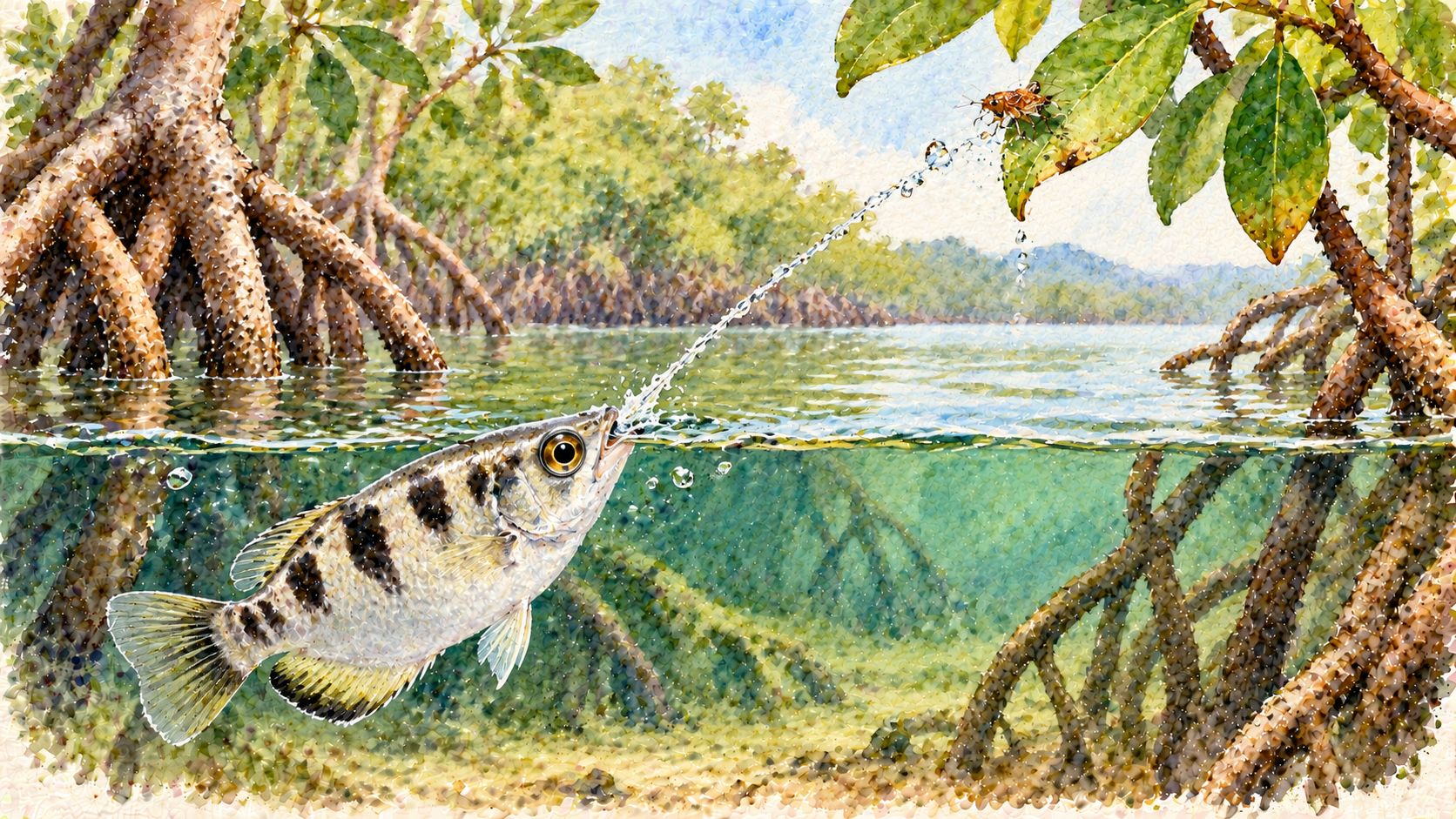
The archerfish shoots down its prey with water
The archerfish lives in mangroves and rivers from India to Australia, and it hunts in a remarkable way. When it spots an insect sitting on a leaf above the water, it squirts a powerful jet of water from its mouth, knocking the insect down so it can gobble it up. Archerfish can hit targets well over a metre above the surface, and they even adjust their aim to make up for the way light bends at the surface of the water. In experiments, archerfish have even learned to recognise human faces.
Guppies are tiny but useful. In India, they are released into ponds and drains to eat mosquito larvae and help control diseases like malaria.
The glass catfish is almost completely see-through, so you can see its bones and organs.
The upside-down catfish of Africa often swims belly-up. Its belly is darker than its back, the reverse of most fish, which helps it blend in while upside down.
Blind cave fish living in dark caves in Mexico are born with eyes, but the eyes stop developing and become covered by skin as the fish grow.
A neon tetra's glowing blue stripe may help members of a shoal keep sight of each other in dark, murky Amazon waters.
Angelfish have tall, flat bodies that help them hide among the reeds and roots of South American rivers.
Clown loaches make clicking sounds and sometimes lie on their sides as if they are dead, giving new owners a fright.
Corydoras catfish can dart to the surface to gulp air and appear to "wink" by rolling their eyes downwards.
Clownfish can live for more than 20 years in a well-kept aquarium.
India's "Miss Kerala" is one of the world's most beautiful aquarium fish
The Denison barb, often called "Miss Kerala" or the red-line torpedo barb, is found only in the fast-flowing rivers of the Western Ghats in Kerala and Karnataka. With its sleek silver body, bright red stripe and black-and-yellow tail, it became one of the most popular aquarium fish in the world. But so many were caught from the wild for the aquarium trade that the species became endangered. Today, breeding them on fish farms is helping to take pressure off wild populations.

Several popular aquarium fish come from India, including the dwarf gourami, the honey gourami and the see-through Indian glassy fish.
The zebrafish, a favourite aquarium fish and science superstar, is also native to India's rivers and rice fields.
On coral reefs, parrotfish crunch up coral and produce fine white sand. Much of the sand on some tropical beaches has passed through a parrotfish.
Some parrotfish sleep inside a bubble of mucus they produce each night, which may protect them from parasites and predators.
Cleaner wrasse, small reef fish, have passed a version of the mirror test, suggesting they may recognise themselves.
Sources and Further Reading
- ICAR-National Bureau of Fish Genetic Resources
- Kerala University of Fisheries and Ocean Studies
- IUCN Red List of Threatened Species
- Smithsonian Ocean
- Encyclopaedia Britannica
- National Geographic
Frequently asked questions
What are tropical fish?
Tropical fish are fish that come from warm waters, usually around 24 to 28°C, in rivers, lakes and coral reefs near the equator.
Which aquarium fish come from India?
Several popular aquarium fish come from India, including the Denison barb ("Miss Kerala"), dwarf gourami, honey gourami, Indian glassy fish and zebrafish.
How does an archerfish catch insects?
An archerfish squirts a jet of water from its mouth to knock insects off leaves above the water, then eats them when they fall in.
Can some fish breathe air?
Yes. Bettas and gouramis have a labyrinth organ that lets them breathe air from the water's surface, and corydoras catfish can also gulp air.
What does "livebearer" mean?
Livebearers are fish, like guppies, mollies and platies, that give birth to fully formed baby fish instead of laying eggs.
Why is the Denison barb endangered?
The Denison barb, or "Miss Kerala", became endangered mainly because too many were caught from the wild for the aquarium trade, along with damage to its river habitat.
More Fun Facts