25 Raccoon Facts: Masked Bandits With Clever Hands

With their black eye masks and ringed tails, raccoons look like little bandits, and they often act like them too, raiding bins and opening latches with their nimble paws. These clever animals have learned to thrive in forests, wetlands and even big cities.
Here are 25 fascinating facts about raccoons, from their incredible sense of touch to the surprising story of raccoons in Japan.
Raccoon Facts
Raccoons are native to North and Central America.
The common raccoon's scientific name is Procyon lotor. "Lotor" means "washer" in Latin.
The English name "raccoon" comes from a Native American Powhatan word meaning something like "one who scratches with its hands".
Raccoons have a black "mask" of fur around their eyes, which may help reduce glare and help raccoons recognise each other.
A raccoon's bushy tail usually has around five to seven dark rings.
Most of a raccoon's thick fur is soft underfur, which keeps it warm in cold weather.
Adult raccoons usually weigh around 4 to 9 kilograms, though some get much heavier.
Raccoons are mostly active at night, but in cities they sometimes come out during the day.
Raccoons are omnivores and eat almost anything, including fruit, nuts, insects, frogs, crayfish, eggs and leftover human food.
Raccoons "see" with their hands
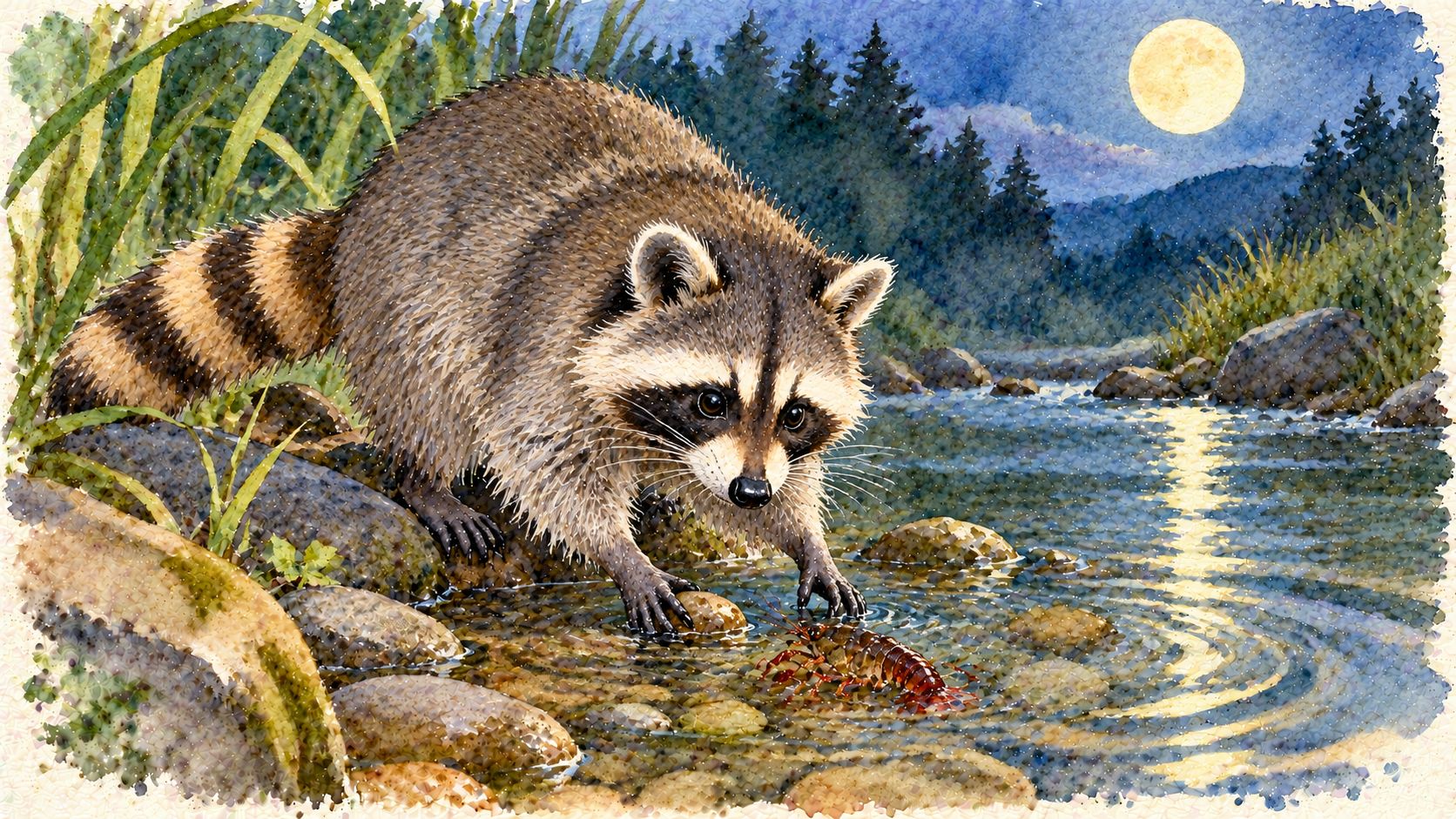
A raccoon's front paws are incredibly sensitive, almost like human hands, with five long, flexible fingers. A large part of the area of a raccoon's brain that handles the senses is used for touch. Raccoons often dip their food or paws in water before eating. They aren't really washing their food. Scientists think wetting their paws makes them even more sensitive, helping them feel every detail of what they're holding.
Raccoons can turn their back feet around, which lets them climb down trees headfirst.
Raccoons are good swimmers and can also survive falls from surprisingly great heights.
In a famous experiment in the early 1900s, raccoons learned to open complicated locks, and they can remember how to solve a problem for up to three years.
In a 2017 study, some raccoons solved a version of the "thirsty crow" puzzle, dropping stones into water to raise a floating treat.
Raccoons often live in greater numbers in cities than in the countryside, thanks to plentiful food and shelter.
In Toronto, Canada, raccoons are so good at raiding bins that the city introduced special raccoon-resistant bins.
Raccoons don't truly hibernate, but in very cold weather they sleep for long periods in their dens.
Female raccoons are pregnant for about two months and usually give birth to two to five babies, called kits.
Raccoon kits stay with their mother for close to a year, learning how to find food and survive.
Raccoons were once thought to be relatives of the red panda
For many years, scientists placed the red panda, which lives in the eastern Himalayas of India, Nepal, Bhutan and China, in the same family as raccoons. Both have reddish-brown or grey fur, ringed tails, mask-like face markings and a love of climbing. However, DNA studies later showed that the red panda belongs to its own separate family. The raccoon's real relatives include coatis, kinkajous and ringtails of the Americas.

Raccoons were brought to Germany in the 1930s, and today Germany has one of the largest raccoon populations outside the Americas.
In Japan, raccoons became popular pets after a 1970s cartoon, and many released or escaped pets started a wild population.
The "raccoon dog" of Japan and East Asia isn't a raccoon at all. It's a member of the dog family.
The Cozumel raccoon, found only on an island off Mexico, is critically endangered.
Wild raccoons usually live only about two to three years, but in captivity they can live for up to 20 years.
Sources and Further Reading
- Smithsonian's National Zoo & Conservation Biology Institute
- IUCN Red List of Threatened Species
- University of Wyoming
- Animal Cognition (journal)
- Encyclopaedia Britannica
- National Geographic
Frequently asked questions
Where do raccoons come from?
Raccoons are native to North and Central America, but they have been introduced to parts of Europe and Japan.
Do raccoons really wash their food?
Not exactly. Raccoons often dip food or their paws in water, but scientists think this makes their paws more sensitive rather than cleaning the food.
Are raccoons intelligent?
Yes. Raccoons can open locks, solve puzzles and remember solutions for up to three years.
Are raccoons related to red pandas?
No. Red pandas were once grouped with raccoons, but DNA studies showed they belong to their own separate family.
Do raccoons hibernate?
No. Raccoons don't truly hibernate, but they sleep for long periods in their dens during very cold weather.
How long do raccoons live?
Wild raccoons usually live about two to three years, while captive raccoons can live for up to 20 years.
More Fun Facts