25 Giant Anteater Facts: The Toothless Termite Champion
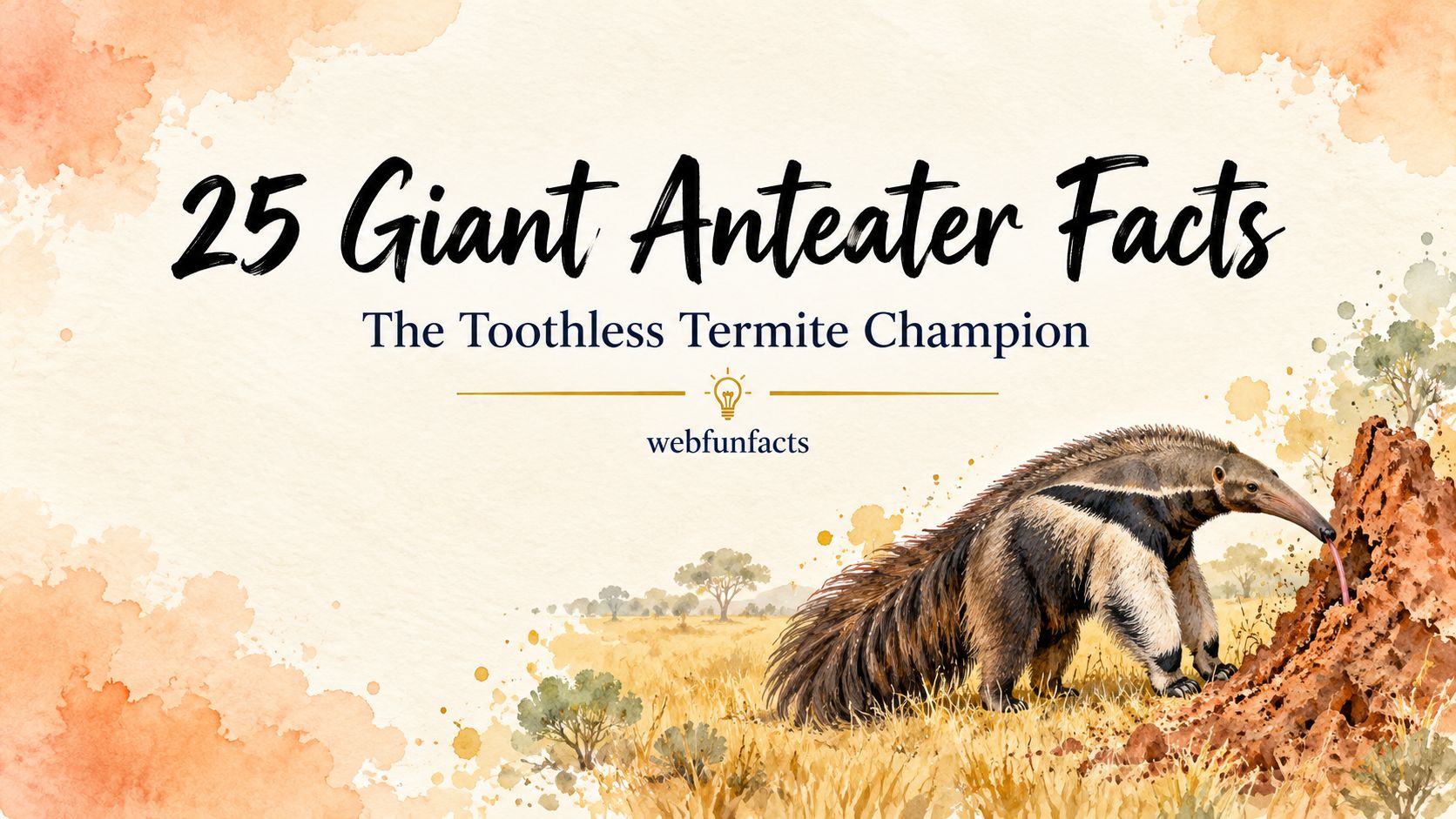
With a snout like a long tube, a bushy flag of a tail and not a single tooth in its head, the giant anteater looks like an animal built from spare parts. Yet every odd feature has a job, and together they make it one of nature's most specialised insect hunters.
Giant anteaters roam the grasslands, wetlands and forests of Central and South America, quietly raiding termite mounds and ant nests. Here are 25 fascinating facts about how they eat, defend themselves, raise their young and why they need our help today.
Giant Anteater Facts
The giant anteater is the largest of the four living anteater species, measuring roughly 1.8 to 2.1 metres from nose to tail tip, with the tail making up around 40 per cent of that length.
Adults usually weigh about 25 to 40 kilograms, and males are generally a little heavier than females.
Its scientific name, *Myrmecophaga tridactyla*, means roughly "three-fingered ant-eater", a nod to the large claws on its front feet.
A giant anteater has no teeth at all. Instead, it crushes insects with hard folds in its muscular stomach, helped along by grit and small stones it swallows while feeding.
Its diet is made up almost entirely of termites and ants, along with some beetle larvae. Zoo anteaters are often fed a special insect-based mash with fruit added.
It is reported to eat tens of thousands of insects a day, with estimates of around 30,000 often quoted.
The anteater's eyesight is poor, but its sense of smell is excellent. It sniffs out nests by scent and can tell which kind of insect is inside.
It walks on its knuckles, curling its long front claws inwards to keep them sharp and out of the way. The largest claw can be about 10 centimetres long.
Those powerful forelimbs can rip open termite mounds that are hard as sun-baked clay, then the snout and tongue take over.
A Tongue Longer Than Its Head
The giant anteater's tongue can stretch to about 60 centimetres, longer than its whole head, and it is anchored far back near the breastbone rather than in the mouth. The tongue is covered with tiny backward-pointing spines and coated in thick, sticky saliva from enormous salivary glands, so insects cannot easily escape once caught. The anteater can flick it in and out roughly 150 times a minute, yet its mouth opening is tiny. Because it has no teeth, the tongue does nearly all the work, slurping up termites, ants and eggs before the stomach grinds them down.
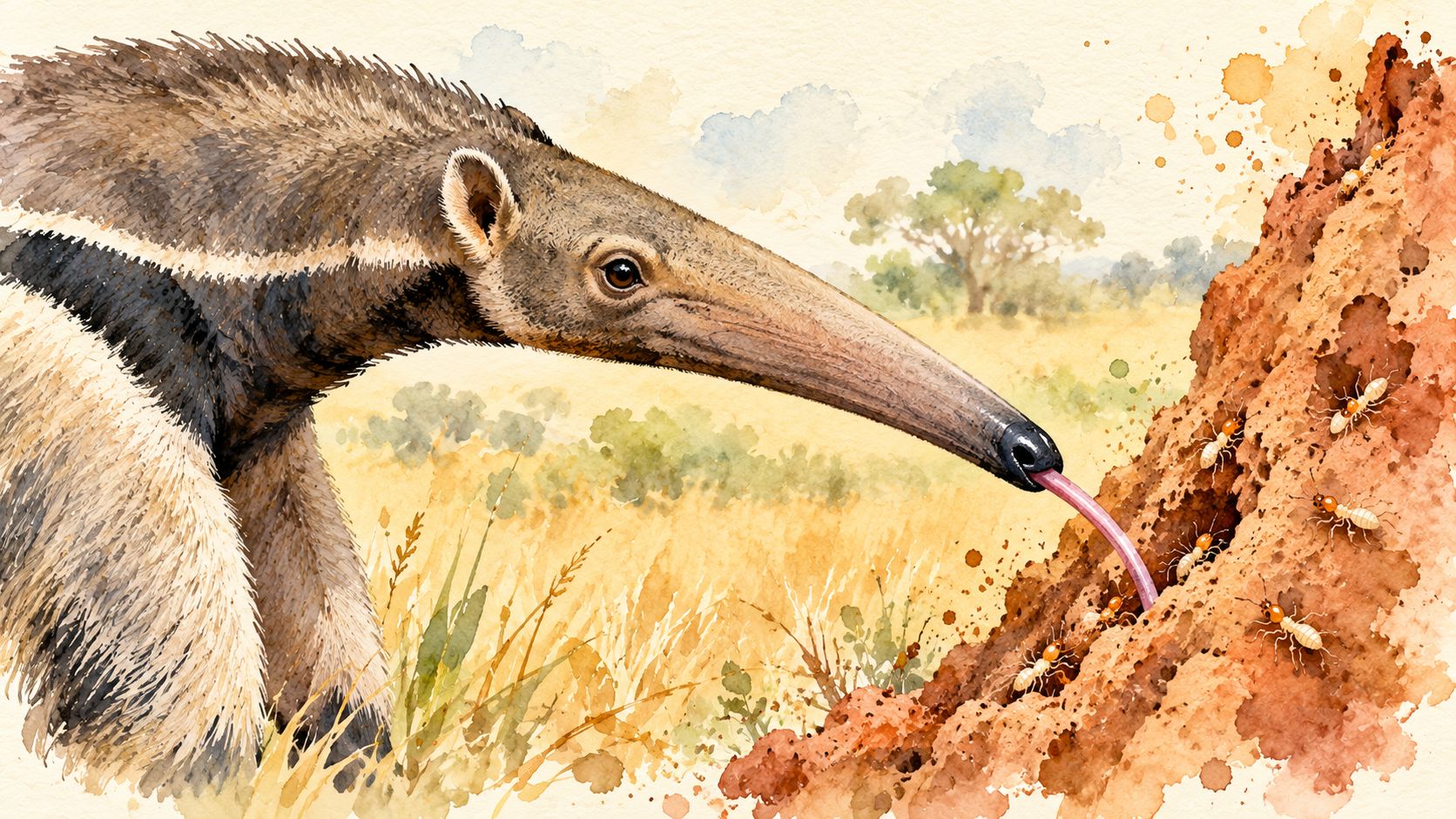
An anteater usually feeds at a single nest for only a minute or so before moving on, probably because biting soldier ants and termites soon arrive to defend their home.
Because it rarely destroys a colony completely, the same nest can recover and be visited again later, a little like a farmer returning to a field.
Giant anteaters are close relatives of sloths and more distant cousins of armadillos, all part of an ancient group of mammals that evolved in the Americas.
They have a low body temperature for a mammal, about 33°C, and a slow metabolism, which suits a diet of small, low-energy insects.
Their big bushy tail doubles as a blanket. When an anteater sleeps, it curls up and drapes the tail over its body for warmth or shade.
They are mostly solitary, and each anteater wanders over a home range that may cover a few square kilometres, depending on how much food is available.
They can be active by day or night. In areas with lots of people or very hot weather, they tend to switch to feeding after dark.
Despite their slow, shuffling walk, giant anteaters are capable swimmers and have been seen crossing rivers and bathing in water.
When threatened, an anteater rears up on its hind legs, using its tail as a prop, and slashes with its claws. Jaguars and pumas are its main natural predators, and even they treat it with caution.
A Vulnerable Giant Under Pressure
The giant anteater is listed as Vulnerable on the IUCN Red List, and it is thought to have already vanished from parts of its former range, including Uruguay and several Central American countries. Its biggest threats are the loss of grasslands and forests to farming, large wildfires in places such as Brazil's Cerrado and Pantanal, collisions with vehicles on busy roads and hunting. Because females usually raise just one pup at a time, populations recover slowly. Conservation groups now track anteaters, rescue orphaned pups and push for wildlife-friendly roads, helping this remarkable insect eater keep its place in South America's wild landscapes.
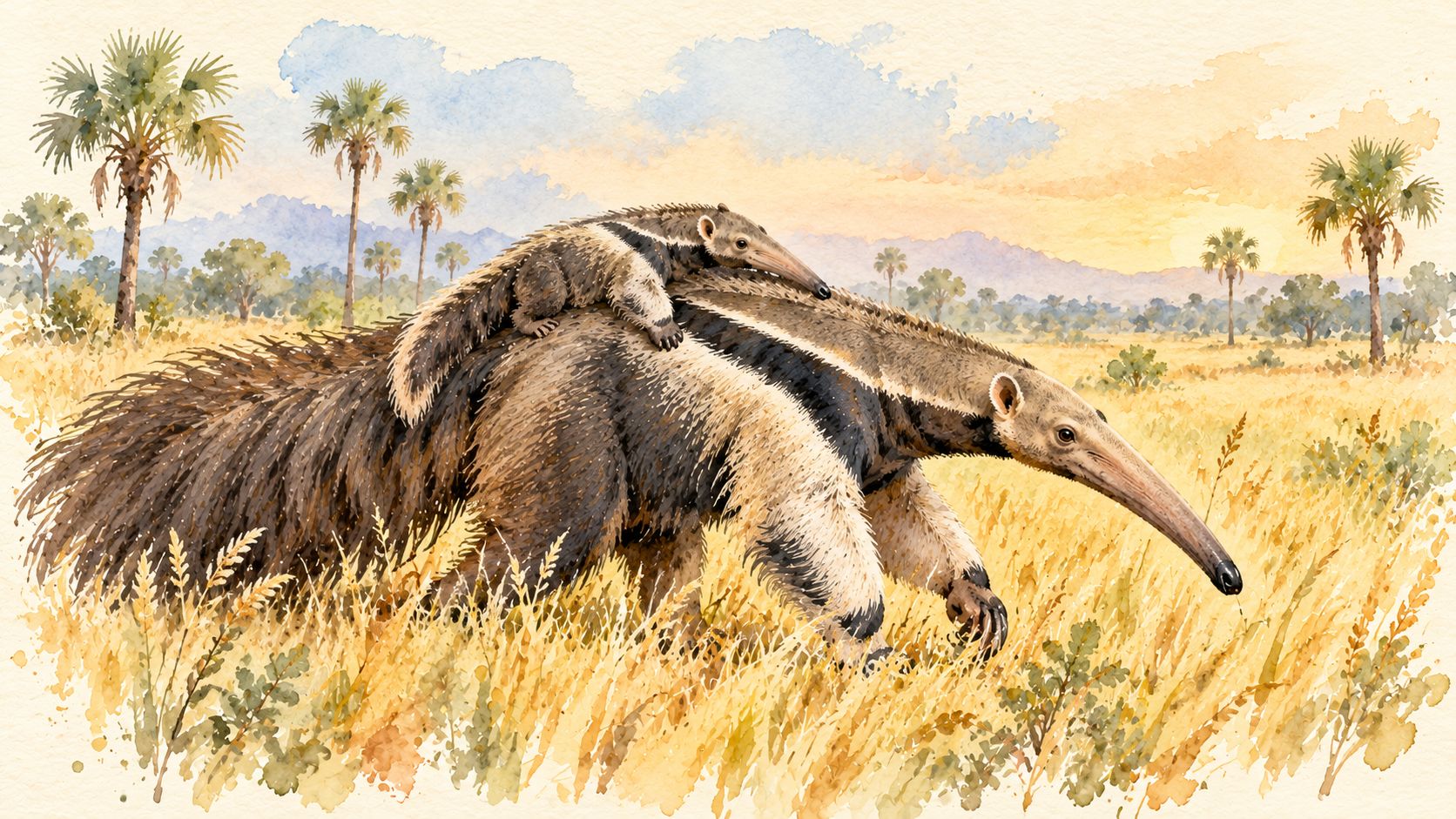
A female gives birth to a single pup after a pregnancy of about six months. The pup is born with a full coat of fur.
The pup rides on its mother's back for several months. Its dark stripe lines up with hers, helping the pair blend together into one larger, harder-to-spot shape.
Giant anteaters have lived for more than 25 years in zoos, though wild animals generally have shorter lives.
Anteaters, aardvarks, pangolins and echidnas are not closely related, yet all evolved long snouts and sticky tongues for eating ants and termites, a classic case of convergent evolution.
India has its own ant and termite specialists. The Indian pangolin uses a long sticky tongue much like an anteater's, while the sloth bear has a gap in its front teeth that lets it suck termites out of mounds like a vacuum cleaner.
Sources and Further Reading
- IUCN Red List
- Smithsonian's National Zoo and Conservation Biology Institute
- Encyclopaedia Britannica
- San Diego Zoo Wildlife Alliance
- National Geographic
- Animal Diversity Web, University of Michigan
Frequently asked questions
Do giant anteaters have teeth?
No. Giant anteaters are completely toothless and rely on their long sticky tongue to collect insects and their muscular stomach to grind them up.
How long is a giant anteater's tongue?
It can reach about 60 centimetres and can be flicked in and out roughly 150 times a minute.
Where do giant anteaters live?
They live in Central and South America, from parts of Central America down to northern Argentina, in grasslands, savannas, wetlands and forests.
Are giant anteaters dangerous?
They are shy and usually avoid people, but if cornered they can defend themselves with sharp claws, so they should always be watched from a distance.
Are giant anteaters endangered?
They are listed as Vulnerable by the IUCN, mainly because of habitat loss, wildfires, road accidents and hunting.
Are anteaters related to pangolins?
No. Pangolins are more closely related to cats and dogs, while anteaters are related to sloths. They simply evolved similar features for eating ants and termites.
More Fun Facts