25 Peacock Facts: The Dazzling National Bird of India
With its shimmering blue neck and a magnificent fan of eye-spotted feathers, the peacock is one of the most beautiful birds in the world. In India, it's much more than a pretty bird. It's the national bird, a symbol of grace and a part of the country's myths, art and history.
Here are 25 dazzling facts about peacocks, from the secret science behind their colours to their special place in Indian culture.
Peacock Facts
The correct name for these birds is peafowl. The males are peacocks, the females are peahens and the babies are peachicks.
There are three species of peafowl: the Indian peafowl, the green peafowl of Southeast Asia and the Congo peafowl of Central Africa.
The Indian peafowl is found mainly in India, Sri Lanka, Nepal and Pakistan.
The peacock was declared the national bird of India in 1963.
In India, peafowl are fully protected under the Wildlife (Protection) Act, and hunting them is illegal.
A peacock's famous fan isn't really its tail. It's a "train" of around 150 to 200 long feathers that grow from its back, held up by shorter, stiff tail feathers underneath.
A peacock's train can be around 1.5 metres long, making up most of the bird's total length.
A peacock's brilliant blues and greens don't come from blue or green pigments. Tiny structures in the feathers reflect light in a way that creates the shimmering colours.
The circular patterns on the train feathers are called eyespots.
Peacocks make secret sounds we can't hear
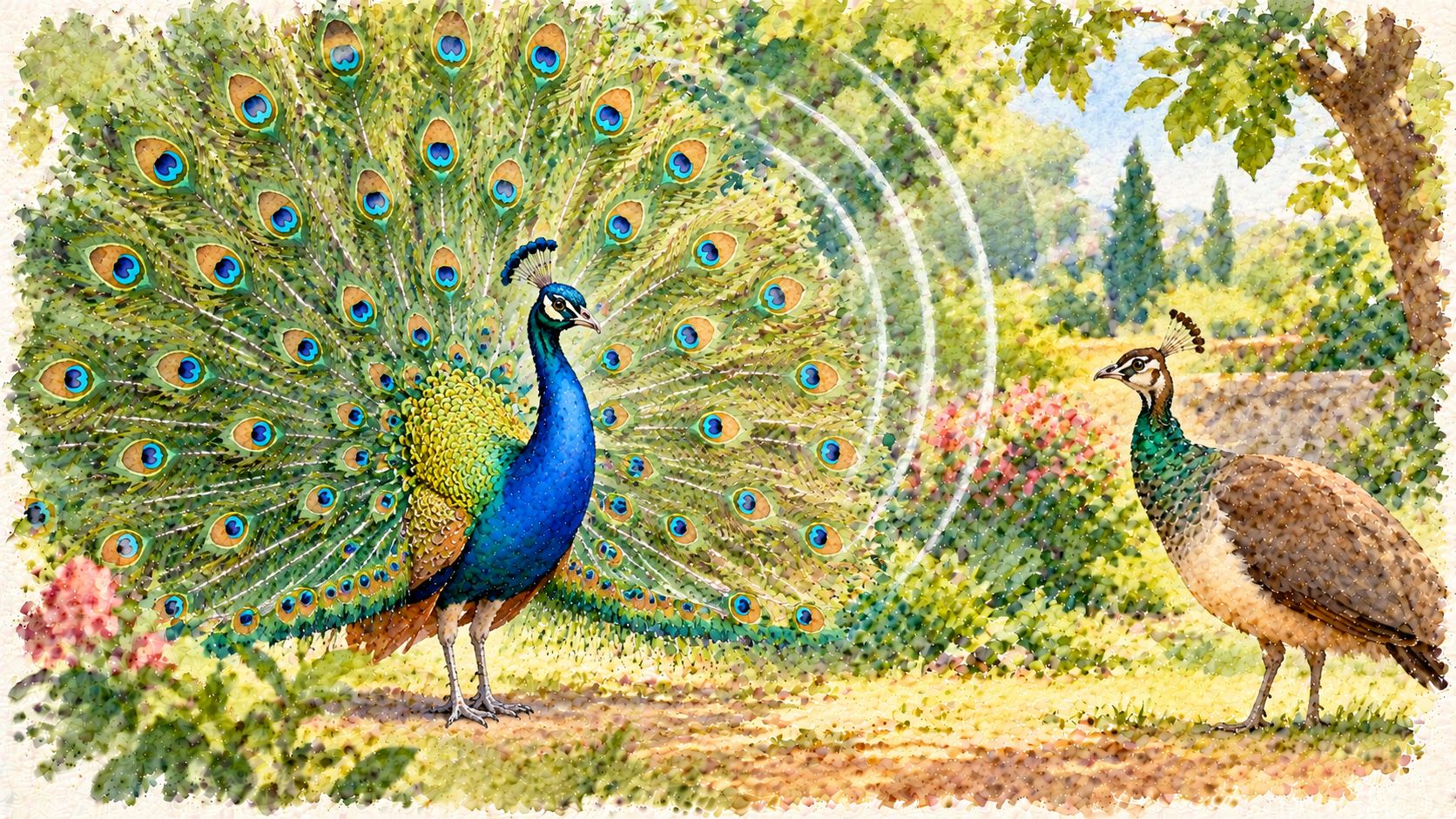
When a peacock fans its train to impress a peahen, it doesn't just put on a visual show. It also rattles its feathers, making them shimmer and shake. A 2016 study found that this shaking produces very low-pitched sounds called infrasound, which are too low for human ears to hear. Peahens appear to be able to detect these sounds, and the crest feathers on top of their heads may vibrate in response. So a peacock's display may be part dance, part secret song.
A young peacock grows its full, colourful train by the time it's around three to four years old.
Every year after the breeding season, peacocks shed their long train feathers and grow a brand new set.
Peahens are mostly brown and grey, which helps them stay hidden while sitting on their eggs.
A peahen usually lays around three to six eggs, which hatch after about 28 days.
Despite their long trains, peafowl can fly, and they usually fly up into tall trees to roost safely at night.
Peafowl are omnivores. They eat seeds, grains, insects, lizards and even small snakes.
A peacock's loud, piercing call can be heard from far away. In Indian forests, peafowl often call in alarm when they spot a tiger or leopard.
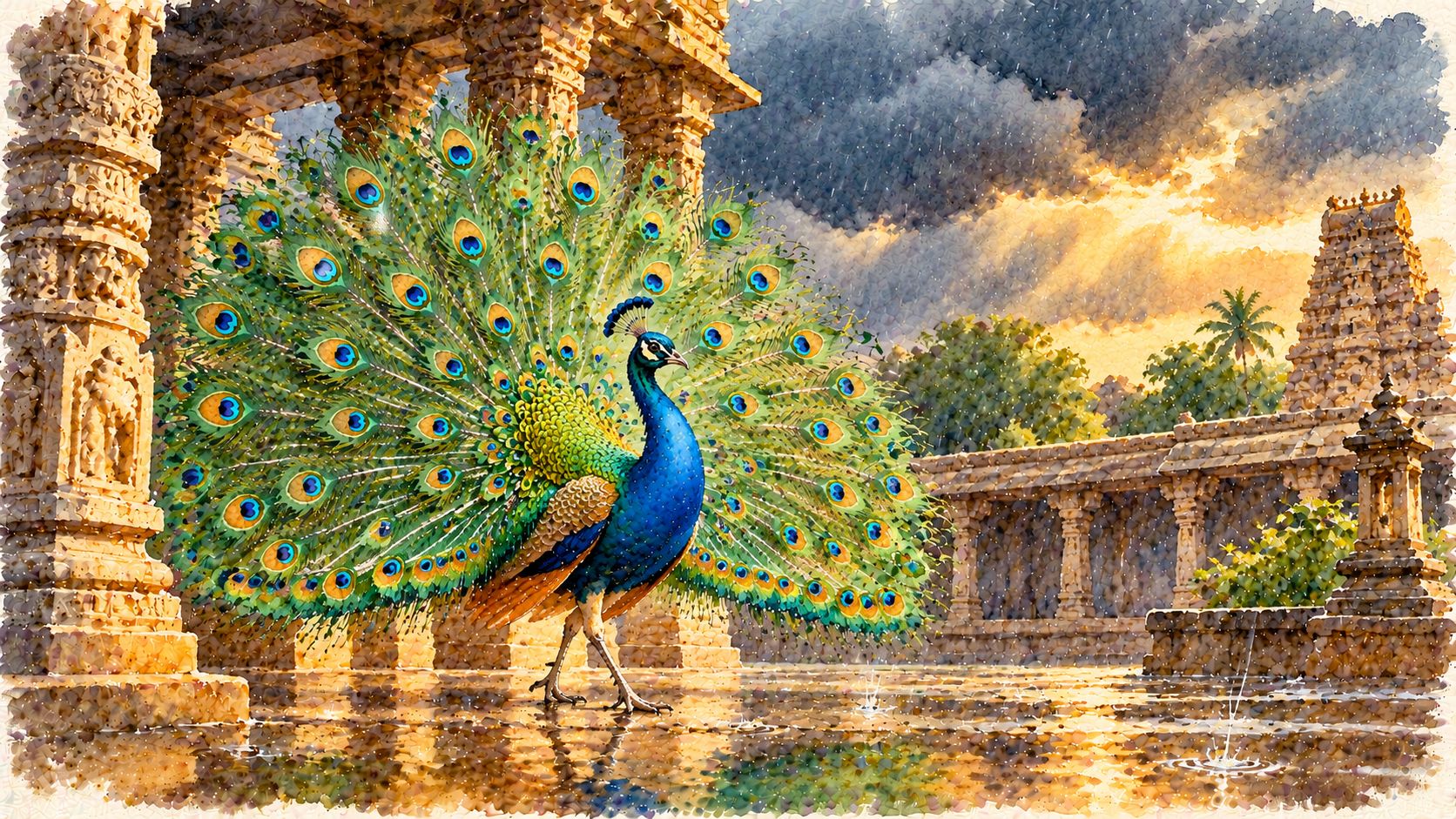
In India, peacocks are famous for dancing at the start of the monsoon, as the rains mark the beginning of their breeding season.
White peacocks aren't albino. They have a condition called leucism, which reduces colour in their feathers but leaves their eyes a normal colour.
Peacocks hold a special place in Indian culture
The peacock appears throughout Indian culture, history and religion. It's the vahana, or vehicle, of Lord Kartikeya, also known as Murugan, and Lord Krishna is often shown wearing a peacock feather in his crown. In the 1600s, the Mughal emperor Shah Jahan built the magnificent Peacock Throne, decorated with gold and precious gems and shaped with peacock figures. It was carried away from Delhi by the Persian ruler Nadir Shah in 1739 and later lost. Peacocks are also a favourite design in Indian paintings, textiles, jewellery and temple carvings.
Thanks to protection, peafowl numbers in India are healthy, and studies have found they're increasing and spreading into new areas.
The green peafowl of Southeast Asia is endangered, and it's a national symbol of Myanmar.
The Congo peafowl was first described by scientists in 1936, after an American zoologist became curious about an unusual feather he had seen in a hat.
Peafowl have been kept in palaces, gardens and parks around the world for thousands of years, prized for their beauty.
Wild peafowl usually live for around 15 to 20 years.
Sources and Further Reading
- Ministry of Environment, Forest and Climate Change
- State of India's Birds Report
- Bombay Natural History Society (BNHS)
- IUCN Red List of Threatened Species
- Encyclopaedia Britannica
- National Geographic
Frequently asked questions
Why is the peacock India's national bird?
The peacock was declared India's national bird in 1963 because of its beauty, its long history in Indian culture and religion, and its presence across the country.
Are peacocks protected in India?
Yes. Peafowl are fully protected under India's Wildlife (Protection) Act, and hunting or harming them is illegal.
Why are peacock feathers so colourful?
Peacock feathers get their shimmering blues and greens from tiny structures that reflect light, not from blue or green pigments.
Can peacocks fly?
Yes. Despite their long trains, peacocks can fly short distances, and they usually fly up into trees to sleep at night.
Why do peacocks dance?
Peacocks dance by fanning and shaking their trains to attract peahens. In India, this often happens at the start of the monsoon, which marks their breeding season.
What is a female peacock called?
A female is called a peahen, and together males and females are called peafowl. Babies are called peachicks.
More Fun Facts