25 T. Rex Facts: Secrets of the Tyrant Lizard King
Tyrannosaurus rex is probably the most famous dinosaur ever discovered. This giant meat-eater roamed western North America at the very end of the age of dinosaurs, around 68 to 66 million years ago, and its massive skull and bone-crushing teeth made it one of the most powerful land predators known.
More than a century of digging has turned up dozens of skeletons, letting scientists study how T. rex grew, hunted, saw and smelled. Here are 25 facts about this mighty predator, plus a look at India's very own top predator dinosaur, which lived on the other side of the world.
T. Rex Facts
T. rex lived roughly 68 to 66 million years ago, in the last few million years of the Cretaceous period.
Its fossils come mainly from western North America, from Montana, the Dakotas and Wyoming in the USA to Alberta and Saskatchewan in Canada, on a landmass then called Laramidia.
The largest adults were about 12 metres long and roughly 3.7 metres tall at the hips. Weight estimates for big individuals are commonly around 8 tonnes or more, though figures vary between studies.
The first skeleton recognised as T. rex was dug up in 1902 by fossil hunter Barnum Brown in the Hell Creek area of Montana.
Henry Fairfield Osborn of the American Museum of Natural History named it in 1905, joining Greek words for "tyrant lizard" with the Latin rex, meaning "king".
Its skull could be about 1.5 metres long, but large openings in the bone helped keep its weight down.
It had around 50 to 60 thick, serrated teeth. The biggest, including the root, were about 30 cm long, roughly the size of a banana.
Like other dinosaurs, T. rex replaced lost or worn teeth throughout its life.
Its arms were only about 1 metre long, each with two clawed fingers. They were tiny compared with its body but thick-boned and muscular, and their exact use is still debated.
One of the Strongest Bites Known
Computer models suggest T. rex had one of the most powerful bites of any land animal known. Estimates vary, but a 2012 study put the force at its back teeth at roughly 35,000 to 57,000 newtons, about two to three times the strongest bite measured in a living saltwater crocodile. Its thick, cone-shaped teeth were built to puncture and crush bone, not just slice meat. Fossils back this up: a huge fossil dropping from Saskatchewan, Canada, thought to be from T. rex, contains crushed bone, and bite-marked bones of other dinosaurs show it bit straight through.
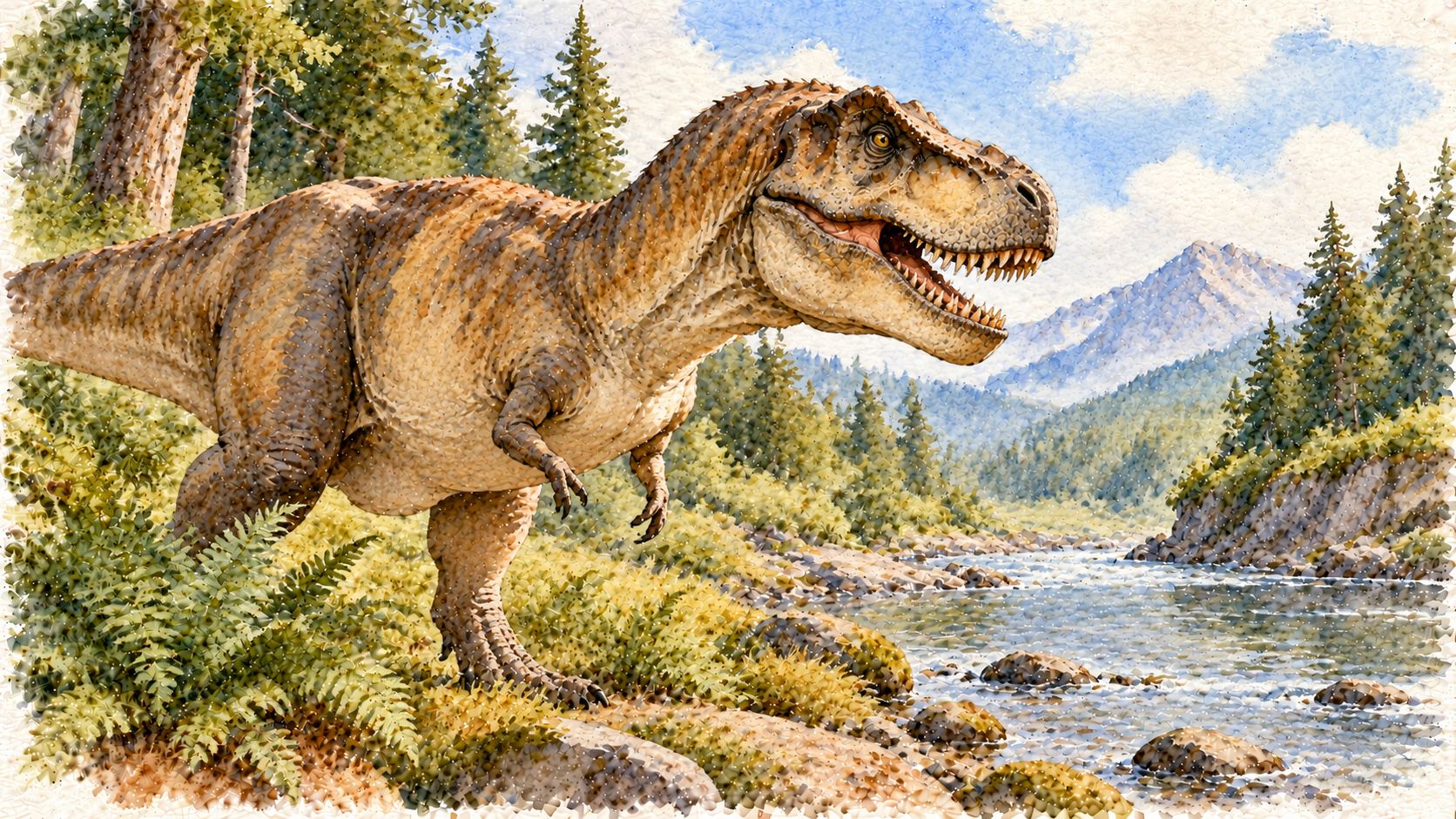
T. rex had forward-facing eyes, giving it good binocular vision and depth perception, which would have helped it judge the distance to prey.
The parts of its brain that handled smell, called the olfactory bulbs, were very large, suggesting a keen sense of smell.
It was probably both a hunter and a scavenger. A T. rex tooth found lodged in the healed tail bones of a duck-billed Edmontosaurus, described in 2013, shows at least one victim was alive when bitten and escaped.
Despite what films show, adult T. rex was probably not a fast runner. Studies suggest a top speed of perhaps 20 to 30 km/h at most, and some researchers think it could only walk briskly.
T. rex grew remarkably fast as a teenager, gaining perhaps around 2 kg a day during its peak growth spurt.
Growth rings in its bones suggest the oldest known individuals were in their late twenties, roughly 30 years old, when they died.
Young T. rex were long-legged and slender. Scientists have long debated whether small skeletons named Nanotyrannus are young T. rex or a separate animal, and some recent studies argue they are a separate genus.
Fossil skin patches from T. rex and close relatives show small scales, so adults were probably mostly scaly. Some earlier, smaller tyrannosaur relatives, such as Yutyrannus from China, had long filament-like feathers, so young T. rex may have had some fuzz.
The most complete T. rex skeleton, nicknamed "Sue", was found in South Dakota in 1990 and is on display at the Field Museum in Chicago. It is often described as roughly 90 per cent complete by bulk.
India's Own King Lizard: Rajasaurus
India never had T. rex, but it had its own fearsome top predator. Rajasaurus narmadensis, roughly "royal lizard from the Narmada", was described in 2003 by Indian and American scientists from fossils found near Rahioli, close to Balasinor in Gujarat. It lived around 70 to 66 million years ago, when India was an island drifting towards Asia. Rajasaurus was an abelisaurid, a group with short, deep skulls and even tinier arms, and it was not closely related to T. rex. Estimates suggest it was perhaps 6 to 9 metres long, with a small bony bump on its head.
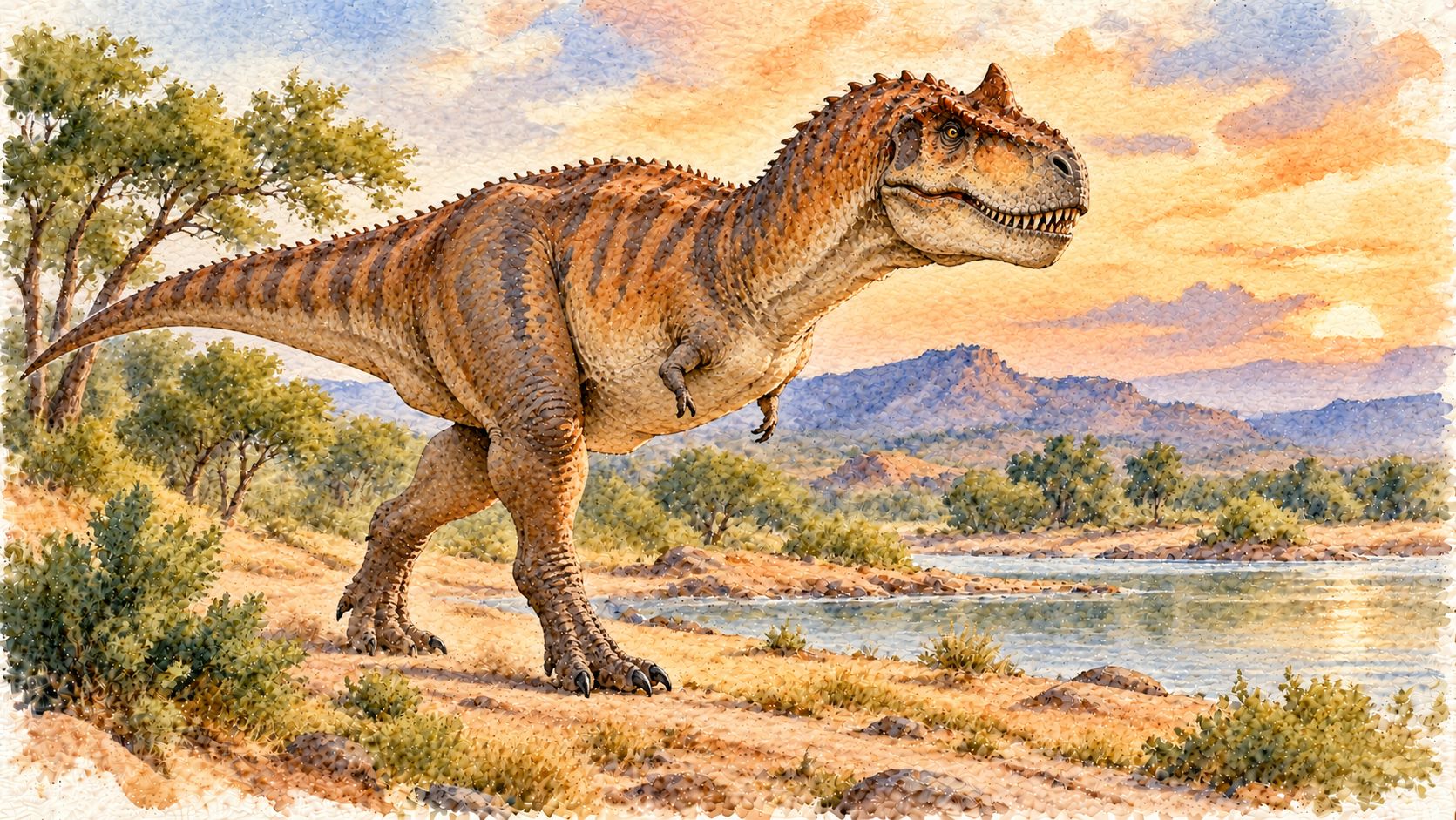
The Rahioli area near Balasinor has yielded many dinosaur bones and eggs, and a dinosaur fossil park there is open to visitors.
T. rex lived closer in time to us than to Stegosaurus. More than 80 million years separate Stegosaurus from T. rex, while only about 66 million years separate T. rex from today.
Its close relatives included Tarbosaurus from Asia, and many scientists think T. rex's ancestors may have come from Asia across a land connection.
T. rex shared its world with plant-eaters such as Triceratops and Edmontosaurus, and Triceratops bones carrying T. rex bite marks have been found.
T. rex was among the last non-bird dinosaurs. It died out about 66 million years ago, when an asteroid struck what is now Mexico, with huge volcanic eruptions in India's Deccan region possibly adding to the stress on life.
Sources and Further Reading
- Field Museum
- American Museum of Natural History
- Natural History Museum London
- Smithsonian National Museum of Natural History
- Encyclopaedia Britannica
- Geological Survey of India
Frequently asked questions
How big was T. rex?
The largest adults were about 12 metres long and roughly 3.7 metres tall at the hips, and probably weighed around 8 tonnes or more.
How strong was a T. rex bite?
Models suggest its bite force reached roughly 35,000 to 57,000 newtons, among the strongest of any land animal known.
Could T. rex run fast?
Probably not. Studies suggest adults could reach perhaps 20 to 30 km/h at most, and some think they could only walk briskly.
Did T. rex have feathers?
Skin fossils suggest adults were mostly scaly, though young T. rex may have had some fuzzy feathers like some of their relatives.
How long did T. rex live?
Bone growth rings suggest the oldest known individuals lived to around 30 years.
Did T. rex live in India?
No. T. rex lived only in North America, but India had its own large predator, Rajasaurus, whose fossils were found near Balasinor in Gujarat.