25 Armadillo Facts: Nature's Little Armoured Diggers
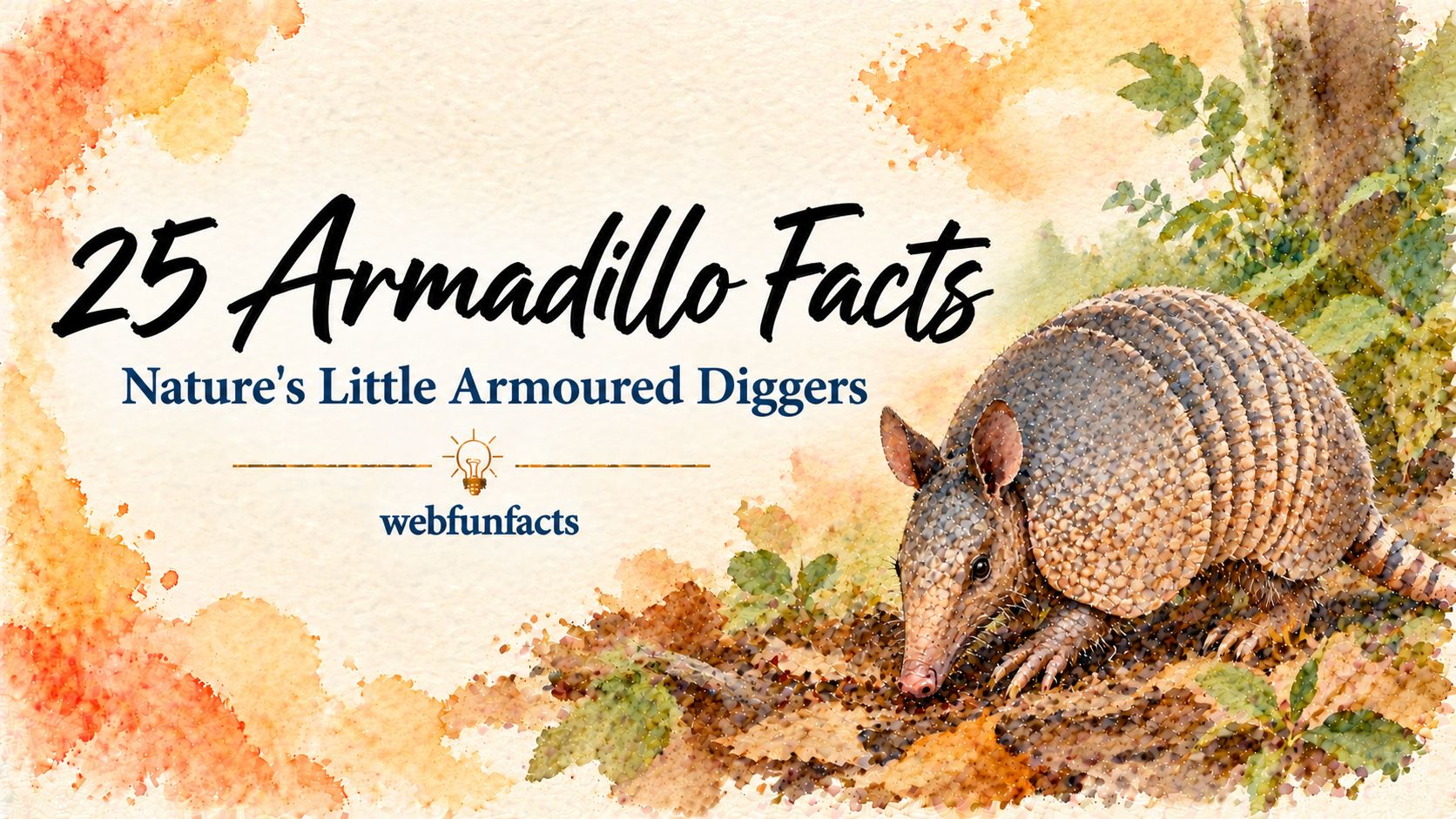
With their tough, armour-plated shells, armadillos look like tiny tanks waddling through the undergrowth. These unusual mammals are expert diggers, surprisingly good swimmers and have some of the strangest family lives in the animal kingdom.
Here are 25 amazing facts about armadillos, from their identical quadruplets to India's own armoured mammal, the pangolin.
Armadillo Facts
The name "armadillo" comes from Spanish and means "little armoured one".
There are around 20 species of armadillo, all found in the Americas, mostly in Central and South America.
Only one species, the nine-banded armadillo, is found in the United States.
An armadillo's armour is made of small plates of bone in the skin, covered with tough scales made of keratin, the same material as our fingernails.
Armadillos are related to anteaters and sloths.
The pink fairy armadillo of Argentina is the smallest species, only around 10 centimetres long, with a pale pink shell.
The giant armadillo is the largest species, growing up to about 1.5 metres long, including its tail.
Giant armadillos can have up to around 80 to 100 small teeth, more than almost any other land mammal.
Only the two species of three-banded armadillo can roll up into a complete, tight ball to protect themselves.
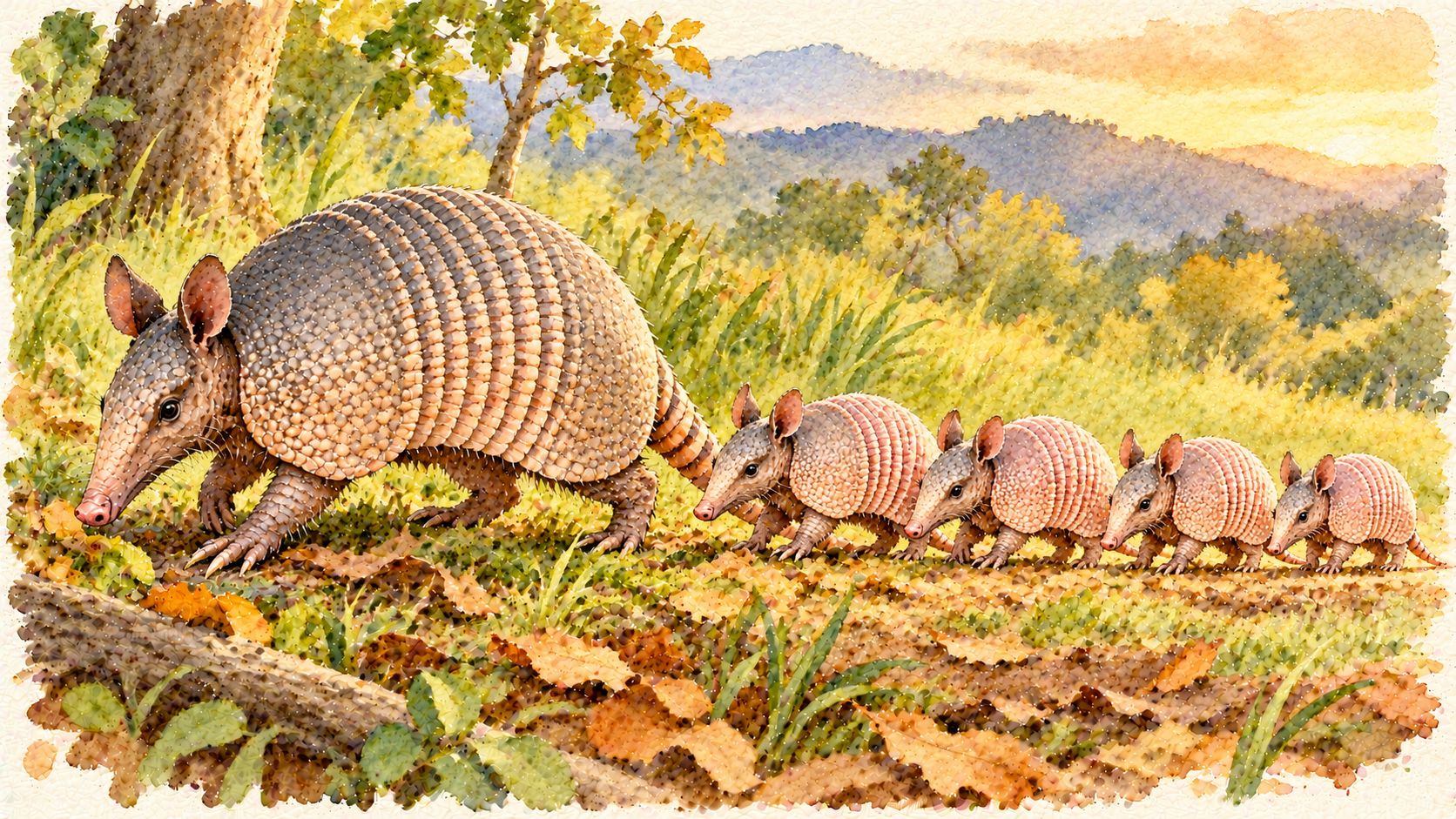
Nine-banded armadillos are almost always born as identical quadruplets
The nine-banded armadillo has one of the most unusual ways of having babies of any mammal. After mating, a single fertilised egg splits into four, so the mother almost always gives birth to four identical babies, all the same sex. Female armadillos can also delay the development of their babies for months after mating, so the young are born at the best time of year. Newborn armadillos have soft, leathery shells, which slowly harden as they grow.
When startled, a nine-banded armadillo can jump straight up into the air, sometimes around a metre high.
Most armadillos escape danger by running away quickly or by digging into the ground.
Armadillos have poor eyesight but an excellent sense of smell, which they use to find food underground.
They use their long, sticky tongues to slurp up ants, termites and other insects.
Armadillos are powerful diggers, using their strong claws to make burrows and search for food.
The burrows of giant armadillos are used as shelters by dozens of other animal species.
Armadillos can cross rivers by gulping air to help them float, or by holding their breath and walking along the bottom.
Armadillos have a low body temperature for a mammal and struggle in cold weather.
Because of their low body temperature, armadillos are one of the few animals that can carry the bacteria that cause leprosy, which has made them important in leprosy research.
India's pangolin looks like an armadillo, but isn't related
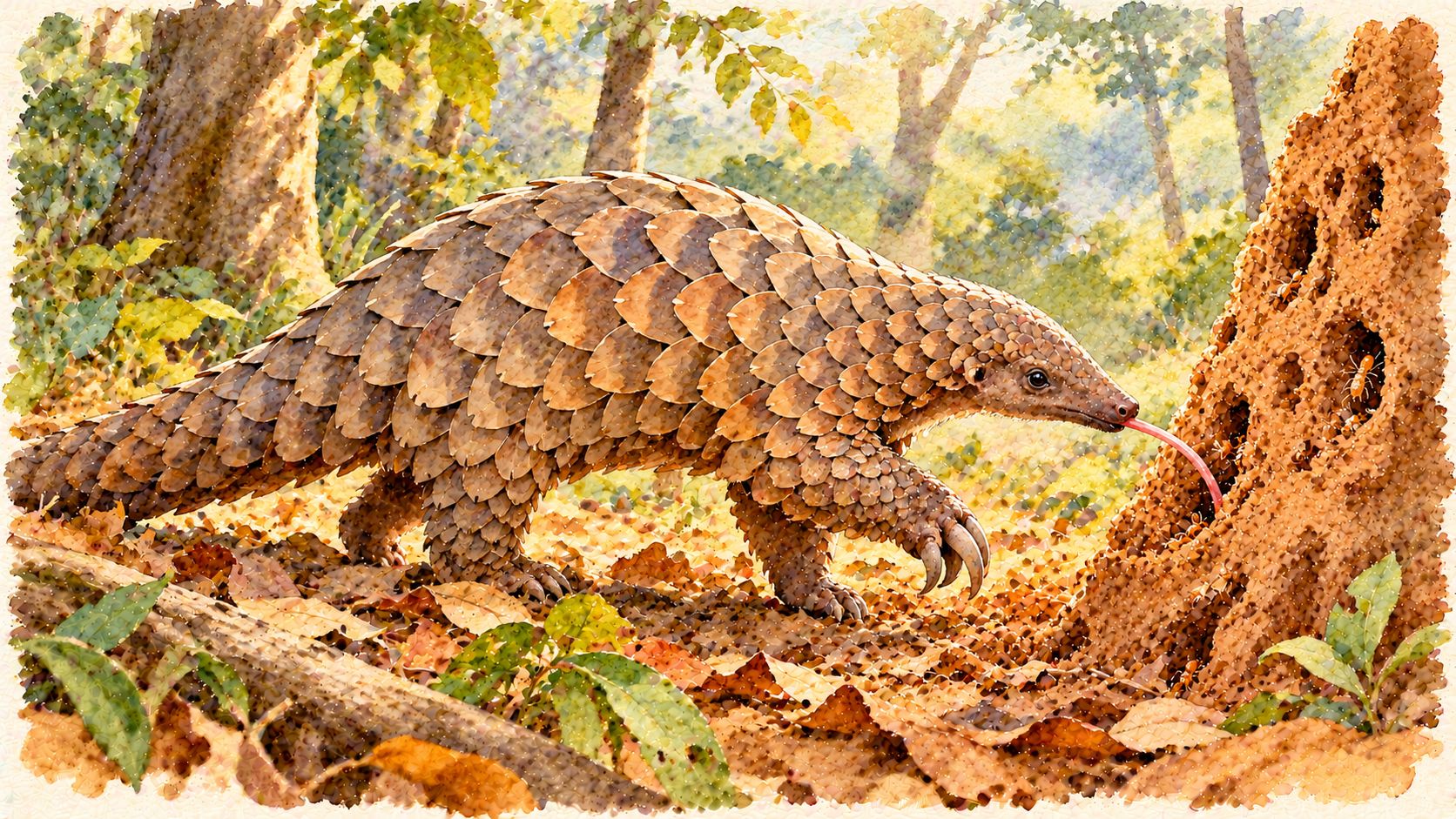
India doesn't have armadillos, but it does have its own armour-plated mammal: the pangolin. The Indian pangolin is covered in large overlapping scales and, like the three-banded armadillo, can roll into a tight ball when frightened. It also uses a long, sticky tongue to eat ants and termites. But pangolins and armadillos aren't closely related. They developed their armour and ant-eating habits separately, an example of convergent evolution. Sadly, pangolins are among the most trafficked mammals in the world, hunted illegally for their scales and meat.
The screaming hairy armadillo of South America gets its name from the loud squealing noise it makes when it's disturbed.
The nine-banded armadillo has spread northwards across the United States over the past century.
The traditional Andean string instrument called the charango was once commonly made using an armadillo's shell.
Long ago, armadillos' giant relatives, called glyptodonts, were about the size of a small car and covered in a huge domed shell.
Fuleco, the mascot of the 2014 FIFA World Cup in Brazil, was a three-banded armadillo, a species that is now threatened.
Sources and Further Reading
- Smithsonian's National Zoo & Conservation Biology Institute
- IUCN Red List of Threatened Species
- Wildlife Institute of India
- TRAFFIC India
- Encyclopaedia Britannica
- National Geographic
Frequently asked questions
Can all armadillos roll into a ball?
No. Only the two species of three-banded armadillo can roll into a complete, tight ball. Most other armadillos run away or dig to escape.
Do armadillos lay eggs?
No. Armadillos give birth to live young. The nine-banded armadillo usually has four identical babies from a single fertilised egg.
What do armadillos eat?
Armadillos mainly eat ants, termites and other insects, but they also eat small animals, roots and fruit.
Are armadillos found in India?
No. Armadillos live only in the Americas. India does have pangolins, which look similar and also eat ants, but they aren't related.
What is the smallest armadillo?
The pink fairy armadillo of Argentina is the smallest species, only around 10 centimetres long.
Why are armadillos used in leprosy research?
Armadillos have a low body temperature, which allows the bacteria that cause leprosy to grow in them, making them useful for studying the disease.
More Fun Facts