
25 Fun Facts
25 Hamster Facts: Fluffy Little Food Hoarders
With their round bodies, twitchy noses and stuffed cheeks, hamsters are among the world's most popular small pets. But in the wild, these little rodents are busy burrowers and expert food collectors.
Here are 25 cute facts about hamsters, from their amazing stretchy cheeks to the surprising story of how Syrian hamsters became pets.
Hamster Facts
There are around 20 species of hamster, found in the wild across parts of Europe and Asia.
The word "hamster" comes from the German word "hamstern", which means "to hoard", after their habit of storing food.
In Chinese, a hamster is called "cāngshǔ", which means "granary mouse".
The most common pet hamsters are the Syrian hamster and several kinds of dwarf hamster, including the Roborovski, Campbell's, winter white and Chinese hamster.
The Syrian, or golden, hamster is the largest common pet hamster, usually about 13 to 18 centimetres long.
The Roborovski hamster is the smallest pet hamster, only about 5 centimetres long, and it's very fast.
Syrian hamsters prefer to live alone and will often fight if kept together.
Hamsters are most active around dusk and during the night, and they sleep for much of the day.
Like all rodents, hamsters have front teeth that never stop growing, so they need to chew to keep them short.
Most pet Syrian hamsters come from one family found in 1930
In 1930, a scientist named Israel Aharoni dug up a mother Syrian hamster and her litter from a field near Aleppo, in Syria. Only a few of the babies survived, but they bred successfully in his laboratory. Their descendants were shared with labs and pet owners around the world, and most pet Syrian hamsters today are thought to come from that single small family. Meanwhile, wild Syrian hamsters are now listed as vulnerable because their farmland homes are disappearing.

Hamsters have poor eyesight. They are near-sighted and rely mainly on their senses of smell, hearing and touch.
Hamsters use their whiskers to feel their way around in the dark.
Hamsters have scent glands that they rub on objects to mark their territory.
Hamsters are born blind, deaf and hairless, and they usually open their eyes at around two weeks old.
A Syrian hamster is pregnant for only about 16 days, one of the shortest pregnancies of any mammal.
Hamster litters usually have around 6 to 12 babies, called pups.
Hamsters can run several kilometres in a single night on their exercise wheels.
In the wild, hamsters dig underground burrows with separate rooms for sleeping, storing food and going to the toilet.
Hamsters are omnivores. Wild hamsters eat seeds, grains, plants and insects.
A hamster's cheeks work like stretchy shopping bags
Hamsters have special pouches inside their cheeks that stretch all the way back to their shoulders. When a hamster finds food, it stuffs as much as it can into these pouches, sometimes making its head look twice as wide. It then carries the food back to its burrow and pushes it out with its paws to store for later. This hoarding habit helps wild hamsters survive the winter, when food is hard to find.
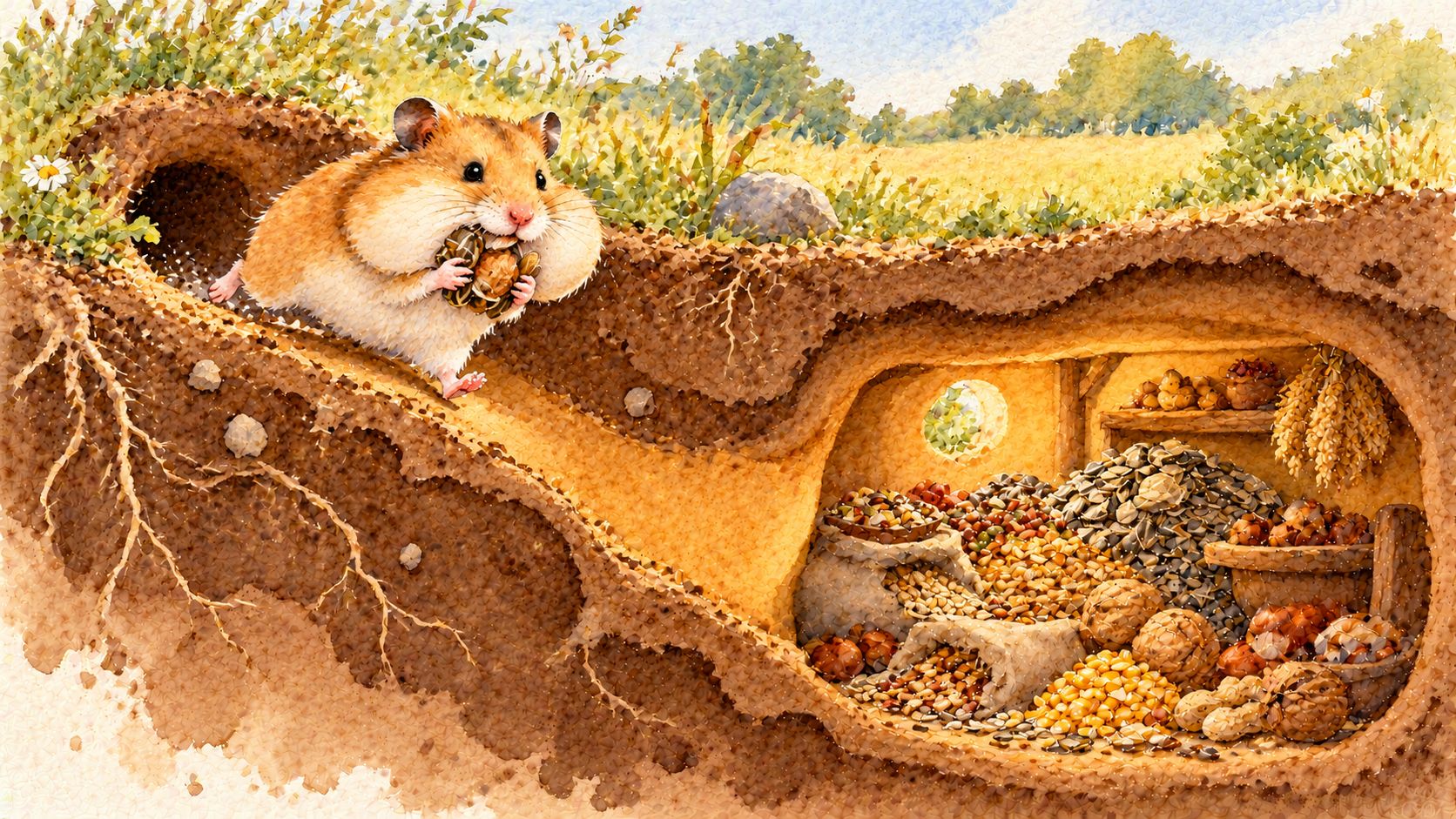
Wild hamsters can store large amounts of food in their burrows to last them through the winter.
Some wild hamsters hibernate in winter, and pet hamsters can become sluggish and drowsy if their room gets too cold.
The tiny Ladakh dwarf hamster lives high in the mountains of Ladakh in northern India.
The European hamster, once common across farmland, is now critically endangered.
Pet hamsters usually live for around two to three years.
Sources and Further Reading
- RSPCA
- Blue Cross
- IUCN Red List of Threatened Species
- Smithsonian Institution
- Encyclopaedia Britannica
- National Geographic
Frequently asked questions
How long do hamsters live?
Pet hamsters usually live for around two to three years.
Can Syrian hamsters live together?
No. Syrian hamsters prefer to live alone and often fight if kept together. Some dwarf hamsters can live in pairs, but they need careful care.
Why do hamsters stuff their cheeks?
Hamsters have stretchy cheek pouches that they use to carry food back to their burrows, where they store it to eat later.
Are hamsters nocturnal?
Hamsters are most active around dusk and during the night, and they sleep for much of the day.
What is the smallest hamster?
The Roborovski hamster is the smallest pet hamster, only about 5 centimetres long.
Where do pet Syrian hamsters come from?
Most pet Syrian hamsters are thought to be descended from a mother and her babies found near Aleppo, Syria, in 1930.