
25 Fun Facts
25 Giraffe Facts: The Tallest Animals on Earth
With their towering necks, long legs and patchwork coats, giraffes are some of the most remarkable animals on the planet. Their bodies are full of clever adaptations that let them reach the treetops and survive on the African savanna.
Here are 25 amazing facts about giraffes, from their super-powered hearts to a giraffe that travelled from Bengal to the court of a Chinese emperor.
Giraffe Facts
Giraffes are the tallest animals on Earth. Adult males can reach around 5.5 metres tall.
Giraffes live in the savannas and woodlands of Africa.
Genetic studies suggest that there are four separate species of giraffe, rather than just one.
A giraffe's legs alone can be about 1.8 metres long, taller than many adult humans.
A giraffe's neck can be around 2 metres long, yet it has only seven neck bones, the same number as humans. Each bone is just much longer.
No two giraffes have exactly the same coat pattern, and calves often inherit pattern features from their mothers.
Both male and female giraffes have horn-like bumps on their heads called ossicones, which are covered in skin and fur.
A giraffe's tongue can be around 45 to 50 centimetres long and is dark blue-black, which may help protect it from sunburn.
Giraffes use their long, tough tongues to pull leaves from thorny acacia trees without getting hurt.
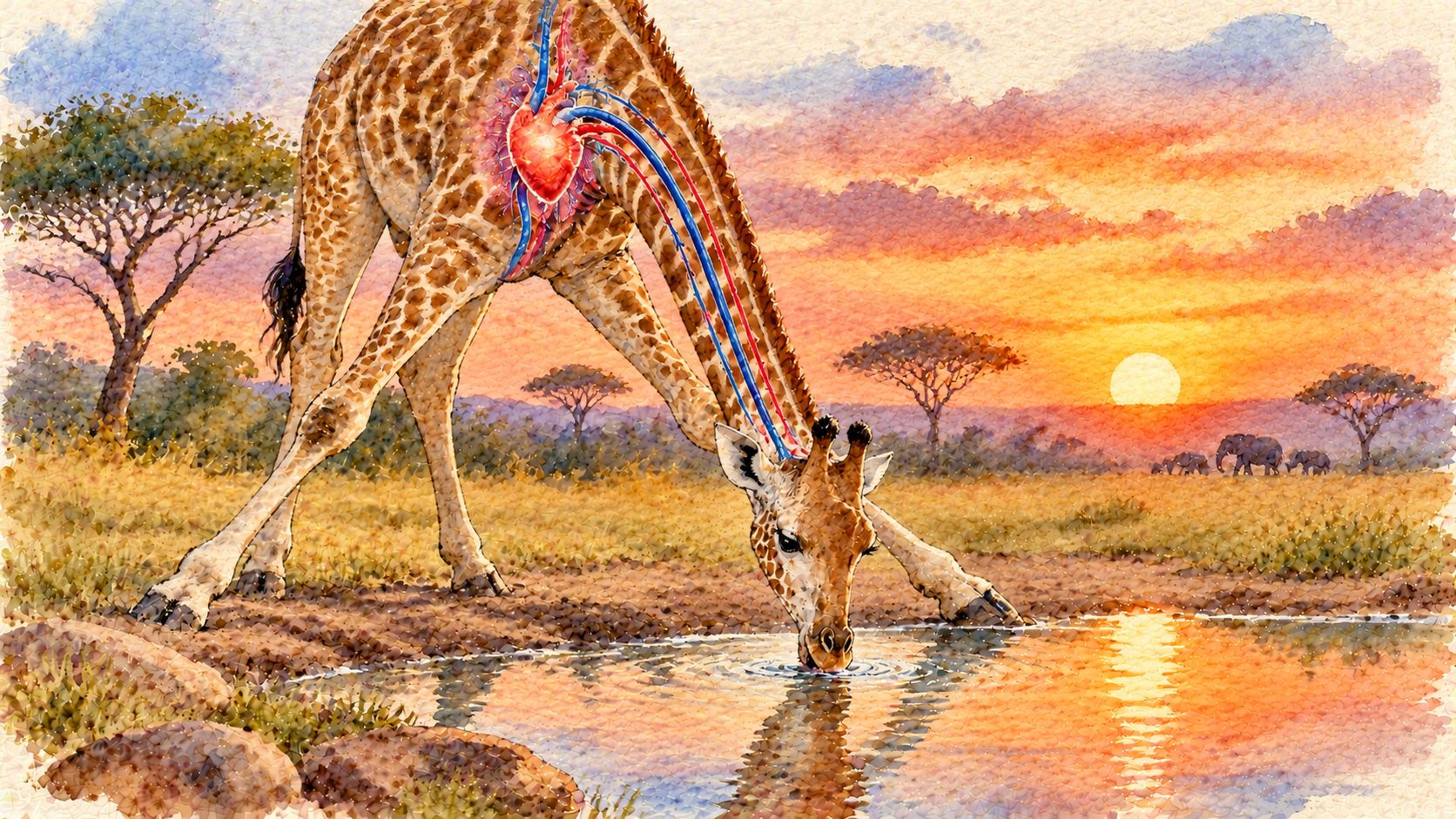
A giraffe's heart weighs about 11 kilograms
Pumping blood all the way up a 2-metre neck to the brain takes a lot of power. A giraffe's heart can weigh around 11 kilograms and is about 60 centimetres long. Its blood pressure is roughly twice as high as a human's. To stop blood rushing to its head when it bends down to drink, a giraffe has special valves in its neck veins. The tight, thick skin on its legs works like compression socks, stopping blood from pooling in its feet.
An adult giraffe can eat more than 30 kilograms of leaves in a day.
Like cows, giraffes are ruminants. They bring up their food and chew it again.
Giraffes get much of their water from the leaves they eat and may go several days without drinking.
To drink, a giraffe has to spread its front legs wide and bend down awkwardly, which leaves it open to predators.
Giraffes sleep very little, often just a few short naps adding up to a few hours a day, sometimes lying down with their necks curled back.
Giraffes are pregnant for about 15 months and give birth standing up, so the calf drops around 1.5 to 2 metres to the ground.
A newborn giraffe is already about 1.8 metres tall and can usually stand up within an hour.
Young giraffes often gather in groups called crèches, watched over by a few adults while the mothers feed nearby.
Male giraffes fight by swinging their necks and banging their heads against each other, which is called necking.
A giraffe once travelled from Bengal to the court of a Chinese emperor
In 1414, the Sultan of Bengal sent an extraordinary gift to the Yongle Emperor of China: a giraffe, originally from East Africa. The giraffe travelled to China with the great Chinese fleet of Admiral Zheng He. When it arrived, people at the Chinese court believed it might be a qilin, a gentle mythical creature thought to appear only in times of peace and wise rule. Court artists painted the giraffe, and its arrival was celebrated as a lucky sign.

A giraffe's kick is so powerful that it can seriously injure or even kill a lion.
Giraffes can run at around 55 to 60 kilometres per hour in short bursts.
Giraffes make soft humming sounds at night, which scientists only discovered in 2015.
The word "giraffe" comes from the Arabic word "zarāfa". The ancient Romans called it "camelopardalis", or "camel-leopard", because it looked like a mix of both.
Africa's giraffe population fell sharply in recent decades, and there are now around 117,000 giraffes in the wild. World Giraffe Day is celebrated every year on 21 June, the longest day of the year.
Sources and Further Reading
- Giraffe Conservation Foundation
- IUCN Red List of Threatened Species
- Smithsonian's National Zoo & Conservation Biology Institute
- San Diego Zoo Wildlife Alliance
- Encyclopaedia Britannica
- National Geographic
Frequently asked questions
How tall is a giraffe?
Adult male giraffes can reach around 5.5 metres tall, making giraffes the tallest animals on Earth.
How many neck bones does a giraffe have?
A giraffe has seven neck bones, the same number as a human. Each bone is just much longer.
Why is a giraffe's tongue dark?
A giraffe's tongue is dark blue-black, which scientists think may help protect it from sunburn while it feeds in the sun.
How do giraffes sleep?
Giraffes sleep very little, usually taking a few short naps that add up to a few hours a day, either standing up or lying down with their necks curled back.
How big is a baby giraffe?
A newborn giraffe is already about 1.8 metres tall and can usually stand within an hour of being born.
Are giraffes endangered?
Giraffe numbers have fallen sharply in recent decades. There are now around 117,000 in the wild, and some types are endangered.