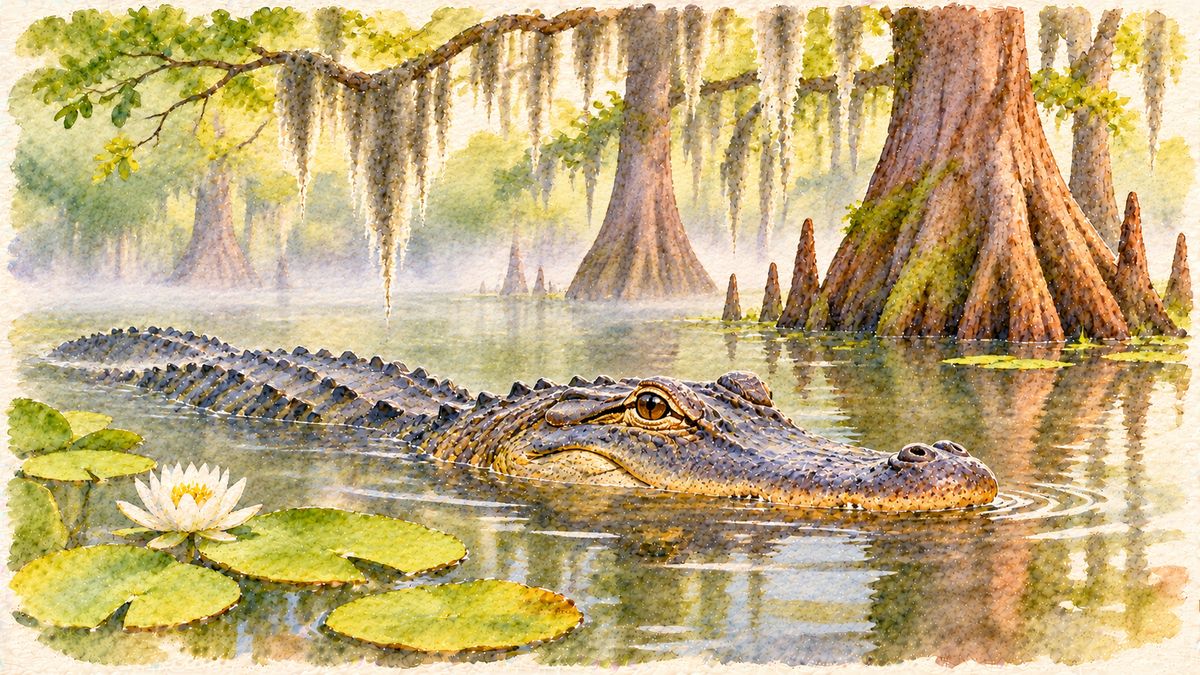
The American alligator is one of the most iconic reptiles in North America. Armored, powerful and nearly unchanged in shape for millions of years, this giant of the southeastern swamps looks like a living dinosaur. It sunbathes on riverbanks, glides silently through black water with only its eyes and nostrils showing, and fills spring nights with deep, rumbling bellows that shake the water into tiny dancing droplets.
It is also one of the great success stories of wildlife conservation. Once hunted close to extinction, the American alligator recovered so well that it is now common across the southeastern United States. In this complete guide, you will learn what an American alligator is, what it looks like, where it lives, what it eats, how it behaves, how it raises its young, how long it lives, how it differs from a crocodile and why it matters so much to wetlands.
Quick answer: The American alligator (Alligator mississippiensis) is a large freshwater reptile native to the southeastern United States. Adult males typically reach 3.4 to 4.6 m (11 to 15 ft) and weigh 230 to 450 kg (500 to 1,000 lb), and the species eats fish, turtles, birds and mammals. It lives about 30 to 50 years in the wild and is listed as Least Concern by the IUCN after a remarkable recovery.
American Alligator at a Glance
| Feature | Details |
|---|---|
| Scientific name | Alligator mississippiensis |
| Class | Reptilia |
| Order | Crocodilia |
| Family | Alligatoridae |
| Size / length | Males typically 11 to 15 feet (3.4 to 4.6 m); females about 8 to 10 feet (2.4 to 3 m) |
| Weight | Males about 500 to 1,000 pounds (230 to 450 kg); females much lighter, often under 300 pounds (135 kg) |
| Lifespan | About 30 to 50 years in the wild; 60 or more in captivity |
| Diet | Fish, turtles, snakes, birds, mammals and invertebrates |
| Habitat | Freshwater swamps, marshes, rivers, lakes and ponds |
| Range | Southeastern United States, from North Carolina to Texas, including Florida and Louisiana |
| Conservation status (IUCN) | Least Concern |
What Is an American Alligator?
The American alligator is one of the world's two living alligator species. The other is the much smaller and rarer Chinese alligator, which lives in the Yangtze River region of eastern China and is Critically Endangered. Alligators belong to the order Crocodilia, along with crocodiles, caimans and gharials, a group of reptiles that has existed for roughly 200 million years in various forms.
Crocodilians are the closest living relatives of birds, which means that the American alligator is more closely related to an eagle than to a lizard or a snake. It is a cold-blooded reptile that depends on the sun to warm its body but shares some surprisingly bird-like traits, such as a four-chambered heart and attentive parental care.
American Alligator vs Crocodile
People often confuse alligators and crocodiles, but there are several easy ways to tell them apart:
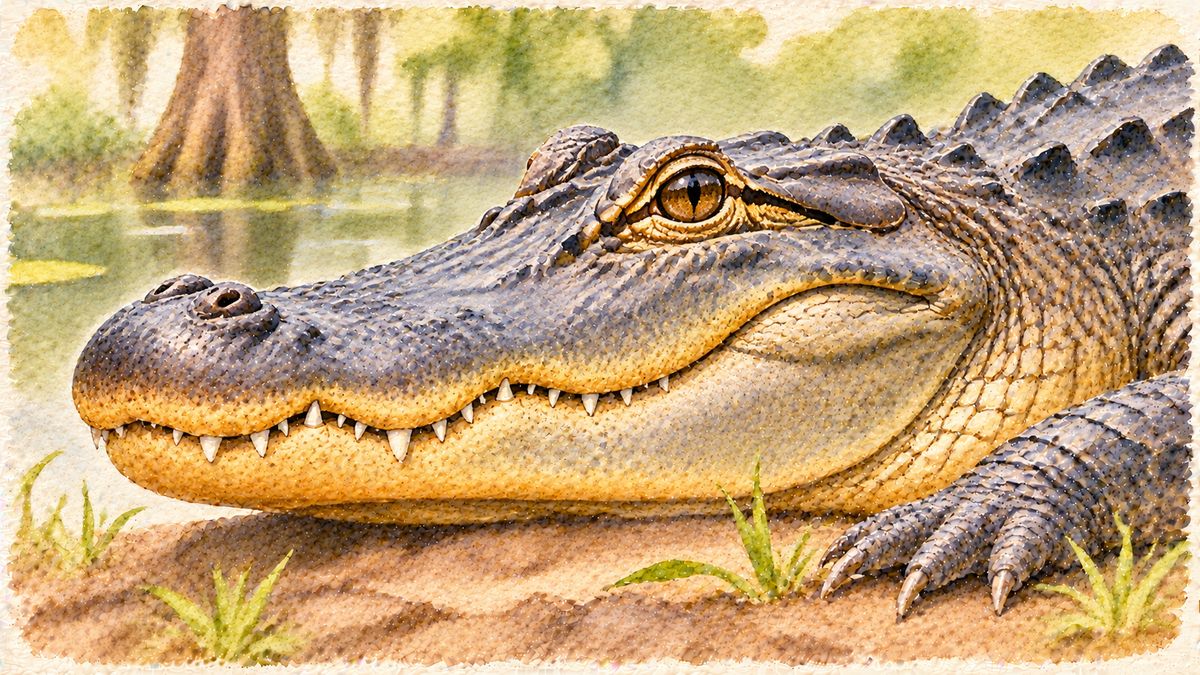
- Snout shape: Alligators have a wide, rounded, U-shaped snout. Crocodiles have a narrower, pointed, V-shaped snout.
- Teeth: When an alligator's mouth is closed, the upper jaw hides most of the lower teeth. In crocodiles, the lower fourth tooth sticks up visibly.
- Color: Alligators are usually dark gray to black. Crocodiles tend to be lighter olive or tan.
- Habitat: Alligators prefer fresh water. Crocodiles tolerate salt water better, thanks to specialized salt glands.
- Temperament: Alligators are generally less aggressive toward people.
Florida is the only place in the world where both the American alligator and the American crocodile live in the wild.
What Does an American Alligator Look Like?
Size and Shape
Adult male alligators typically measure 3.4 to 4.6 meters (11 to 15 feet) long, and the biggest individuals may be larger. Females are smaller, usually 2.4 to 3 meters (8 to 10 feet). Hatchlings are only about 15 to 20 centimeters (6 to 8 inches) long. Males can weigh up to about 450 kilograms (1,000 pounds) or more.
Armor and Color
The skin is thick, rough and covered in bony plates called osteoderms, which form a tough shield along the back. Adults are dark gray, black or olive, which helps them blend into dark water. Young alligators are black with bright yellow bands and stripes, a pattern that fades over several years.
Eyes, Ears and Nose
The eyes, ears and nostrils sit on top of the head, so an alligator can hide almost completely underwater while still seeing, hearing and breathing. Special transparent eyelids called nictitating membranes protect the eyes underwater, and the eyes shine orange or red when a light hits them at night, thanks to a reflective layer behind the retina.
Jaws and Teeth
An adult alligator has around 74 to 80 teeth, which are constantly replaced throughout its life. The bite force is one of the strongest recorded for any living animal, measured at more than 9,000 newtons (about 2,000 pounds per square inch) in studies. Yet the muscles that open the jaws are weak, which is why a person can hold an alligator's mouth shut with a strong rubber band, though no one should ever try it.
Tail
The long, muscular tail makes up about half the animal's length. It is the alligator's main swimming organ, and it can also be used as a powerful weapon.
Where Do American Alligators Live?
American alligators live in the southeastern United States. Their range covers Florida, Louisiana, Georgia, South Carolina, Alabama, Mississippi, parts of North Carolina, eastern Texas, southeastern Oklahoma and southern Arkansas. Florida and Louisiana have the largest populations, each with well over a million alligators.
Habitat
- Swamps and marshes: Slow, shallow, vegetation-filled water.
- Rivers and lakes: Quiet, warm freshwater systems.
- Ponds and canals: Including man-made water bodies such as golf course ponds and drainage ditches.
- Brackish water: They can tolerate some salt for short periods but do not live permanently in the sea.
Gator Holes
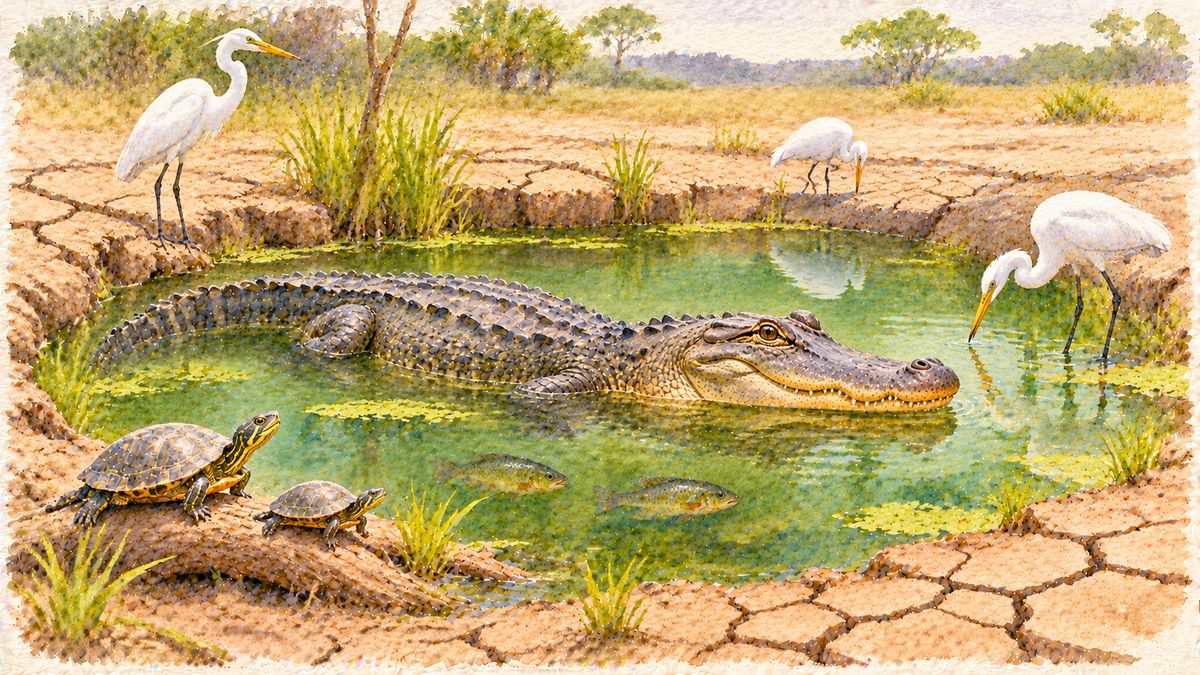
Alligators dig depressions in wetlands called gator holes. These pools hold water even when everything around them dries up, so they become vital refuges for fish, turtles, birds and other animals during droughts.
What Do American Alligators Eat?
The American alligator is an apex predator and an opportunistic feeder. It will eat almost any animal it can catch.
What They Eat by Age
- Hatchlings and juveniles: Insects, snails, small fish, frogs and crayfish.
- Subadults: Larger fish, snakes, turtles and small mammals.
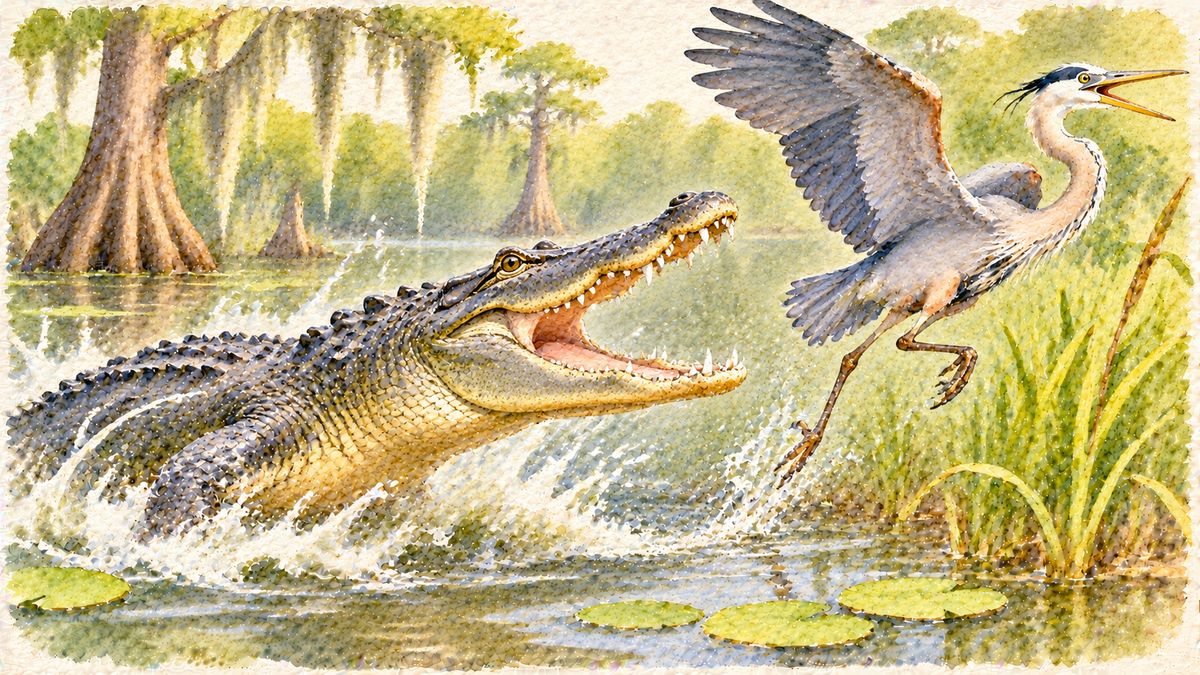
- Adults: Big fish, turtles, wading birds, raccoons, nutria, deer and other large animals, sometimes even smaller alligators.
How They Hunt
Alligators are ambush hunters. They float silently with only their eyes and nostrils above water, then lunge with a sudden burst of speed. They grab their prey and often drag it underwater to drown it. Large prey is twisted apart with a "death roll." Alligators swallow small prey whole and tear large prey into pieces.
Eating Habits
Being cold-blooded, alligators need much less food than mammals of the same size. A large adult can go weeks or even months without eating. When temperatures fall, they eat little or nothing at all.
American Alligator Behavior and Lifestyle
Sunbathing and Temperature
Alligators bask on banks and logs to warm up and cool off in water when it gets too hot. In winter, when temperatures drop, they become sluggish and enter a state called brumation, similar to hibernation. In very cold spells, alligators have been seen sticking only their snouts above the surface of icy water, a behavior known as "icing."
Bellowing and Communication
During the breeding season, adult alligators produce deep, rumbling bellows. These sounds create vibrations that make water on the animal's back "dance." Alligators also hiss, cough and make low sounds, and hatchlings chirp to call their mother.
Solitary but Social
Adults generally live alone, but groups often gather in good basking or feeding areas, and males establish territories during the breeding season. They have a social structure that is more complex than many people realize.
Speed and Movement
On land alligators can sprint for short distances at about 11 to 18 kilometers per hour (7 to 11 miles per hour), though not for long. In water they swim at around 32 kilometers per hour (20 miles per hour) in bursts.
Alligators and People
Alligators usually avoid humans. Attacks are rare compared to the number of people and alligators sharing the same areas, and fatalities are even rarer. Most conflicts happen when alligators lose their fear of people, often because they have been fed. Feeding wild alligators is illegal in many states and is dangerous for everyone.
American Alligator Reproduction and Babies
Courtship and Mating
The breeding season starts in spring. Males bellow, slap their heads on the water and release scents to attract females. Mating occurs in water in late spring.
Building the Nest
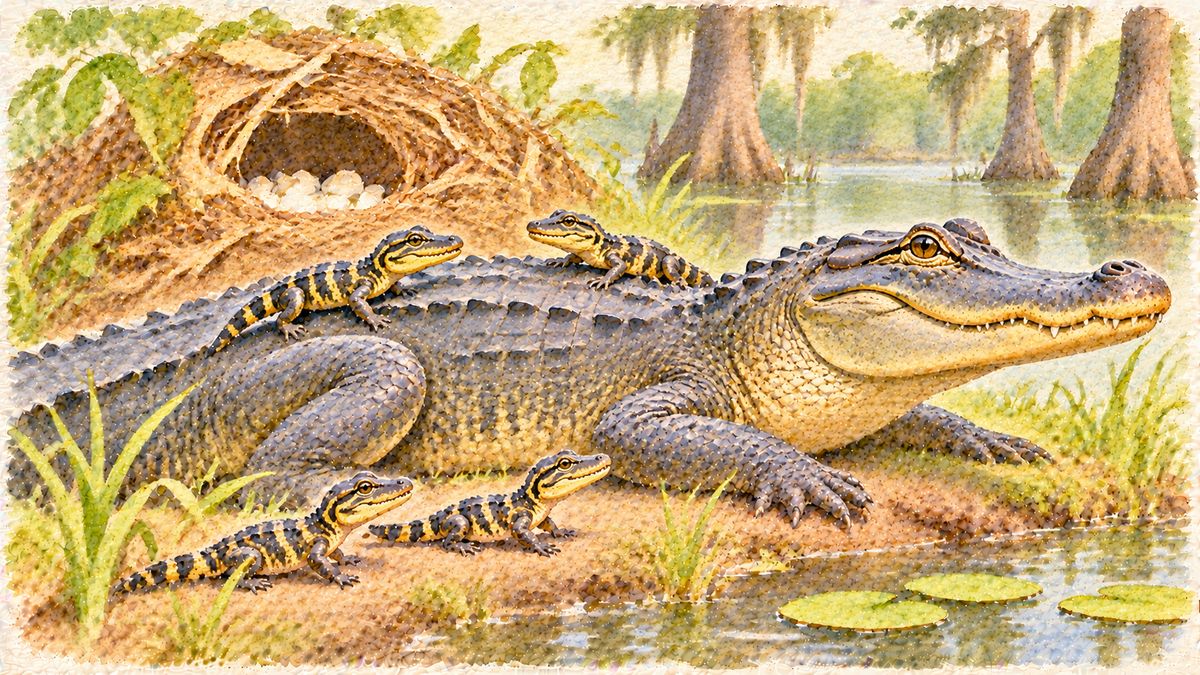
A female builds a large mound nest of vegetation, mud and sticks, usually about 1 meter (3 feet) high and 2 to 3 meters (6 to 10 feet) wide, near water. As the plants rot, they produce heat that keeps the eggs warm.
Eggs and Temperature
She lays about 20 to 50 eggs in early summer. The temperature of the nest decides the sex of the babies, a trait called temperature-dependent sex determination. Cooler nests, below about 30 C (86 F), produce mostly females, while warmer nests, around 32 to 33 C (90 to 91 F), produce mostly males. Mixed temperatures produce both.
Hatching and Maternal Care
After about 65 days, in late summer, the babies begin to chirp inside their eggs. The mother digs the nest open and may carry the hatchlings gently in her mouth to the water. She guards them for months, sometimes up to two years, protecting them from predators.
How Long Do American Alligators Live?
In the wild, American alligators live about 30 to 50 years, and some may live longer. In captivity, they commonly live 50 to 60 years, and some have reached even greater ages. Growth is rapid in the early years, then slows. Females generally reach maturity at about 6 to 10 years or around 1.8 meters (6 feet) long, while males take a little longer.
Predators and Threats
Natural Predators
Eggs and hatchlings face many predators: raccoons, otters, birds, snakes, fish, bobcats and even adult alligators. Fewer than a small share of hatchlings survive to adulthood. Adult alligators have no natural predators except for occasional encounters with large cats such as Florida panthers and, of course, humans.
Human Threats
- Habitat loss: Wetlands are drained for development and agriculture.
- Pollution: Chemicals and metals can affect health and reproduction.
- Road mortality: Alligators crossing roads can be hit by vehicles.
- Climate change: Rising seas, saltwater intrusion and changing temperatures affect nests and habitat.
- Hunting and poaching: Regulated hunting exists, but illegal killing still occurs.
Why American Alligators Are Important
American alligators are called a keystone species, because their activities support many other animals.
- Gator holes: They create pools that shelter fish, turtles and birds in droughts.
- Nest mounds: The old nest mounds are used by turtles and other animals.
- Predator control: They keep populations of fish, turtles and rodents in balance.
- Bird protection: Birds often nest above alligators to take advantage of predator protection from raccoons and snakes.
- Nutrient cycling: Their waste and the remains of prey recycle nutrients in wetlands.
Are American Alligators Endangered?
Not anymore. In the early and mid 20th century, uncontrolled hunting for hides and meat and the loss of wetlands pushed the species close to extinction. The American alligator was listed as endangered in 1967 under US law, and strong protection led to a remarkable comeback. By 1987 it was removed from the endangered list, and today the population is believed to be several million animals. The IUCN lists it as Least Concern.
Today, alligators are managed through regulated hunting, farming and monitoring. The species is still protected under a "similarity of appearance" rule that helps protect threatened crocodilians. Its recovery is considered one of the great successes of the Endangered Species Act, though wetland loss and climate change still need attention.
Fun Facts About American Alligators
- Living fossils: The crocodilian family looks much as it did millions of years ago.
- Temperature decides sex: Nest warmth determines whether hatchlings are male or female.
- Armored skin: Bony plates make the skin tough.
- Water dance: Bellows make the water dance on the alligator's back.
- Sees in the dark: Eyes glow red or orange at night.
- Careful mothers: Females guard nests and carry babies to water.
- Strong bite, weak opening: Closing muscles are very strong, opening muscles are weak.
- Cold survivors: In winter, they stick their snouts above the ice.
- Close to birds: Their closest living relatives are birds.
- Hole diggers: Gator holes help wildlife survive droughts.
Frequently Asked Questions
How big do American alligators get? Adult males typically reach 3.4 to 4.6 m (11 to 15 ft) and weigh 230 to 450 kg (500 to 1,000 lb). Females are smaller.
What do American alligators eat? They eat fish, turtles, snakes, birds and mammals, plus insects and crustaceans when young.
Where do American alligators live? They live in freshwater swamps, rivers, lakes and marshes across the southeastern United States, from North Carolina to Texas.
How long do American alligators live? About 30 to 50 years in the wild, and longer in captivity.
Are American alligators dangerous to humans? They can be, but attacks are rare. Keep a safe distance, never feed them and do not swim in water where they live at dawn, dusk or night.
Are American alligators endangered? No. They recovered from near extinction and are now listed as Least Concern.
Final Thoughts
The American alligator is a survivor in every sense. It has outlived the dinosaurs' other relatives, endured centuries of hunting and rebuilt its numbers thanks to protection and wetland conservation. It is feared and admired in equal measure, but it is also a guardian of the swamps, a builder of pools in droughts and a symbol of how people can help wildlife recover. By protecting wetlands and respecting these reptiles, we make sure the bellow of the alligator continues to echo through the southern spring.