Walk along a sunny wall in West or Central Africa and you are likely to meet an agama lizard. Perched on a rock or a rooftop, nodding its head and doing what looks like push-ups, a male agama is hard to miss, with his bright orange head, deep blue body and long, banded tail. These lively reptiles are among the most common and recognizable lizards in Africa, and they are just as comfortable in villages and cities as they are in open savanna.
The agama lizard is also a fascinating study in color and social life. Males defend territories, bob their heads to send signals and change color depending on temperature and mood. In this complete guide, you will learn what an agama lizard is, how to recognize one, where it lives, what it eats, how it behaves, how it breeds and why it is such an important part of the African landscape.
Quick answer: The agama lizard, best known as the common agama (Agama agama), is a medium-sized, ground- and rock-dwelling lizard from sub-Saharan Africa. Adults grow to roughly 25 to 30 cm (10 to 12 in) in total length, eat mostly insects such as ants and termites, and live in colonies led by a dominant male. Breeding males show a bright orange-red head and blue body, and the IUCN lists the species as Least Concern.

Agama Lizard at a Glance
| Feature | Details |
|---|---|
| Scientific name | Agama agama (common agama); the genus Agama has many species |
| Class | Reptilia |
| Order | Squamata |
| Family | Agamidae |
| Total length | About 10 to 12 inches (25 to 30 cm), with some males longer |
| Weight | Roughly 1 to 3.5 ounces (30 to 100 grams) |
| Lifespan | Around 5 to 10 years, perhaps longer in captivity |
| Diet | Mainly insects, especially ants and termites; also some plant material |
| Habitat | Savanna, scrub, rocky areas, farmland, towns and villages |
| Range | West and Central Africa, with related agamas across much of Africa |
| Activity | Diurnal (active in daytime) |
| Conservation status | Least Concern (IUCN) |
What Is an Agama Lizard?
An agama lizard is a member of the genus Agama, a large group of lizards found across Africa. The most familiar species is the common agama (Agama agama), also known as the rainbow agama or the red-headed rock agama. The name "agama" is often used loosely for several related species, which scientists have been reclassifying as new studies appear. Many of the agamas once grouped together under Agama agama are now treated as separate species.
Agamas belong to the family Agamidae, a group of Old World lizards that also includes bearded dragons, water dragons and frilled lizards. Like their relatives, they have strong legs, a stout body, a large head and a long tail.
Where Does the Name Come From?
The name "agama" is thought to come from a word used for lizards in Carib languages of the Caribbean, which was later applied by early naturalists to similar lizards. In many African countries, agamas also have local names and are a familiar sight around houses and compounds.
What Does an Agama Lizard Look Like?
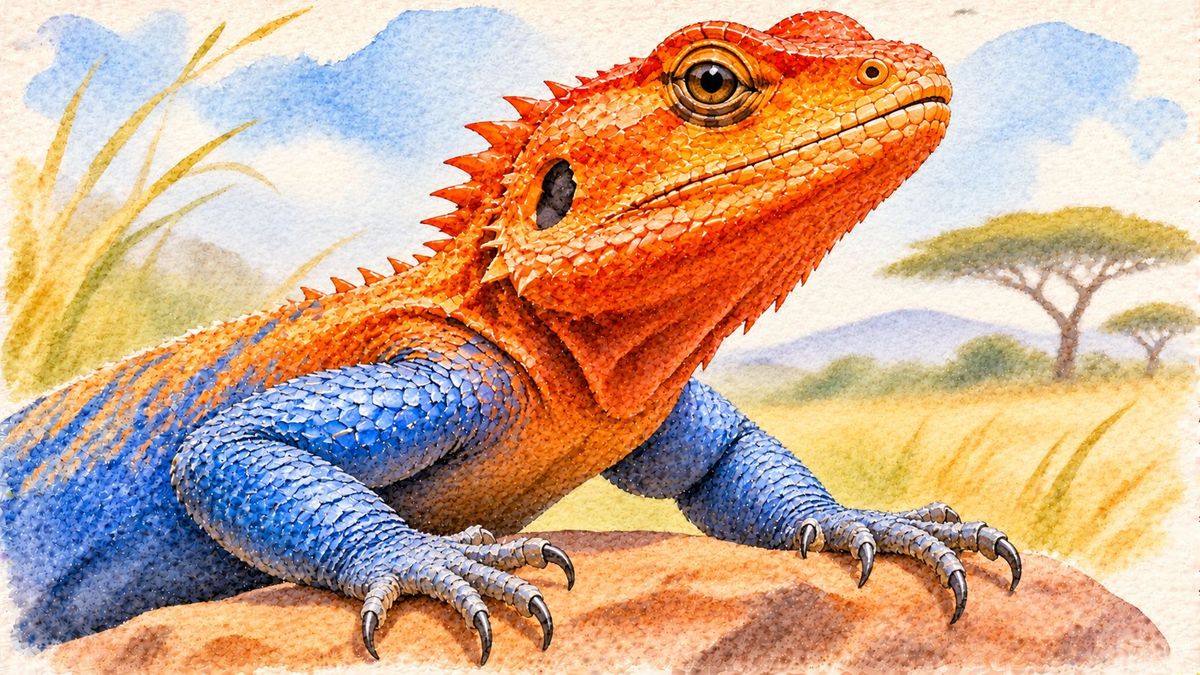
Agamas are stocky, flat-headed lizards with a rugged look, and the males are strikingly colorful.
Size and Shape
A typical adult common agama measures about 25 to 30 cm (10 to 12 in) from snout to tail tip, with the tail making up about half of the length. Males are usually larger and bulkier than females. The body is slightly flattened, and the head is broad and triangular, with a thick neck.
The Male's Colors
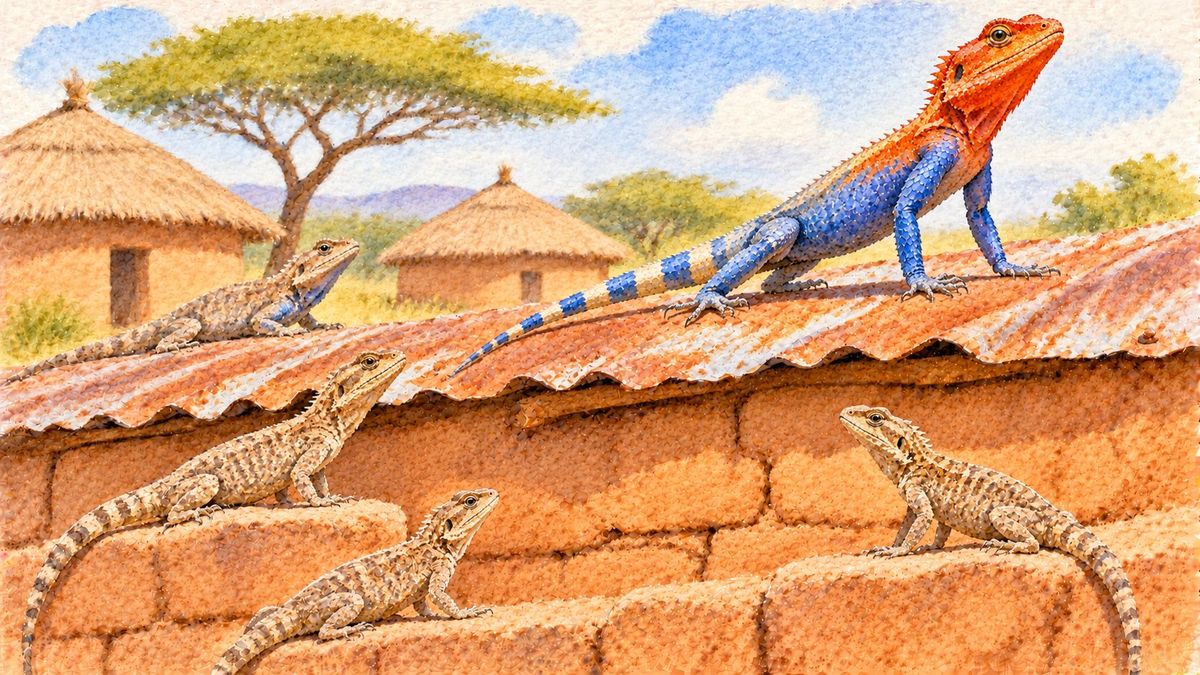
During the breeding season, the dominant male's color can change dramatically. His head and neck turn bright orange, red or yellow, while his body is deep blue or purplish and his tail is banded with white or yellow. This high-contrast pattern is used to signal dominance to other males and to attract females. When the lizard is cold or stressed, the colors fade to a dull gray-brown.
Females and Young Males
Females and young males are much less colorful. They are usually brown or olive-gray, often with a pattern of lighter spots or blotches on the back. Some females develop orange or reddish patches along the sides when they are carrying eggs. Their duller color helps them hide from predators.
Scales and Tail
The skin is covered in rough, overlapping scales, and there are pointed scales on the neck and sides of the head. The tail is long and slender, and it helps with balance when the lizard runs or climbs. The strong claws allow it to grip rock, bark and walls.
Where Do Agama Lizards Live?
Agama lizards live across much of sub-Saharan Africa. The common agama is especially widespread in West and Central Africa, and other agama species live from the Sahel to southern Africa and parts of East Africa.
Their favorite habitats include:
- Savanna and open woodland
- Dry scrub and rocky outcrops
- Farmland and fields
- Villages and towns, where walls, roofs and fences offer perches and shelter
- Beaches, roadsides and ruins
Agamas like warm, sunny places with plenty of rocks, walls or trees to climb. These give them lookout points, places to bask and shelter at night. Because they use buildings so readily, they are one of the few lizards that have adapted well to life in human communities.
Do Agamas Live Outside Africa?
Yes, in a few places. A close relative of the common agama, known as the Peters' rainbow agama, has become established in parts of southern Florida in the United States, where it is considered an introduced species. In Africa, however, agamas are native and valued members of the local wildlife.
What Do Agama Lizards Eat?
Agamas are mostly insect eaters, though they are opportunistic and will eat a variety of foods.
Main Foods
The diet of the common agama includes:
- Ants, which are often their favorite food
- Termites, especially during swarming season
- Beetles and grasshoppers
- Flies and other small insects
- Spiders and other small invertebrates
Other Foods
Agamas also eat some plant matter and other items, including:
- Seeds, flowers and fruits
- Small lizards and the young of other reptiles, occasionally
- Scraps of human food around homes
How They Hunt
Agamas are sit-and-wait predators. A lizard watches from a perch, then darts out quickly to grab prey in its mouth and returns to its lookout. They have good eyesight, and their quick reflexes make them effective hunters of small, fast-moving insects. Termite swarms after rain can produce a feast, and the lizards will gather in large numbers.
Do Agamas Drink Water?
Agamas get much of their moisture from their food, but they will drink water from rain, dew and puddles when they can.

Agama Lizard Behavior and Lifestyle
Basking and Temperature Control
Like all reptiles, agamas are cold-blooded, so they depend on the environment for body heat. They begin the day by basking in the morning sun to warm up. Once warm, they become active, hunting and defending their patch. During the hottest hours they may retreat to shade, and at night they hide in cracks, holes or under bark.
Colonies and Social Life
Agamas live in social groups. A typical colony includes one dominant male, several females and a few younger or lower-ranking males. The dominant male occupies the best perch, often a high rock or wall, from which he can watch his territory and signal to rivals.
Push-Ups and Head Bobbing
The most famous behavior of the agama is its head-bobbing display. Males bob their heads up and down, and may do push-ups with their front legs, to show strength and warn rivals. They also puff up their throats and display their colors. Sometimes rival males will chase and fight, but most disputes are settled by display.
Color Change
Agamas can change the intensity of their colors in a matter of minutes. This is partly controlled by temperature and partly by mood or social rank. A dominant male is at his brightest when warm and confident, while a subordinate male often stays dull and brown to avoid conflict.
Communication
Besides visual signals, agamas use body posture, tail movements and scent. They are generally silent, although some can produce a hiss when threatened.
Agama Lizard Reproduction and Babies
Breeding in agamas is closely linked to the seasons, and many populations breed during or just after the wet season, when insects are plentiful. The dominant male mates with several females in his colony.
After mating, the female digs a small hole in soft, warm soil and lays a clutch of eggs, typically around five to ten, although the number varies with her size and the species. She then covers them and leaves. The eggs incubate in the warm soil for roughly two months, depending on temperature, and the young hatch fully formed.
Newly hatched agamas are small, brown and look like miniature versions of the females. They must find food and avoid predators from day one. The young grow quickly and become adults in about a year or two. Males often take a few years to become dominant.

How Long Do Agama Lizards Live?
In the wild, agamas typically live around five to ten years, although many die young because of predators. In captivity, with good care, they may live longer. Exact lifespan depends on the species and the environment.
Predators and Defense
Agama lizards are food for many other animals, including:
- Snakes
- Birds of prey such as kestrels and buzzards
- Monitor lizards
- Hornbills, shrikes and other large birds
- Small carnivores such as mongooses and genets
To avoid becoming a meal, agamas rely on a few defenses:
- Alertness: Their sharp eyesight lets them spot danger early.
- Speed: They dash to a crack in a rock, a hole or a wall.
- Camouflage: Duller colors, especially in females and young, help them blend in.
- Squeezing into crevices: They can wedge into narrow cracks, making it hard for predators to pull them out.
- Biting and tail whipping: When cornered, they may bite or lash their tail.
Why Agama Lizards Are Important
Agamas may look like simple wall-dwellers, but they play a useful part in African ecosystems.
- Insect control: They eat huge numbers of ants, termites, beetles and other insects, which helps keep populations in balance.
- Food for predators: They are an important food source for snakes, birds and mammals.
- Neighbors to people: Their presence around homes means fewer pest insects, and they are often tolerated and even welcomed.
- Cultural value: In many parts of Africa, agamas appear in stories, sayings and traditions.
- Scientific value: Their social behavior, color signals and adaptation to cities make them great subjects for researchers.
Are Agama Lizards Endangered?
The common agama is not considered threatened and is listed as Least Concern by the IUCN. It is widespread, abundant and very adaptable. Other agama species may have smaller ranges and different conservation needs, so it is always worth checking the status of the specific species.
Local threats to agamas include:
- Habitat loss from the expansion of farmland and cities
- Pesticides, which reduce their insect food and can poison them
- Collection for the pet trade in some places
- Persecution by people who mistakenly fear lizards
Fortunately, because agamas can live in towns and gardens, they generally cope better with human activity than many other reptiles.
Fun Facts About Agama Lizards
- Males are brilliantly colored. An orange-red head with a blue body is the classic look.
- They do push-ups. The head-bobbing display is a signal to rivals and mates.
- They change color. Warmth, mood and social rank all affect their shades.
- They live in colonies. One dominant male typically rules a group.
- They love ants. Ants and termites make up a big part of their diet.
- They thrive near people. Walls, roofs and gardens are good agama habitat.
- They are cold-blooded. Basking helps them warm up each morning.
- They are related to bearded dragons. Both belong to the family Agamidae.
Frequently Asked Questions
What is an agama lizard? An agama lizard is a medium-sized African lizard in the genus Agama. The best-known species, the common agama (Agama agama), is famous for the bright orange head and blue body of breeding males.
What do agama lizards eat? They eat mainly insects such as ants, termites, beetles and grasshoppers, and occasionally seeds, flowers, small lizards and food scraps.
Why do agama lizards do push-ups? Males do push-ups and head bobs to show strength, defend territory and attract females. It is a form of visual communication.
Are agama lizards poisonous or dangerous? No. Agamas are not venomous and are harmless to people. They may bite if handled roughly, but they usually run away.
Where do agama lizards live? They live across much of sub-Saharan Africa in savanna, scrub, rocky areas, farmland and towns, often basking on walls and rocks.
Are agama lizards endangered? The common agama is listed as Least Concern and is widespread. Some other agama species have smaller ranges and may be more vulnerable.
Final Thoughts
The agama lizard is one of Africa's great everyday wildlife sights. With its blazing colors, push-up displays and fearless way of living beside people, it brings a splash of life to rocks, walls and rooftops across the continent. Watching an agama bask in the morning sun is a small but memorable reminder that wildlife can thrive in the places we share with it.