The albino corn snake is one of the most popular and recognizable pet snakes in the world. With its glowing orange, red and pale yellow-white pattern, it looks like a living sunset, and its gentle nature makes it a favorite for beginner and experienced keepers alike. Despite the name, however, the albino corn snake is not a separate species. It is a color morph of the common corn snake, a harmless constrictor native to the United States.
In this complete guide, you will learn what an albino corn snake really is, how the albino trait works genetically, what the snake looks like, how big it grows, how to set up its enclosure, what to feed it, how long it lives and whether it makes a good pet. We will also look at the wild corn snake it comes from and the many other colors that can be produced from the albino gene.
Quick answer: The albino corn snake is a captive-bred color morph of the corn snake (Pantherophis guttatus) that lacks black pigment (melanin), leaving only reds, oranges and yellows on a pale background. It grows to about 3 to 5 feet (0.9 to 1.5 m), eats mice and rats, and can live 15 to 20 years or more in captivity. The albino trait is recessive, and the corn snake species is Least Concern in the wild.
Albino Corn Snake at a Glance
| Feature | Details |
|---|---|
| Scientific name | Pantherophis guttatus (albino or amelanistic morph) |
| Class | Reptilia |
| Order | Squamata |
| Family | Colubridae |
| Morph | Albino (amelanistic), a recessive color mutation |
| Adult length | About 3 to 5 feet (0.9 to 1.5 m), sometimes a little longer |
| Weight | About 1 to 3 pounds (0.45 to 1.4 kg) |
| Lifespan | Commonly 15 to 20 years in captivity, sometimes longer |
| Diet | Frozen-thawed mice and small rats in captivity |
| Habitat | Captive-bred; the wild species lives in woodlands, fields and farmland |
| Native range of the species | Southeastern and central United States |
| Temperament | Docile, non-venomous, good for beginners |
| Conservation status | Corn snake: Least Concern (IUCN) |
What Is an Albino Corn Snake?
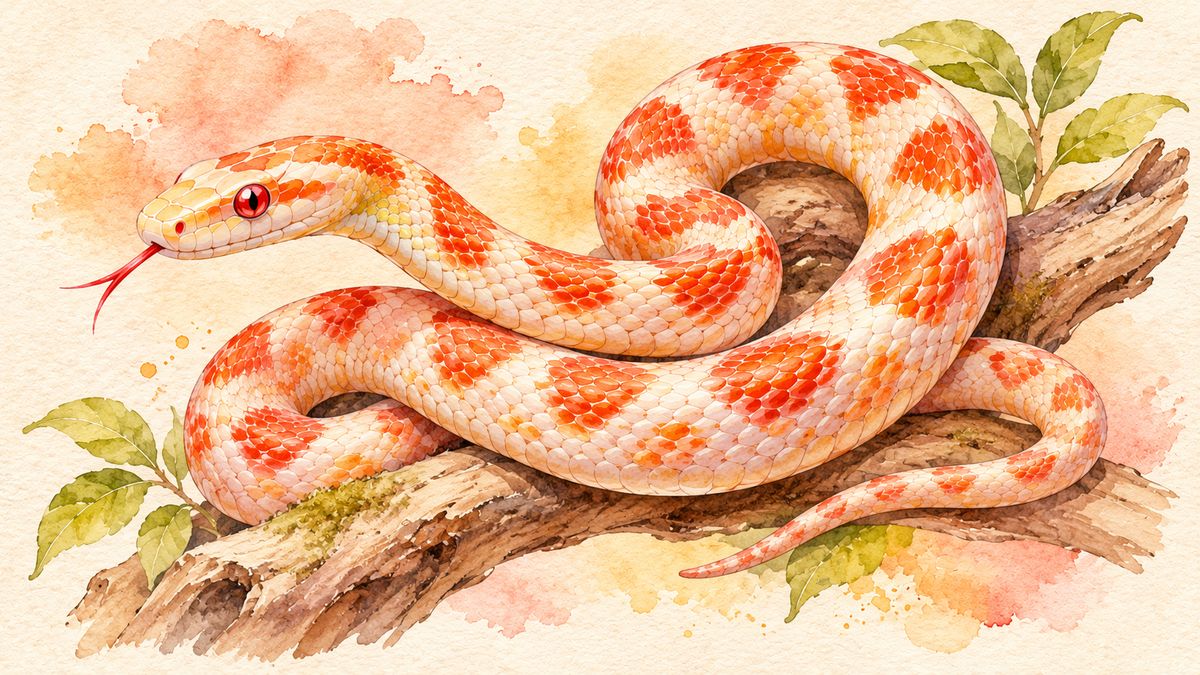
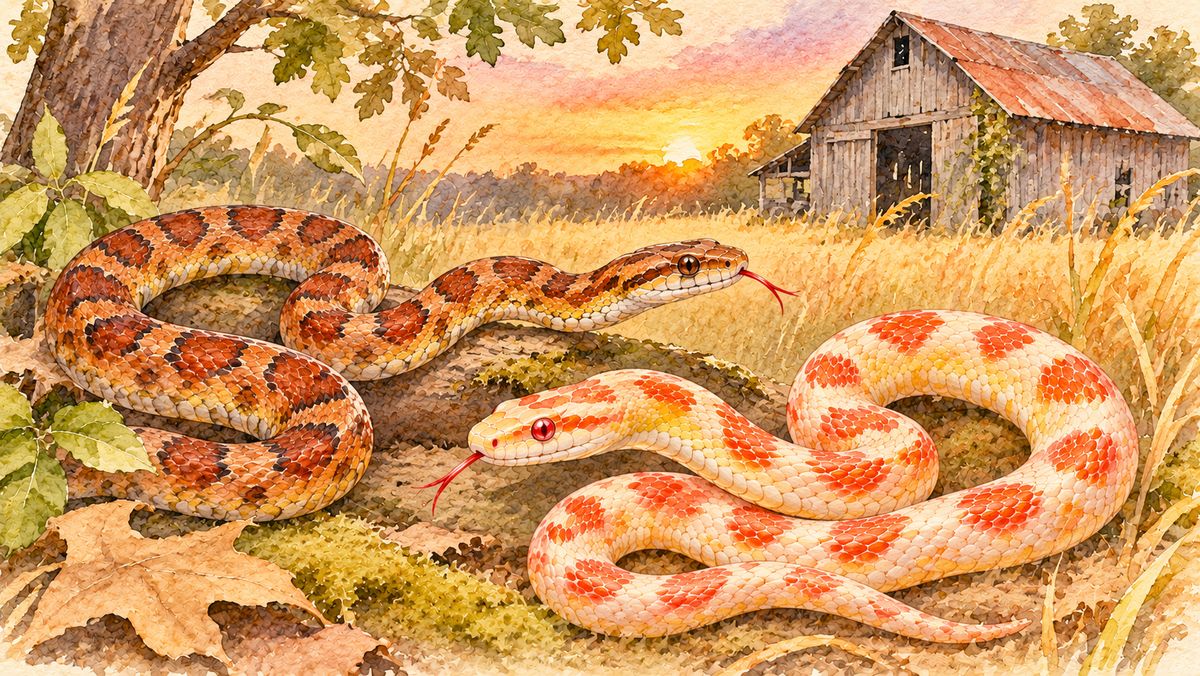
An albino corn snake is a corn snake that has a genetic mutation preventing it from producing melanin, the dark pigment that gives most animals their black and brown colors. Without melanin, the snake's patterns appear in the remaining pigments, which are red, orange and yellow. The result is a bright, warm-toned snake with a white, pale pink or yellowish background, rich orange or red blotches on the back and a bright orange to reddish belly pattern.
The correct genetic term is amelanistic, often shortened to "amel." Snake breeders usually call it "albino" for convenience, but true albinism in the strict biological sense (the absence of all pigment) is not what these snakes have. They still produce other pigments, which is why they remain colorful.
Albino corn snakes are not found in the wild in large numbers. A snake with this mutation would stand out to predators and might struggle to survive, so the morph is largely a captive-bred creation. Breeders have built entire lines of albino corn snakes by pairing animals that carry the trait.
What Does an Albino Corn Snake Look Like?
Color and Pattern
The classic albino corn snake has:
- A pale background of white, cream or pinkish tones
- Large, bright orange to red saddle-shaped blotches down the back, usually outlined in white or pale yellow
- Smaller blotches along the sides
- A checkerboard belly of red, orange and white in some animals
- A spear-shaped mark on top of the head, much like the wild corn snake
Because there is no black outlining, the pattern looks soft and glowing. Colors can vary considerably between individual snakes and bloodlines. Some are intensely red-orange, while others are pale with peachy tones.
Eyes
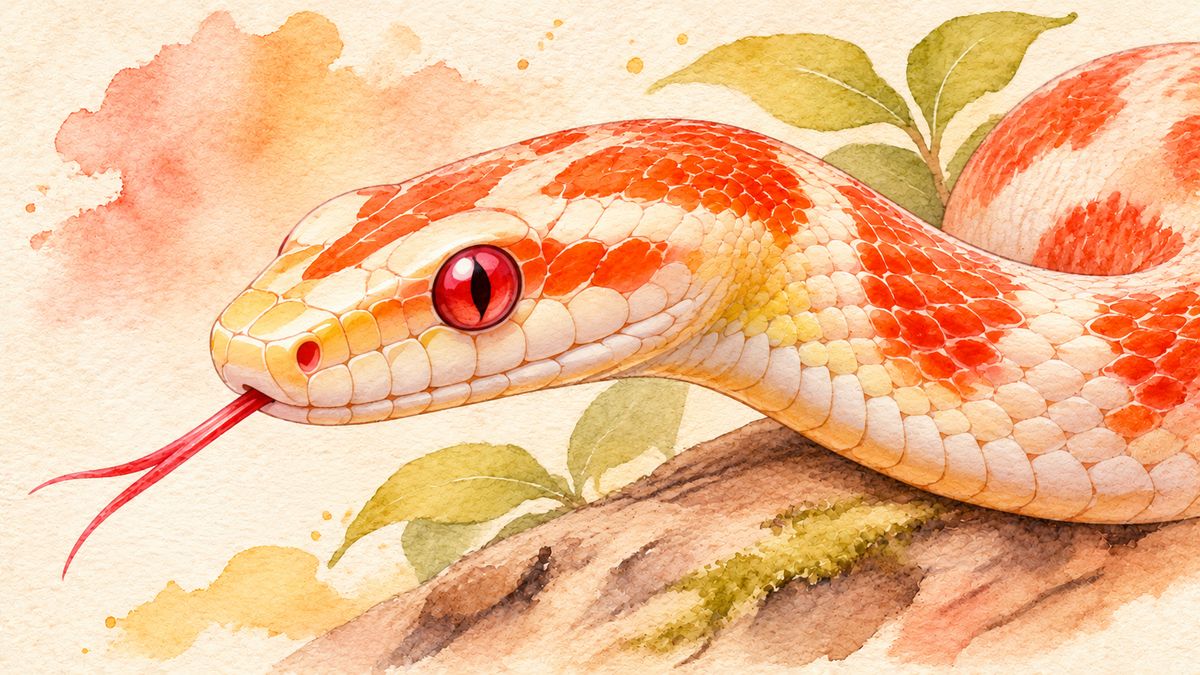
Albino corn snakes usually have eyes that look pink or red-toned, in contrast to the dark eyes of normal corn snakes, because of the lack of dark pigment. Some keepers find that albino snakes can be more sensitive to bright light, so they prefer to provide plenty of dim hiding places.
Size and Shape
Adults are slender, muscular and smooth-scaled, with a body that is slightly flattened on the underside. Hatchlings are about 8 to 12 inches (20 to 30 cm) long. Most adults reach 3 to 5 feet (0.9 to 1.5 m), with some exceeding 5 feet. Males tend to be slightly larger than females.
How Does the Albino Gene Work?
Albinism in corn snakes is a simple recessive trait. This means a snake needs two copies of the albino gene, one from each parent, to look albino. A snake with only one copy is called a heterozygote (or "het") and looks like a normal corn snake while carrying the gene.
Here are some basic breeding outcomes:
- Albino x albino: all babies are albino.
- Albino x normal (non-carrier): all babies look normal but carry one copy of the albino gene (100 percent het).
- Albino x het albino: about half the babies are albino and half are het.
- Het x het: about 25 percent of babies are albino, 50 percent are het and 25 percent are normal.
The albino gene can also be combined with other color mutations to produce an incredible range of morphs, such as:
- Snow corn snake: albino plus anerythristic (lacking red pigment), giving a white or pale yellow snake with little pattern
- Blizzard corn snake: albino plus charcoal, producing a nearly pure white snake
- Many other lines: breeders also combine albino with other color and pattern genes to produce a wide variety of pale and bright morphs
Where Do Corn Snakes Live?
The wild corn snake (Pantherophis guttatus) lives in the southeastern and south-central United States, from New Jersey south to Florida and west to Louisiana, with its range extending into some neighboring states. It is found in pine forests, hardwood woodlands, rocky hillsides, farmland and even around old barns, where it hunts mice and rats. The name "corn snake" probably comes from its frequent presence around corn storage buildings, where it eats rodents, though some say it refers to the corn-like pattern on its belly.
The albino morph has been bred in captivity for decades. Today, most pet corn snakes in the world were born in captivity, which makes them hardy and used to handling.
Is the Albino Corn Snake a Good Pet?
Yes, albino corn snakes are among the best pet snakes for beginners.
- Docile: Corn snakes are calm and rarely bite, especially when handled gently from a young age.
- Non-venomous: They are constrictors, not venomous snakes.
- Hardy: They tolerate a range of conditions as long as basic care is correct.
- Manageable size: They do not grow as large as pythons or boas.
- Easy to feed: They readily take frozen-thawed rodents.
- Long-lived: They can be companions for 15 to 20 years or more.
Keep in mind that corn snakes are escape artists. Their enclosures must be secure with a locking lid, since they can squeeze through small gaps.
Albino Corn Snake Care Guide
Enclosure Size
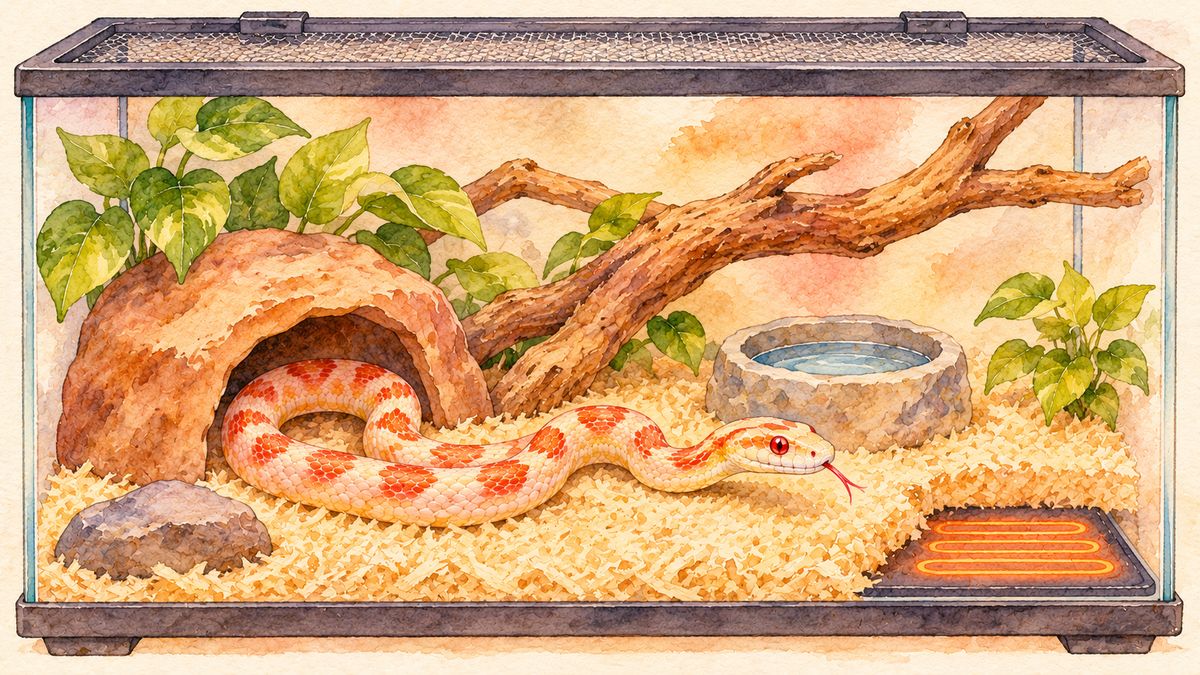
Hatchlings can start in a small enclosure or tub of about 10 gallons (40 L), but adults need a larger home. A 40-gallon breeder tank (about 150 L) or a similar sized enclosure is a common adult setup, with more room being even better. The enclosure should have a secure lid and good ventilation.
Temperature and Heating
Corn snakes are cold-blooded and need a temperature gradient so they can regulate their body temperature:
- Warm side: about 82 to 85 degrees Fahrenheit (28 to 29 degrees Celsius)
- Basking spot: around 85 to 88 degrees Fahrenheit (29 to 31 degrees Celsius) at most
- Cool side: about 70 to 75 degrees Fahrenheit (21 to 24 degrees Celsius)
- Night: a slight drop is fine, typically down to the low 70s Fahrenheit (about 21 to 23 degrees Celsius)
Use an under-tank heat mat or a ceramic heat emitter controlled by a thermostat, and always check temperatures with reliable thermometers. Never use hot rocks, which can cause burns.
Humidity
Aim for moderate humidity of about 40 to 60 percent. Raise it slightly during shedding by offering a humid hide, such as a box filled with damp moss.
Substrate and Hides
Good substrates include aspen shavings, cypress mulch or paper-based bedding. Avoid cedar and pine shavings, which can irritate or harm snakes. Provide at least two hides, one on the warm side and one on the cool side, plus branches or décor for climbing and security. A water bowl large enough for soaking should always be available.
Lighting
Corn snakes are mostly active at dusk and night, and many do well without special lighting. A normal day-night cycle is helpful. Because albino snakes may be more sensitive to bright light, avoid strong, direct lighting and make sure there are many dark, covered areas.
What Do Albino Corn Snakes Eat?
Corn snakes are carnivores and, in the wild, eat mostly rodents, as well as birds, eggs, frogs and lizards. Pet corn snakes are fed pre-killed rodents.
Feeding Schedule
- Hatchlings: pinky mice, once every 5 to 7 days
- Juveniles: fuzzy and hopper mice, every 7 days
- Adults: adult mice or small rats, about every 10 to 14 days
The prey should be roughly as wide as the thickest part of the snake's body. Frozen-thawed prey is safer than live prey because live rodents can injure the snake. Always thaw prey fully and warm it to room temperature or slightly above before offering it with feeding tongs. Avoid handling the snake for a day or two after a meal to reduce the chance of regurgitation.
Handling and Temperament
Albino corn snakes are well known for their gentle nature. Young snakes may be nervous or quick at first, but regular, calm handling helps them settle down. Support the body and avoid sudden movements. Wash your hands before and after handling, and do not handle a snake that is shedding or has just eaten.
Albino Corn Snake Breeding and Babies
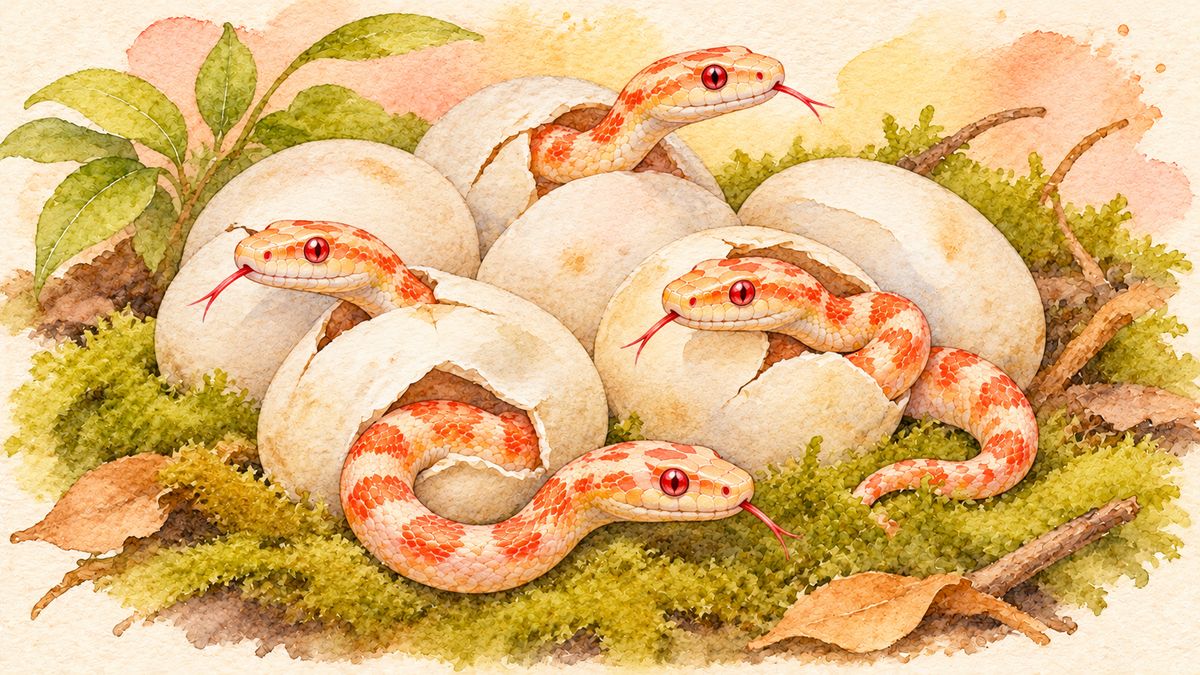
Corn snakes usually mature at around 18 months to three years of age, depending on size and condition. Breeding often follows a cooling period known as brumation, which mimics winter. Females lay a clutch of about 10 to 30 eggs, usually in late spring or summer, around a month after mating. The eggs are incubated at about 80 to 82 degrees Fahrenheit (27 to 28 degrees Celsius) and hatch after roughly 60 days.
Hatchlings emerge with a slit in the shell and are independent right away. They shed their skin for the first time within about one to two weeks and start feeding soon after.
How Long Do Albino Corn Snakes Live?
With good care, albino corn snakes typically live 15 to 20 years in captivity, and a few have lived longer. In the wild, corn snakes face predators, accidents and disease, so their average lifespan is shorter.
Health Concerns
Albino corn snakes are generally healthy, but some common issues include:
- Respiratory infections: often caused by cold or damp conditions
- Mites: tiny parasites that appear as black or red specks and cause rubbing and irritation
- Retained shed: often a sign of low humidity
- Mouth rot (stomatitis): a bacterial infection that needs veterinary care
- Obesity: from overfeeding
The albino gene itself does not generally cause major health problems, though sensitivity to bright light is possible. Use a reptile-experienced veterinarian if you notice changes in feeding, breathing, weight or behavior.
Are Albino Corn Snakes Endangered?
No. The corn snake is listed as Least Concern by the IUCN. Wild populations are widespread across the southeastern United States, though they can be affected by habitat loss, road mortality and people killing them by mistake because they resemble venomous snakes. Because albino corn snakes are captive-bred, owning one does not harm wild populations.
Fun Facts About Albino Corn Snakes
- Not truly albino: They are amelanistic, meaning they lack black pigment but not all color.
- Recessive trait: The snake must inherit the gene from both parents to look albino.
- Beginner favorite: Corn snakes are among the most popular pet snakes in the world.
- Constrictors: They kill small prey by squeezing it.
- Escape artists: They can slip through very small gaps.
- Many morphs: Hundreds of color variations exist, many built on the albino gene.
- Helpful pest control: In the wild, corn snakes eat large numbers of rodents.
- Mistaken identity: Corn snakes are often confused with copperheads, though they are harmless.
- Long lives: They can live for two decades in captivity.
Frequently Asked Questions
Is an albino corn snake really albino? Not strictly. Albino corn snakes are amelanistic, which means they lack black and brown melanin but still have red, orange and yellow pigments.
How big do albino corn snakes get? Most adults grow to about 3 to 5 feet (0.9 to 1.5 m) long and weigh roughly 1 to 3 pounds (0.45 to 1.4 kg).
Are albino corn snakes venomous or dangerous? No. Corn snakes are non-venomous constrictors and are generally docile. A bite is uncommon and is usually minor.
What do albino corn snakes eat? In captivity, they eat frozen-thawed mice and small rats, fed every 7 to 14 days depending on age and size.
How long do albino corn snakes live? With good care, they commonly live 15 to 20 years in captivity.
Are albino corn snakes good for beginners? Yes. They are hardy, calm, manageable in size and easy to feed, which makes them an excellent first snake.
Final Thoughts
The albino corn snake brings together everything people love about corn snakes: a gentle temperament, simple care and a spectacular color pattern that glows in shades of orange, red and cream. Understanding that this snake is a color morph of a common native species, and learning how its recessive gene works, makes it even more fascinating. With a secure enclosure, correct temperatures, regular meals and gentle handling, an albino corn snake can be a rewarding companion for many years.