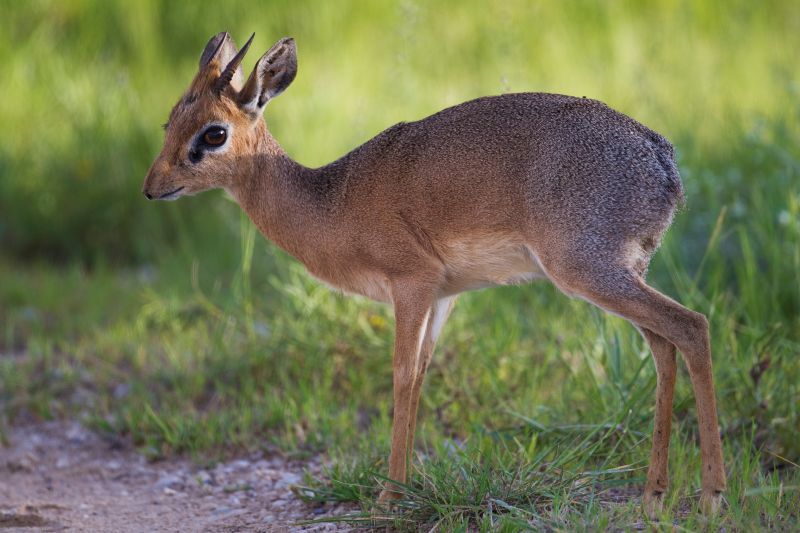
Dik-diks are among the smallest and most charming antelopes in the world. These tiny African animals, often no bigger than a large house cat, capture hearts with their delicate features, big eyes, and quirky behaviors. Despite their petite size, dik-diks are perfectly adapted survivors in harsh African environments.

In this article, we dive into 10 fascinating dik-dik facts that highlight why these miniature antelopes are so remarkable. From their clever heat management to lifelong monogamy, these dik-dik facts reveal a species packed with surprises. Whether you’re a wildlife enthusiast, planning an African safari, or simply love adorable animals, these insights will deepen your appreciation for one of nature’s tiniest wonders.
1. They’re Tiny! One of Africa’s Smallest Antelopes

Dik-diks earn their “miniature antelope” title with impressive stats. Adults stand just 12–16 inches (30–40 cm) tall at the shoulder and weigh only 7–15 pounds (3–6 kg). Females are often slightly larger than males.
Their compact size helps them hide in dense shrublands and thickets, avoiding detection by predators. Despite their small stature, dik-diks are agile and surprisingly tough. Kirk’s dik-dik is the most well-known and largest of the four species (Günther’s, Kirk’s, Salt’s, and Silver). These tiny creatures prove that big personalities come in small packages.
2. Fast Escape Artists: Speed and Zigzag Tactics Save Lives
When danger approaches, dik-diks become lightning-fast escape artists. They can sprint up to 26 mph (42 km/h) in short bursts and employ a distinctive zigzag running pattern to confuse predators like lions, jackals, eagles, and pythons.
Their sharp vision and large ears help them detect threats early. This combination of speed, agility, and erratic movement gives them a fighting chance despite their size. These dik-dik survival traits make them fascinating examples of evolutionary adaptation in the African bush.
3. Their Name Is Their Alarm: The Famous “Dik-Dik” Call
One of the most delightful dik-dik facts is the origin of their name. When alarmed, females (and sometimes males) produce a high-pitched whistling sound through their elongated snouts that sounds exactly like “dik-dik” or “zik-zik.” This alarm call warns others of nearby predators and can even alert larger animals in the area.
The call isn’t just for safety — it’s a key part of their communication. Combined with their zigzag escape, this vocalization has made the dik-dik one of the most memorable small mammals in African wildlife.
4. They Mate for Life: Monogamous Pairs in the Bush
Unlike many antelopes that live in large herds, dik-diks form monogamous pairs and defend small territories together. They don’t join big groups and prefer the privacy of their own 2–86 acre patches of shrubland.
Pairs bond strongly and often stay together for life. Females give birth to one calf at a time after a 5–6 month gestation, sometimes producing two offspring per year. The young stay with parents until about seven months old, when they are gently (or not so gently) pushed out to establish their own territory. This dik-dik behavior is rare among hoofed mammals and adds to their adorable reputation.
5. Unique Territory Marking: The “Defecation Ceremony”
Dik-diks have a very particular way of claiming their space. They perform what researchers call a “defecation ceremony.” The female usually goes first, followed by the male who carefully covers her dung with his own and adds scent from his preorbital glands.
This ritual strengthens pair bonds and clearly marks territory boundaries. It’s one of the most unique dik-dik adaptations in the animal kingdom.
6. Scent Glands for Marking: “Tears” That Claim Territory
Below each eye, dik-diks have prominent dark preorbital glands that produce a sticky, tar-like secretion. They rub this on grass stems and twigs to mark their territory — essentially using “tear-like” fluid as perfume.
Males especially use these glands frequently. The scent communicates ownership, reproductive status, and helps maintain peace between neighboring pairs. This sophisticated chemical communication is essential for their solitary-pair lifestyle.
7. They Rarely Drink Water: Masters of Water Conservation
One of the most impressive dik-dik facts is their near-total independence from drinking water. They obtain almost all their moisture from the leaves, shoots, fruits, and berries they eat. Highly efficient kidneys concentrate their urine, and they produce dry feces to minimize water loss.
This adaptation allows them to thrive in arid bushlands where standing water is scarce. Their nocturnal or crepuscular activity patterns further reduce water loss during the hottest parts of the day.
8. They Chew Their Cud: True Ruminants
Dik-diks are true ruminants with four-chambered stomachs. Like cows and other antelopes, they regurgitate and re-chew partially digested food (called “chewing the cud”) to extract maximum nutrition from tough vegetation.
This process is especially important given their selective browsing diet and high metabolic needs relative to their small body size. It allows them to survive on high-quality, low-fiber foliage that larger grazers might ignore.
9. Amazing Flexible Snouts: Built for Cooling and Feeding
The dik-dik’s elongated, flexible snout is one of its most distinctive features. Some species use it to grasp vegetation, while all benefit from its primary function: thermoregulation.
When temperatures rise above 104°F (40°C), they pant through the snout, cooling blood in a network of nasal blood vessels before it circulates back to the body. This remarkable dik-dik adaptation helps them stay comfortable in extreme heat with minimal water loss.
10. Smart Heat Management: Surviving Scorching Days
Dik-diks are experts at beating the African heat. They rest in the shade during the hottest hours, lower their metabolic rate, and use their specialized snout for evaporative cooling. Their body temperature can even fluctuate slightly to conserve energy and water.
These sophisticated strategies make dik-diks one of the best-adapted small mammals to arid environments — proving that brains and clever physiology matter more than size.
More Incredible Dik-Dik Facts Worth Knowing
- Only males have horns — short, spiked, and ringed, up to 3–4.5 inches long.
- Lifespan — 5–10 years in the wild, up to 17+ in captivity.
- Habitat — Dense shrublands, savannas, and thickets across eastern and southern Africa (Kenya, Tanzania, Somalia, Namibia, etc.).
- Conservation — Generally listed as Least Concern, though habitat loss and poaching pose localized threats.
Why Dik-Dik Facts Matter
These tiny antelopes are more than just adorable faces — they play important roles in their ecosystems as selective browsers and prey animals. Learning dik-dik facts highlights the incredible diversity of African wildlife and the importance of conserving even the smallest species.
Their remarkable adaptations to heat, water scarcity, and predation offer valuable lessons in resilience. For U.S. readers fascinated by safari animals or planning a trip to Africa, dik-diks are a must-see highlight of any wildlife experience.
Next time you see a photo of these pint-sized antelopes, you’ll know they’re not just cute — they’re evolutionary masterpieces. Share these 10 fascinating facts about dik-diks with fellow nature lovers and spread appreciation for one of Africa’s most endearing small mammals.
Dik-diks prove that big surprises really do come in tiny packages.