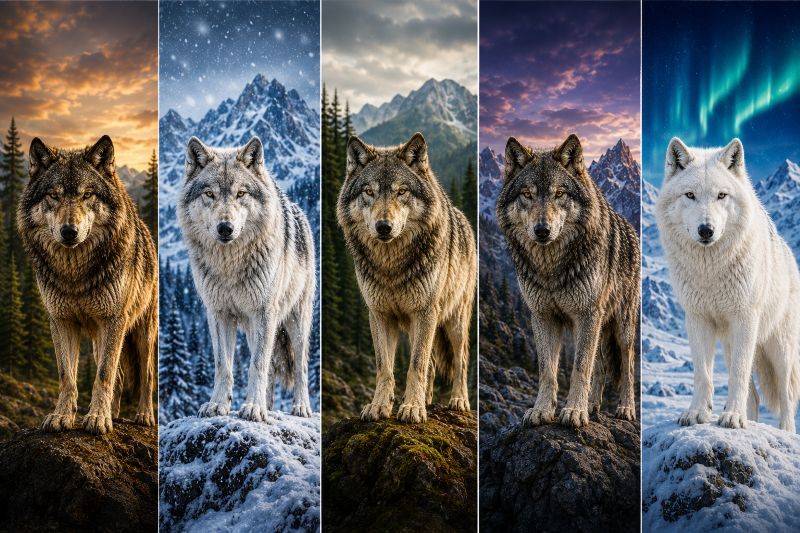
Wolves have fascinated humans for centuries with their power, intelligence, and pack loyalty. While all gray wolves (Canis lupus) command respect, some subspecies stand out as true giants. These massive predators dominate northern landscapes with incredible strength and size.
In this article, we rank the top 5 largest wolves in the world based on average weight, length, and shoulder height. From the remote Alaskan wilderness to the vast Eurasian steppes, these apex predators showcase nature’s most impressive canine engineering. Whether you’re a wildlife enthusiast, hiker, or simply curious about these majestic animals, these largest wolves facts will amaze you.
1. Northwestern Wolf (Canis lupus occidentalis) – The Undisputed King

Also known as: Mackenzie Valley Wolf, Canadian Timber Wolf, Alaskan Timber Wolf
The Northwestern Wolf takes the crown as the largest wolf subspecies on Earth. Found across Alaska, western Canada, and parts of the northwestern United States, these powerful animals are built for taking down massive prey like moose and bison.
- Weight: Males average 100–137 lbs (45–62 kg), with exceptional individuals reaching 175 lbs (79 kg). Females average 80–110 lbs.
- Length: 5–7 feet (1.5–2.1 m) nose to tail.
- Shoulder Height: 26–36 inches (66–91 cm).
Historical records include a legendary 175-pound male trapped in Alaska in 1939. Their robust build, large heads, and powerful jaws make them one of the most formidable predators in North America. These wolves play a vital role in maintaining ecosystem balance by controlling large herbivore populations.
2. Interior Alaskan Wolf (Canis lupus pambasileus) – The Yukon Giant
Also known as: Yukon Wolf
Native to the harsh interiors of Alaska and Yukon Territory, the Interior Alaskan Wolf ranks as a close second. These wolves thrive in some of the most extreme environments on the planet.
- Weight: Males average 95–124 lbs (43–56 kg), with some reaching 150+ lbs. Females average 75–100 lbs.
- Length: Up to 6 feet (1.8 m).
- Shoulder Height: Around 33–35 inches (84–89 cm).
One of the most famous large wolves on record came from this region. Their thick coats and muscular frames allow them to hunt caribou, moose, and Dall sheep in deep snow and freezing temperatures.
3. Eurasian Wolf (Canis lupus lupus) – Europe & Asia’s Largest Predator
Also known as: Common Wolf, Carpathian Wolf
The Eurasian Wolf is the largest wolf subspecies in the Old World. It roams across Europe and northern Asia, from Spain to Russia. While slightly smaller on average than its North American cousins, exceptional individuals rival the biggest Northwestern wolves.
- Weight: Males average 70–110 lbs (32–50 kg), with record specimens over 165 lbs (75 kg).
- Length: 5–6 feet (1.5–1.8 m).
- Shoulder Height: 26–33 inches (66–84 cm).
These wolves are highly adaptable, hunting deer, wild boar, and even livestock in some areas. Their return to parts of Europe through conservation efforts highlights their resilience.
4. Northern Rocky Mountain Wolf (Canis lupus irremotus) – The Rocky Giant
Also known as: Rocky Mountain Wolf
Once nearly extinct in the lower 48 states, the Northern Rocky Mountain Wolf has made a strong comeback in places like Yellowstone and Idaho. These wolves are built tough for mountainous terrain.
- Weight: 70–150 lbs (32–68 kg), with males often 85–115 lbs.
- Length: Up to 6 feet (1.8 m).
- Shoulder Height: 26–32 inches (66–81 cm).
Their reintroduction has been one of the greatest wildlife success stories in the U.S., restoring natural balance to ecosystems by preying on elk and deer.
5. Arctic Wolf (Canis lupus arctos) – The Snow-White Survivor
Also known as: Polar Wolf
The Arctic Wolf rounds out our top 5. Living in the frozen tundra of northern Canada and Greenland, these wolves have evolved incredible adaptations for life above the Arctic Circle.
- Weight: 70–120 lbs (32–54 kg), with some reaching 150+ lbs.
- Length: 3.5–5.9 feet (1.1–1.8 m).
- Shoulder Height: 25–31 inches (64–79 cm).
Their pure white coats provide perfect camouflage against snow, while smaller ears and shorter muzzles help retain body heat. They primarily hunt muskox and Arctic hares.
Size Comparison Table
| Rank | Subspecies | Avg. Male Weight | Max Weight | Length | Shoulder Height |
| 1 | Northwestern Wolf | 100–137 lbs | 175 lbs | 5–7 ft | 26–36 in |
| 2 | Interior Alaskan Wolf | 95–124 lbs | 150+ lbs | Up to 6 ft | 33–35 in |
| 3 | Eurasian Wolf | 70–110 lbs | 165+ lbs | 5–6 ft | 26–33 in |
| 4 | Northern Rocky Mountain Wolf | 85–115 lbs | 150 lbs | Up to 6 ft | 26–32 in |
| 5 | Arctic Wolf | 75–110 lbs | 150 lbs | 3.5–5.9 ft | 25–31 in |
Why Are Northern Wolves Bigger?
According to Bergmann’s Rule, animals in colder climates tend to be larger to conserve body heat. Northern wolves have thicker fur, larger paws for snow, and more powerful builds for hunting large prey in harsh conditions.
Conservation and Human Impact
Many of these wolf populations faced near-extinction in the 20th century due to hunting and habitat loss. Thanks to conservation programs in the U.S., Canada, and Europe, numbers are recovering. Wolves remain vital for healthy ecosystems.
Final Thoughts: Nature’s Ultimate Predators
From the mighty Northwestern Wolf to the resilient Arctic Wolf, these top 5 largest wolves remind us of the raw power and beauty of the wild. Their size, intelligence, and social structure make them one of the most successful predators on Earth.
Next time you see a wolf in a documentary or on a wildlife tour, you’ll appreciate just how impressive these animals truly are. Share these largest wolves facts with fellow nature lovers and support wolf conservation efforts.