25 Rhino Facts: Armoured Giants of Africa and Asia
Rhinoceroses are some of the largest land animals on Earth, with thick folded skin and famous horns. Once found across much of Europe, Asia and North America, today just five species survive, scattered across parts of Africa and southern Asia, and several are in serious danger.
Yet the rhino story also holds real hope. In India, careful protection has helped the greater one-horned rhino climb back from the brink. Here are 25 fact-checked rhino facts, from horn science and feeding habits to the remarkable conservation success of Assam's grasslands.
Rhino Facts
The word "rhinoceros" comes from Greek words meaning "nose horn".
There are five living species: the white and black rhinos of Africa, and the greater one-horned, Javan and Sumatran rhinos of Asia.
The white rhino is generally the largest species, with big males weighing around 2,000–2,300 kilograms. The greater one-horned rhino comes a close second.
The Sumatran rhino is the smallest and the hairiest living rhino, and it is the closest living relative of the extinct woolly rhinoceros.
Woolly rhinos roamed Ice Age Europe and northern Asia and are thought to have died out roughly 14,000 years ago.
Rhino horns are made of keratin, the same protein found in human hair and fingernails, packed into a dense, solid mass that grows from the skin rather than from bone.
Horns keep growing throughout a rhino's life, and a horn that is broken or trimmed can grow back, though slowly.
The two African species and the Sumatran rhino have two horns, while the greater one-horned and Javan rhinos have a single horn. Javan females may have only a small bump.
Despite their names, white and black rhinos are both greyish. The name "white" is sometimes linked to a word meaning "wide", for its broad mouth, but this explanation is disputed.
Grazers and Browsers
The two African rhinos look similar, but their mouths reveal very different diets. The white rhino has a broad, square upper lip that works like a lawnmower, cropping short grass across open plains, so it is a grazer. The black rhino has a pointed, hook-shaped upper lip that can grab twigs, leaves and shoots from bushes, so it is a browser. These feeding styles mean the two species often use different parts of the landscape. The greater one-horned rhino of India also has a partly grasping lip, which helps it pull up tall grasses and water plants.
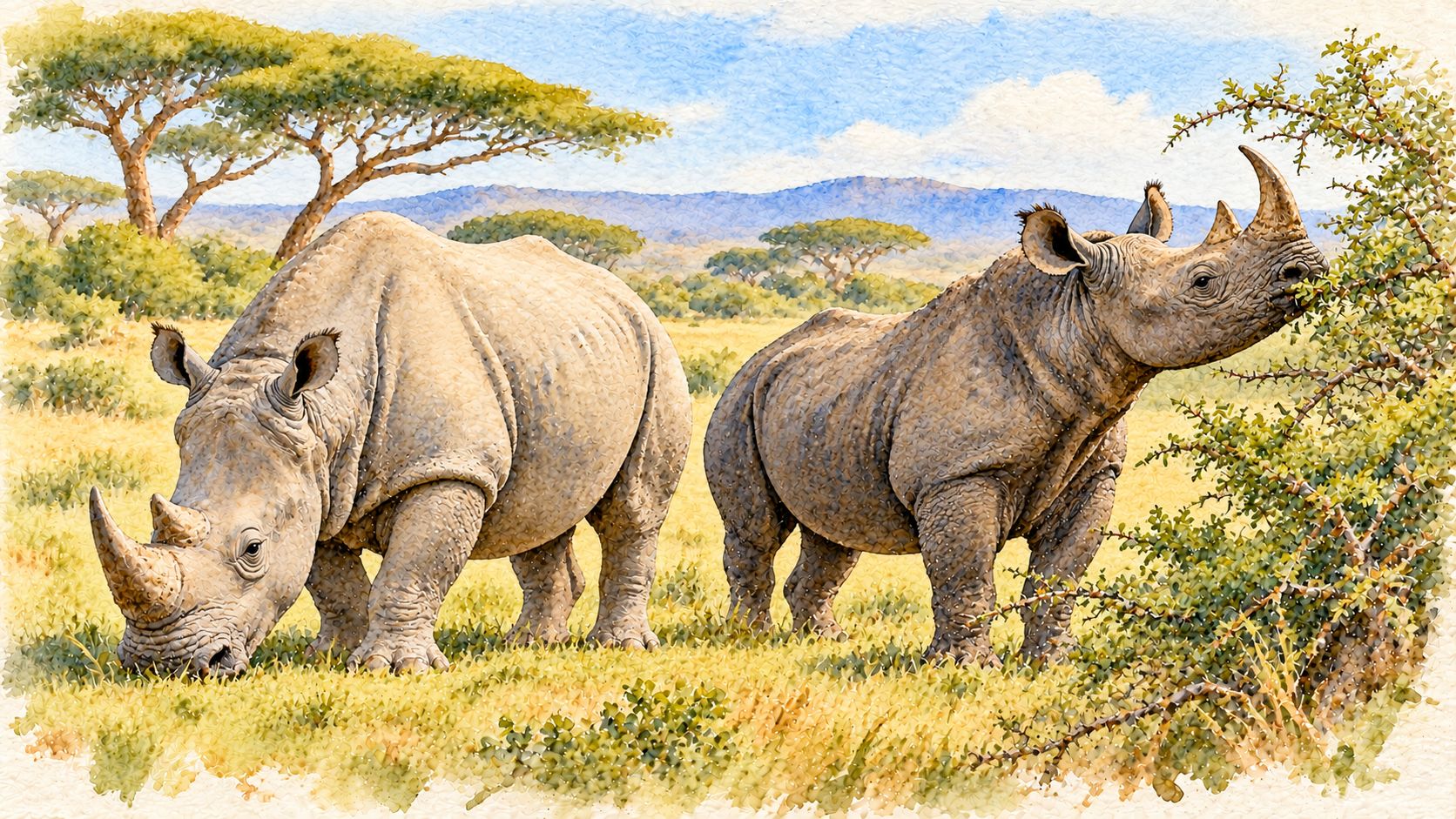
Rhinos are herbivores and spend much of their day feeding, often resting in the hottest hours.
Their eyesight is poor, but they have excellent senses of smell and hearing, which they rely on to detect danger.
A rhino can charge at speeds of around 50 km/h over short distances, so it should always be watched from a safe distance.
Rhinos love wallowing in mud. A coating of mud helps keep them cool and protects their skin from sunburn and biting insects.
Rhinos leave large communal dung piles called middens, which act like scent noticeboards that tell other rhinos who has passed by.
A rhino pregnancy lasts about 15–16 months, and a mother usually gives birth to a single calf, which stays with her for around two to four years.
A group of rhinos is called a "crash", males are bulls, females are cows and young are calves.
Oxpeckers are birds that ride on rhinos and eat ticks. In Swahili they are called the "rhino's guard", and research has shown their alarm calls can warn rhinos of approaching people.
Rhinos' closest living relatives are horses and tapirs, which, like rhinos, are odd-toed hoofed mammals.
Kaziranga's Rhino Comeback
The greater one-horned rhino lives in the grasslands of India and Nepal, and Kaziranga National Park in Assam is its greatest stronghold. In the early twentieth century, hunting and habitat loss had left only a small number in the region. Strict protection since then has helped numbers rise to more than 4,000 across both countries, and Kaziranga alone holds around two-thirds of the world's greater one-horned rhinos. Other Indian homes include Pobitora, Orang and Manas in Assam, Jaldapara in West Bengal and Dudhwa in Uttar Pradesh. The species has improved from Endangered to Vulnerable on the IUCN Red List.
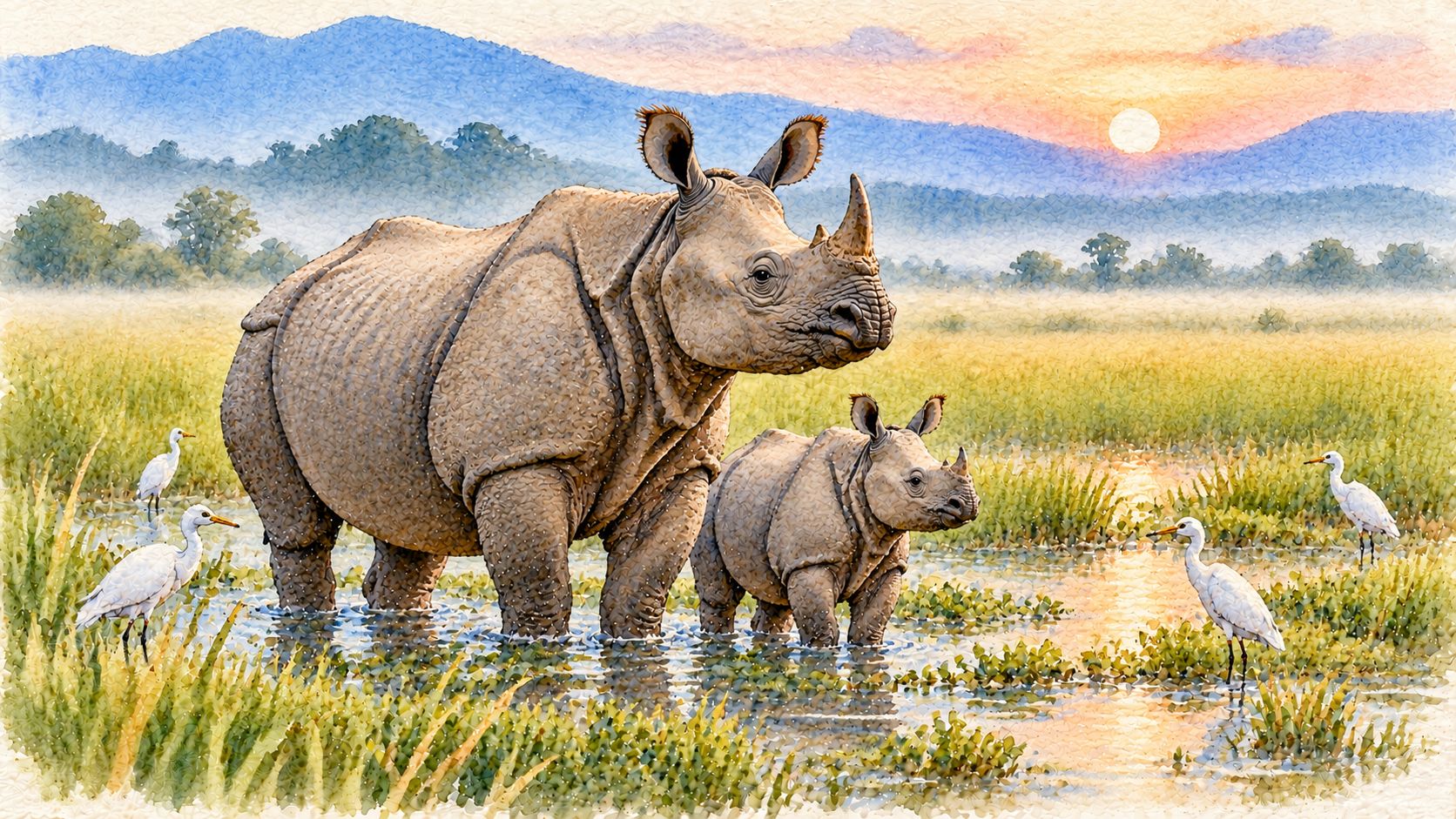
Instead of using its horn, the greater one-horned rhino fights mainly with sharp lower teeth, which can cause deep wounds.
Rhinos once lived across much more of India. The Javan and Sumatran rhinos both once occurred in parts of north-eastern India, and rhinos appear on seals from the Indus Valley Civilisation.
The black rhino, the Javan rhino and the Sumatran rhino are all listed as Critically Endangered, and the Javan rhino survives in just one national park in Indonesia.
The northern white rhino is functionally extinct, with only two females known to remain, guarded in Kenya, while scientists attempt to save it with assisted reproduction.
Poaching for horn remains the biggest threat to rhinos, even though rhino horn has no proven medicinal value. World Rhino Day is marked on 22 September each year.
Sources and Further Reading
- IUCN Red List
- WWF India
- Wildlife Institute of India
- Encyclopaedia Britannica
- National Geographic
- Smithsonian's National Zoo and Conservation Biology Institute
Frequently asked questions
What is a rhino horn made of?
It is made of keratin, the same protein found in hair and fingernails, and it grows from the skin rather than the skull.
How many species of rhino are there?
There are five: the white, black, greater one-horned, Javan and Sumatran rhinos.
Where do rhinos live in India?
Greater one-horned rhinos live mainly in Assam, especially Kaziranga National Park, with smaller populations in West Bengal and Uttar Pradesh.
Are white rhinos really white?
No. White rhinos are grey, much like black rhinos, and the origin of the name is still debated.
Which is the rarest rhino?
The Javan and Sumatran rhinos are among the rarest, and the northern white rhino subspecies has only two known females left.
Why are rhinos poached?
They are killed for their horns, which are illegally traded for supposed medicinal uses that have no scientific backing.