25 Komodo Dragon Facts: Meet the World's Largest Living Lizard

The Komodo dragon is the heaviest lizard alive today, a powerful hunter found on just a handful of Indonesian islands. With its forked tongue, serrated teeth and armoured skin, it looks like a survivor from a lost world, and in many ways it is.
Scientists have learnt a great deal about these giants in recent decades, overturning old myths about deadly mouth bacteria and discovering surprises such as virgin births. Here are 25 carefully checked facts about the Komodo dragon, including its close relatives that live in India.
Komodo Dragon Facts
The Komodo dragon (*Varanus komodoensis*) is the largest living lizard, with big males reaching about 3 metres in length and commonly weighing around 70–90 kilograms in the wild.
It lives only on a few islands in south-eastern Indonesia, chiefly Komodo, Rinca, Flores, Gili Motang and Gili Dasami.
Western scientists first described the species in 1912, after reports reached Dutch colonial officials of giant "land crocodiles" on the islands. Local people call it "ora".
Komodo National Park was set up in 1980 to protect the dragons and their habitat, and it was named a UNESCO World Heritage Site in 1991.
The Komodo dragon belongs to the monitor lizard family, Varanidae, a group of mostly large, active, intelligent lizards found across Africa, Asia and Australia.
It "smells" with its tongue. The forked tongue collects scent particles from the air and passes them to the Jacobson's organ in the roof of the mouth, helping it find carrion that is reportedly several kilometres away.
Adults eat almost any animal they can overpower or find dead, including deer, wild pigs and water buffalo, and they also scavenge carcasses.
A Komodo dragon can reportedly eat up to about 80% of its own body weight in a single meal, thanks to loosely hinged jaws and an expandable stomach.
Because they have a slow metabolism, large adults can go a long time between big meals. They are thought to manage on surprisingly few feeds a year.
Venom, Not Dirty Mouths
For decades, people believed Komodo dragons killed prey with a mouth full of deadly bacteria. Research published in 2009 changed that picture. Scientists found venom glands in the lower jaw that release proteins which stop blood from clotting and lower blood pressure, sending bitten prey into shock. Later studies also found that the bacteria in a dragon's mouth are fairly ordinary, similar to those of other meat-eating animals. Today the accepted view is that a dragon's attack works through a combination of deep, slicing bites from serrated teeth, heavy blood loss and venom, rather than infection.
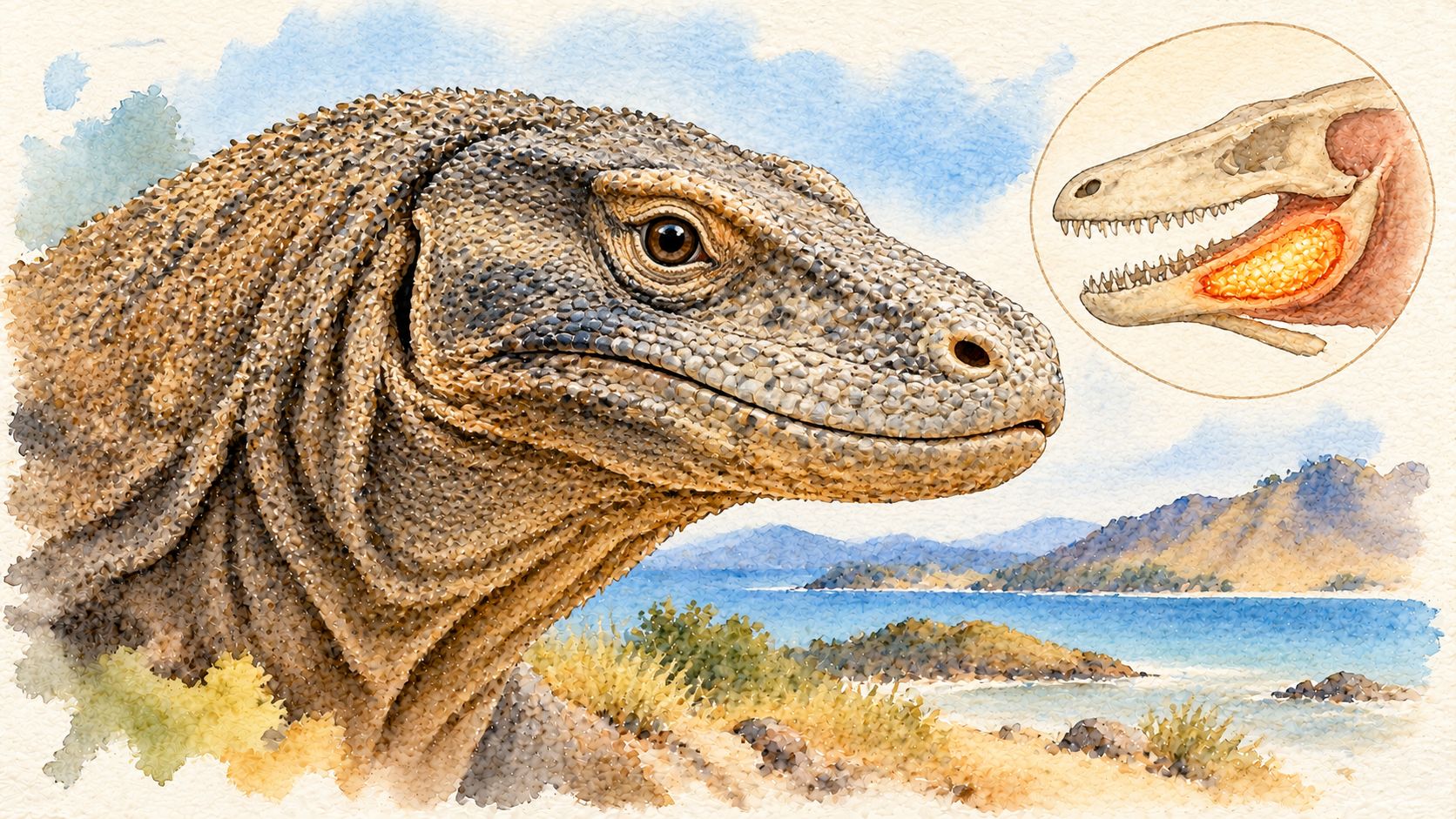
A Komodo dragon has around 60 curved, serrated teeth, which are shed and replaced throughout its life, a little like a shark's.
A 2024 study reported that the cutting edges and tips of their teeth are coated with iron, giving them an orange tinge and probably helping keep them sharp.
Their skin is reinforced with tiny bones called osteoderms, which form a kind of natural chainmail under the scales.
Over short distances, a Komodo dragon can run surprisingly fast, with burst speeds often quoted at around 20 km/h.
They are strong swimmers and have been seen crossing the sea channels between islands.
Females lay a clutch of roughly 20 eggs, often in nest mounds built by birds called scrubfowl, and the eggs take around seven to eight months to hatch.
Hatchlings are only about 40 centimetres long and spend much of their early life up in trees, where they are safer from hungry adult dragons, which sometimes eat young ones.
Females can reproduce without a male. In 2006, two captive females in British zoos, at Chester and London, produced young without mating, a process called parthenogenesis.
Because of how Komodo dragon sex chromosomes work, young born through parthenogenesis are male, which in theory could help an isolated female start a new colony.
India's Own Monitor Lizard Cousins
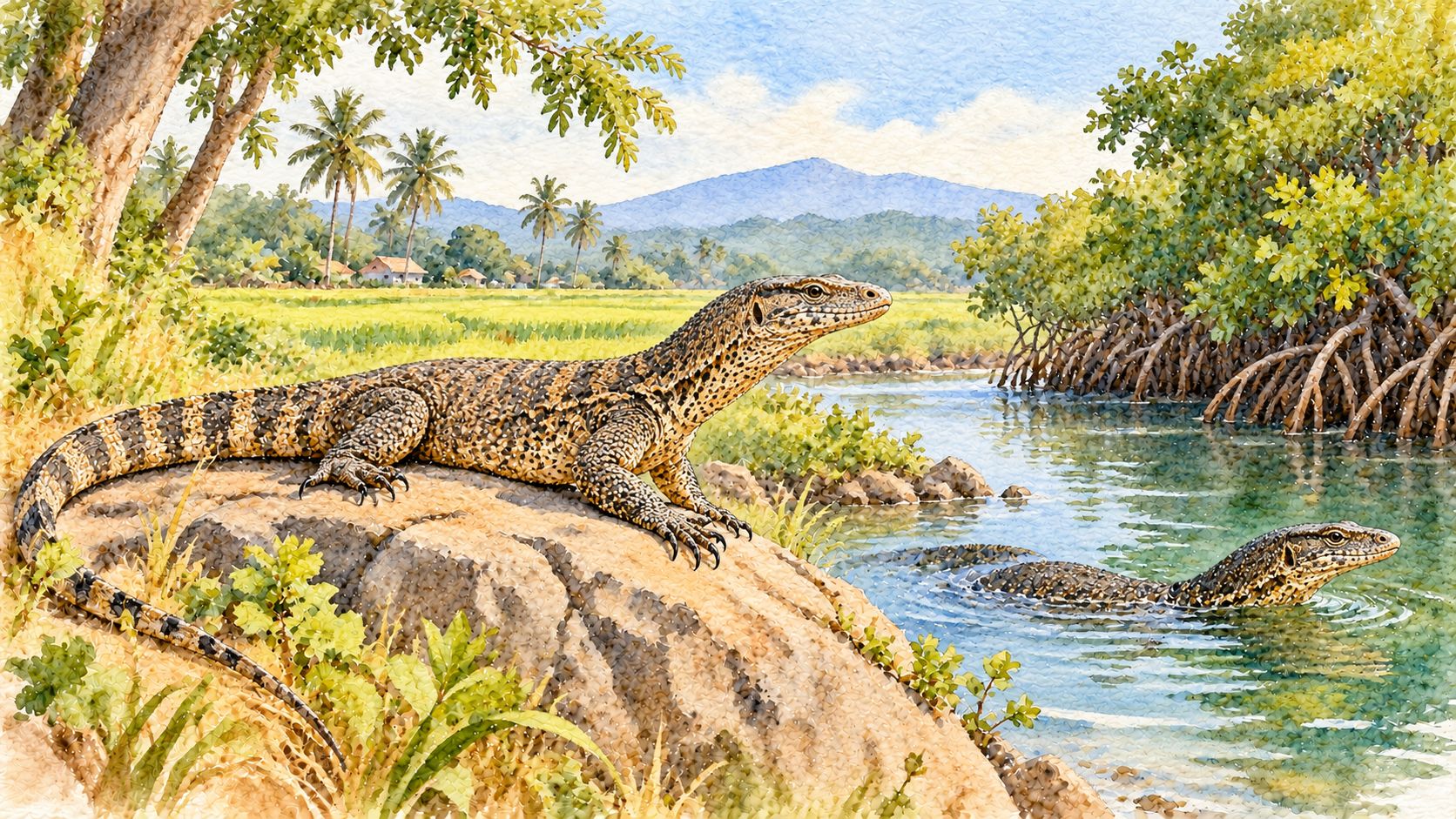
India has no Komodo dragons, but it is home to several of their close relatives in the same genus, *Varanus*. The Bengal monitor is widespread across the country, from farmland and scrub to forest edges. The water monitor, a large, strong swimmer, lives in eastern wetlands such as the Sundarbans and on the Andaman and Nicobar Islands. India also has the yellow monitor and the desert monitor. Like Komodo dragons, these lizards use flicking forked tongues to track food. They are protected under India's Wildlife (Protection) Act, but illegal hunting for meat and the wildlife trade remain threats.
Komodo dragons can live for about 30 years in the wild, though exact lifespans are hard to measure.
Fossil evidence suggests that the Komodo dragon's lineage arose in Australia millions of years ago before spreading to the islands of Indonesia.
The IUCN lists the Komodo dragon as Endangered. Rising sea levels from climate change are expected to shrink its small island habitat.
Attacks on people are rare, but they have happened, including a few fatal ones, so visitors to Komodo National Park are accompanied by trained rangers.
Zoo keepers have observed captive Komodo dragons behaving in ways that look like play, such as tugging and carrying objects, hinting that these lizards are more curious than once thought.
Sources and Further Reading
- IUCN Red List
- Smithsonian's National Zoo and Conservation Biology Institute
- Encyclopaedia Britannica
- National Geographic
- UNESCO World Heritage Centre
- Zoological Survey of India
Frequently asked questions
Are Komodo dragons venomous?
Yes. They have venom glands in the lower jaw that release substances which stop blood clotting and lower blood pressure in their prey.
Where do Komodo dragons live?
They live in the wild only on a few islands in Indonesia, including Komodo, Rinca and Flores.
How big can a Komodo dragon get?
Large males can reach about 3 metres long and usually weigh around 70–90 kilograms in the wild.
Are there Komodo dragons in India?
No, but India has related monitor lizards, such as the Bengal monitor and the water monitor, which belong to the same genus.
Can Komodo dragons reproduce without a male?
Yes. Captive females have produced young without mating through a process called parthenogenesis, and those offspring are male.
Is the Komodo dragon endangered?
The IUCN lists it as Endangered, mainly because of its tiny range and the threat of rising sea levels.