25 Kakapo Facts: The Heavy, Flightless Night Parrot
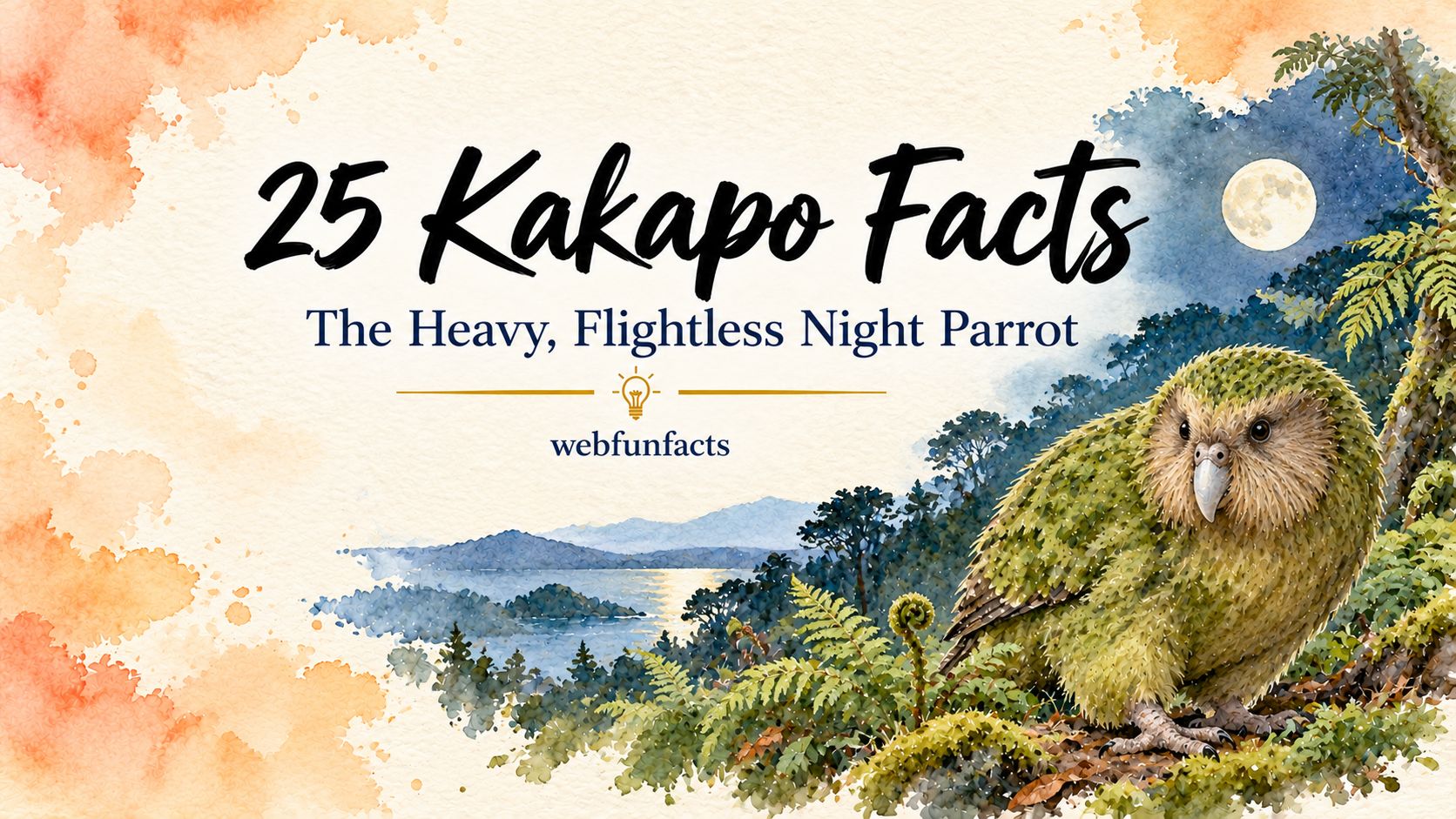
Imagine a parrot that cannot fly, comes out only at night, smells faintly sweet and weighs as much as a small cat. That is the kakapo, one of the strangest and most loveable birds on Earth, found only in New Zealand and cared for almost like a family member by its protectors.
Once common across New Zealand, the kakapo came perilously close to disappearing forever. Today it is the focus of one of the world's most intensive rescue efforts. Here are 25 fascinating facts about its looks, habits, unusual breeding and remarkable comeback.
Kakapo Facts
The kakapo is the world's only flightless parrot. It lives only in New Zealand, and its scientific name is *Strigops habroptilus*.
Its name comes from the Māori language: "kākā" means parrot and "pō" means night, so kākāpō means "night parrot".
It is the heaviest parrot in the world. Males often weigh around 2 kilograms or more, and females are noticeably lighter.
The kakapo is nocturnal, resting quietly by day and becoming active after dark to feed and wander.
Its moss-green feathers are speckled with yellow and black, giving it excellent camouflage among forest plants and ferns.
A disc of fine feathers around its face gives it an owl-like look. Its genus name, *Strigops*, means "owl face", and it is sometimes called the owl parrot.
Although it cannot fly, the kakapo is a strong walker and an excellent climber. It may cover several kilometres in a night.
When climbing down from a tree, a kakapo spreads its short wings and uses them to slow its fall, a little like a parachute.
Its breastbone has only a small keel, so it lacks the large flight muscles that flying birds rely on.
Booming Love Songs in the Dark
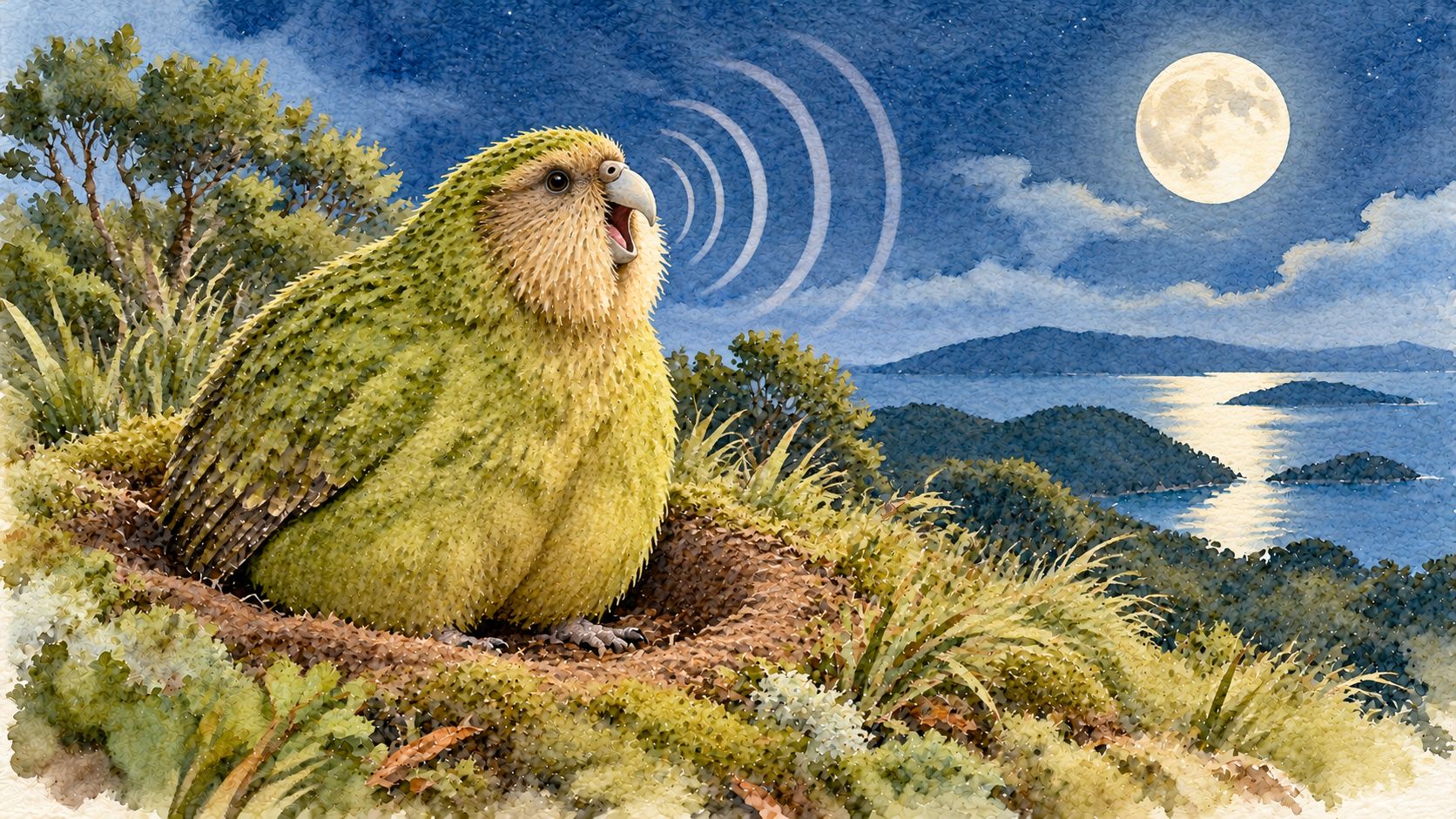
During the breeding season, male kakapo gather on hilltops and dig shallow bowls in the ground, linked by tracks they keep clear. Each male sits in his bowl, puffs up air sacs in his chest and gives a deep, low "boom" that can travel several kilometres through the night. Every so often he adds a sharp metallic "ching" call to help females pinpoint him. A male may boom for hours each night over several months. This kind of courtship, where males display together and females choose a mate, is called lekking, and the kakapo is the only parrot known to breed this way.
Kakapo do not breed every year. They usually breed only every two to four years, when rimu trees produce a heavy crop of fruit.
Researchers think the rich supply of rimu fruit gives females the nutrition they need to lay eggs and raise chicks.
The female raises her chicks completely alone. She nests on the ground or in a hollow, usually lays one to four eggs, and the eggs hatch after about 30 days.
Kakapo are herbivores, eating leaves, shoots, roots, seeds, bark and fruit.
They chew plant material and leave behind small balls of fibre called "chews" on the plant, a tell-tale sign that a kakapo has been feeding there.
Kakapo have a musty-sweet scent that people often compare to honey. This may make it easier for predators that hunt by smell to find them.
When it senses danger, a kakapo freezes and relies on its camouflage. This may have worked well against eagles that hunted by sight but offers little protection from mammals.
New Zealand had no native land mammals apart from bats, so the kakapo evolved without ground predators and never needed to escape quickly.
The arrival of people, along with introduced cats, rats, dogs and stoats, caused kakapo numbers to collapse, and the bird vanished from most of New Zealand.
Back From About 50 Birds
By the 1970s, only a handful of kakapo, all males, were known to survive in Fiordland, and many feared the species was doomed. In 1977, a population including females was found on Stewart Island, but even these were being killed by feral cats. Conservationists moved the surviving birds to predator-free islands, and by the mid-1990s only about 50 remained. New Zealand's Department of Conservation then launched an intensive recovery programme with supplementary feeding, nest monitoring and hand-rearing chicks. Thanks to this work, the kakapo has grown to a few hundred birds, though it is still listed as Critically Endangered.
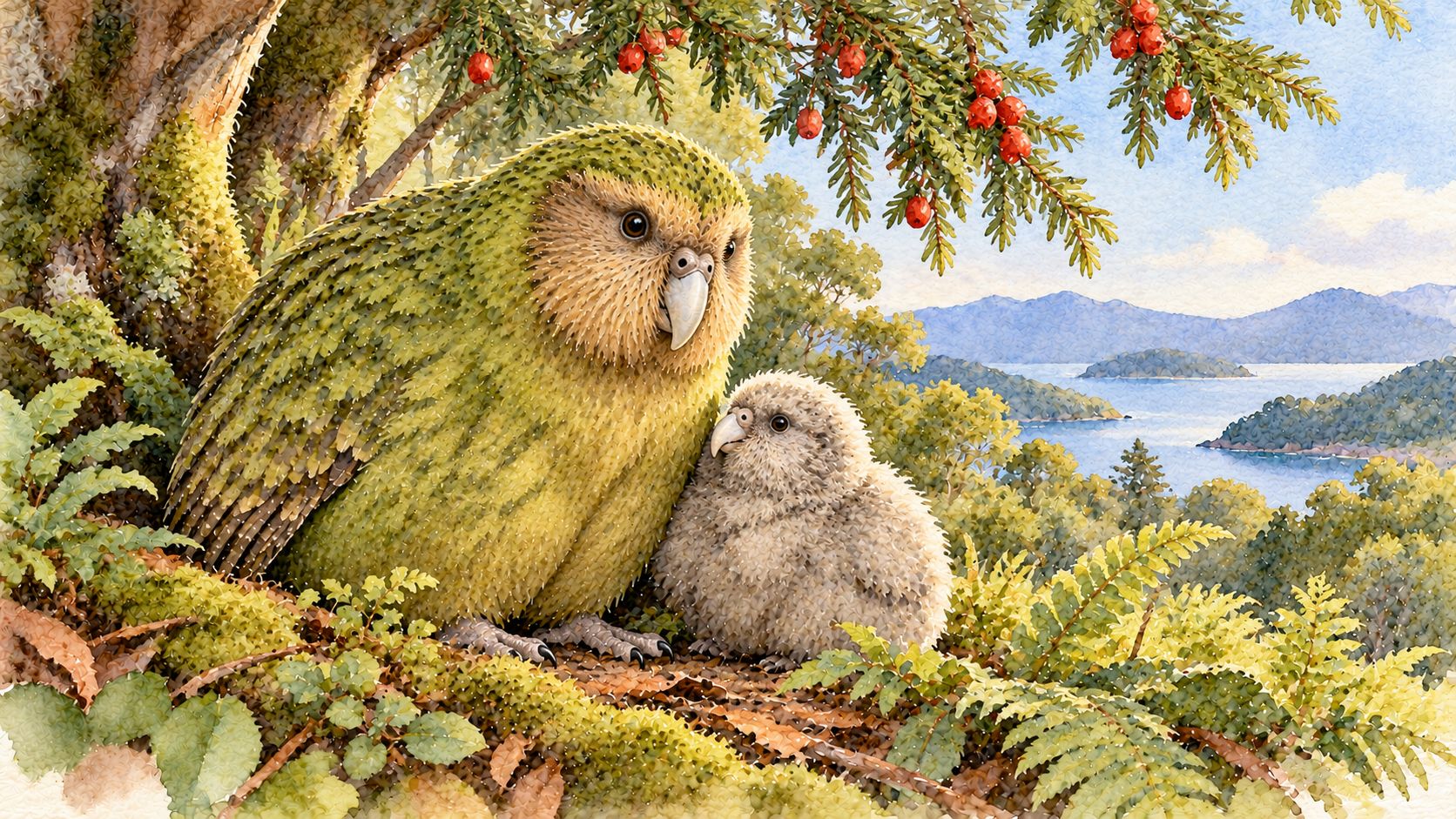
Kakapo now live mainly on predator-free offshore islands such as Whenua Hou (Codfish Island) and Anchor Island, where they are closely monitored.
Each kakapo is known by name, and the birds carry small transmitters so rangers can check on their health and track breeding.
Scientists have sequenced the genomes of almost every living kakapo, helping them plan matings that keep the population as genetically healthy as possible.
Kakapo are thought to be very long-lived, with life spans estimated at 60 years or more, which makes them one of the longest-living birds.
The kakapo's closest relatives are two other New Zealand parrots, the kea and the kākā. Together they form an ancient group found nowhere else in the world.
Sources and Further Reading
- New Zealand Department of Conservation
- IUCN Red List
- BirdLife International
- Te Ara: The Encyclopedia of New Zealand
- Encyclopaedia Britannica
- Natural History Museum London
Frequently asked questions
Can kakapo fly?
No. The kakapo is the world's only flightless parrot, though it can climb trees and use its wings to slow its descent.
Why is the kakapo called a night parrot?
Its Māori name kākāpō means "night parrot", because the bird is nocturnal and feeds after dark.
How heavy is a kakapo?
It is the heaviest parrot in the world, with males often weighing around 2 kilograms or more.
How many kakapo are left?
There are now a few hundred kakapo, up from only about 50 in the mid-1990s, though the species remains Critically Endangered.
Where do kakapo live?
They live only in New Zealand, mostly on predator-free islands managed by the Department of Conservation.
Why do kakapo breed so rarely?
They usually breed only every two to four years, when rimu trees produce a large crop of fruit.