
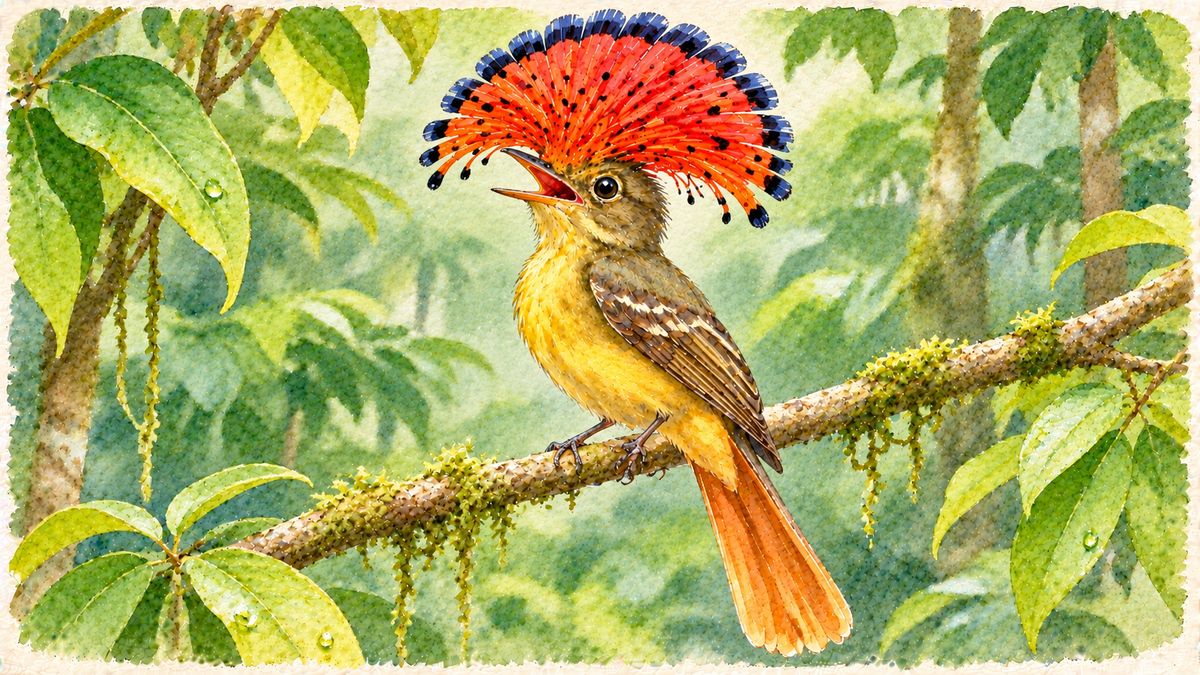
The Amazonian royal flycatcher is a small, brown, rather plain-looking bird until it opens its crown. Then, in a flash, a spectacular fan of scarlet and blue-tipped feathers springs open, as if a tiny royal crown had unfolded on top of its head. Birdwatchers around the world dream of seeing this display, yet very few ever do, because the bird raises its crest only rarely.
This shy forest flycatcher lives in the humid lowlands of the Amazon basin, where it hunts insects near streams and builds one of the strangest nests in the bird world: a long, ragged, dangling bundle that hangs over the water. In this complete guide, you will learn what the Amazonian royal flycatcher is, what it looks like, where it lives, what it eats, how it behaves, how it breeds and what the future holds for this remarkable species.
Quick answer: The Amazonian royal flycatcher (Onychorhynchus coronatus) is a small tyrant flycatcher, about 16 to 17 cm (6.5 in) long, found in the humid lowland forests of the Amazon basin. It is best known for its large, fan-shaped crest, which is red-orange in males and yellow-orange in females, and for its long hanging nest. It eats insects, and the IUCN lists it as Least Concern.
Amazonian Royal Flycatcher at a Glance
| Feature | Details |
|---|---|
| Scientific name | Onychorhynchus coronatus |
| Class | Aves |
| Order | Passeriformes |
| Family | Tyrannidae (tyrant flycatchers) |
| Size / length | About 6.5 inches (16 to 17 cm) |
| Weight | Roughly 0.5 to 0.7 ounces (about 13 to 20 g) |
| Lifespan | Not well known; small forest birds of this type often live a few years |
| Diet | Flying and perched insects, including flies, beetles and butterflies |
| Habitat | Humid lowland forest, especially near streams and swamps |
| Range | Amazon basin of Brazil, Peru, Colombia, Ecuador, Bolivia and the Guianas |
| Conservation status (IUCN) | Least Concern |
What Is an Amazonian Royal Flycatcher?
The Amazonian royal flycatcher is a member of the huge tyrant flycatcher family, a group of more than 400 species found only in the Americas. As their name suggests, flycatchers catch insects, often by darting out from a perch to snatch prey and then returning to the same spot.
The royal flycatchers are a small and unusual group. In older books, there was just one royal flycatcher species with several subspecies. Modern researchers have split it into separate species based on differences in voice, appearance and genetics. These include the Northern royal flycatcher of Central America, the Amazonian royal flycatcher, the Pacific royal flycatcher of western Ecuador and Peru, and the Atlantic royal flycatcher of eastern Brazil. Different checklists may group them differently, so the exact list depends on the source.
Why Is It Called "Royal"?
The name comes from the spectacular crest, which looks like a crown. When spread, the crest forms a broad fan with a bold pattern of red, orange or yellow feathers tipped with glossy blue-black spots. It is one of the most dramatic displays among small birds.
What Does an Amazonian Royal Flycatcher Look Like?
Size and Shape
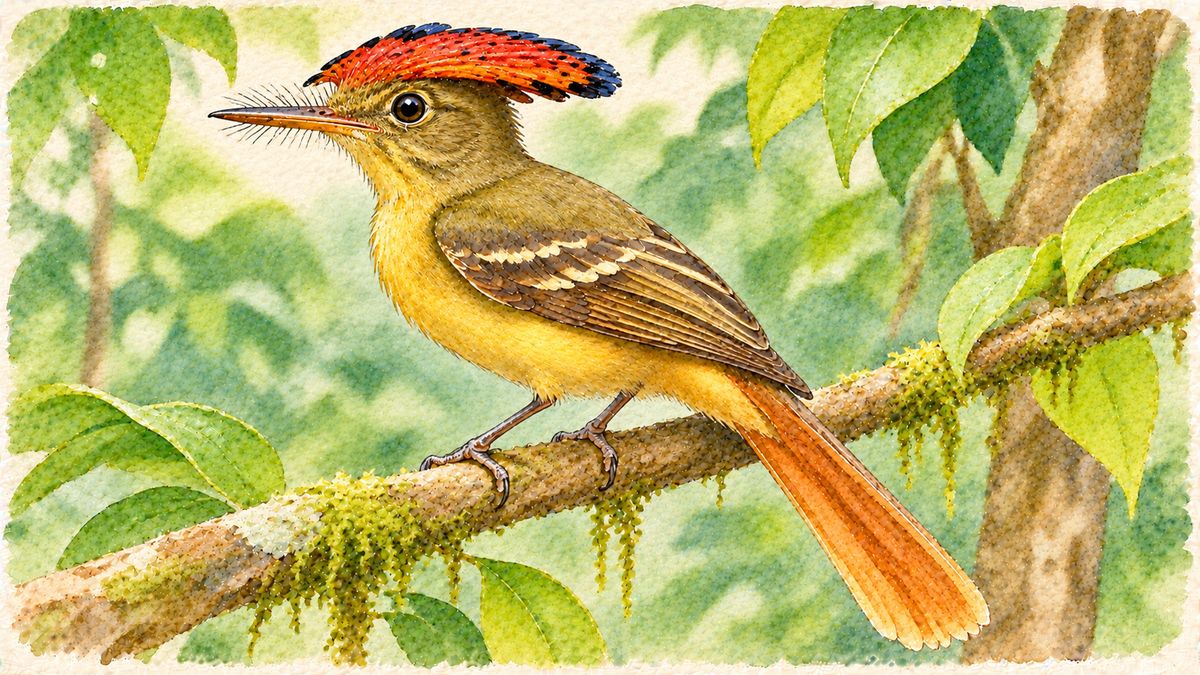
This is a small, slim bird, about 16 to 17 centimeters (6.5 inches) long, with a long tail and a surprisingly long, flat, wide bill. In silhouette, it looks like a brown stick with a hammer-shaped head, because the crest, even when folded, projects backward from the crown.
Plumage
The body is mostly olive-brown above, with a paler, buff or cinnamon underside, and a tail that is often rusty. The plumage helps it vanish among branches and dead leaves.
The Crest
The crest is the star feature. It is made of long, thin feathers that normally lie flat along the head and back, giving the bird the look of a hammer-headed head. When opened, the crest fans out in a semicircle with:
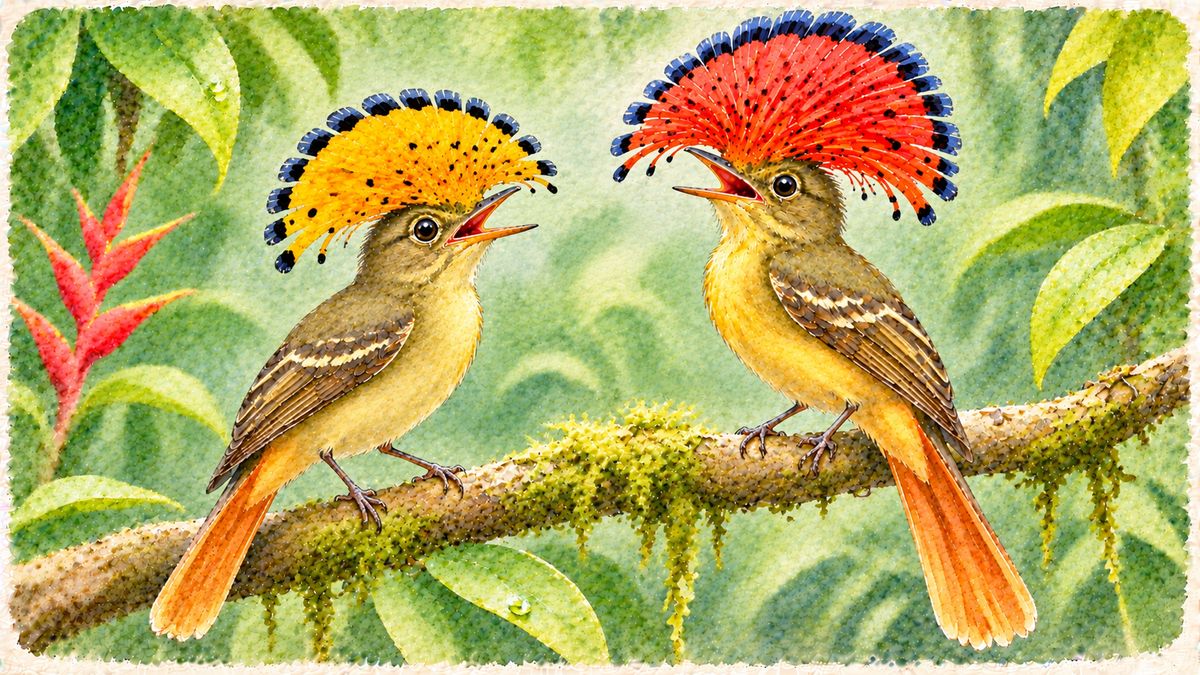
- Males: A scarlet to orange-red crest with blue-black tips.
- Females: A yellow to orange crest with similar dark tips.
- Both sexes: A striking shape that appears much larger than the bird's head.
Scientists do not fully know why the bird raises its crest. Possible reasons include startling predators, signaling to mates or rivals, or reacting to stress. Many people see the crest only when a bird is captured for research.
Bill and Whiskers
The bill is broad at the base, flat and wide, with stiff bristles around the mouth. The bristles, called rictal bristles, may help catch insects in flight and protect the eyes.
Eyes
The dark eyes are surrounded by a pale ring, giving the bird a gentle, watchful look.
Where Do Amazonian Royal Flycatchers Live?
The Amazonian royal flycatcher lives in the lowland rainforest of the Amazon basin. Its range extends across northern and western Brazil, eastern Peru, eastern Ecuador, southeastern Colombia, northern Bolivia, southern Venezuela and the Guianas.
Habitat
- Humid lowland forest: Tall, dense forest with a thick understory.
- Streamsides and swamps: The bird often stays near rivers, creeks and wet areas.
- Forest edges: It sometimes ventures to clearings along rivers.
- Low to mid levels: Rather than the highest canopy, it prefers the shady lower and middle layers of the forest.
It is generally uncommon and widely scattered, and it seems to need undisturbed, mature forest.
What Do Amazonian Royal Flycatchers Eat?
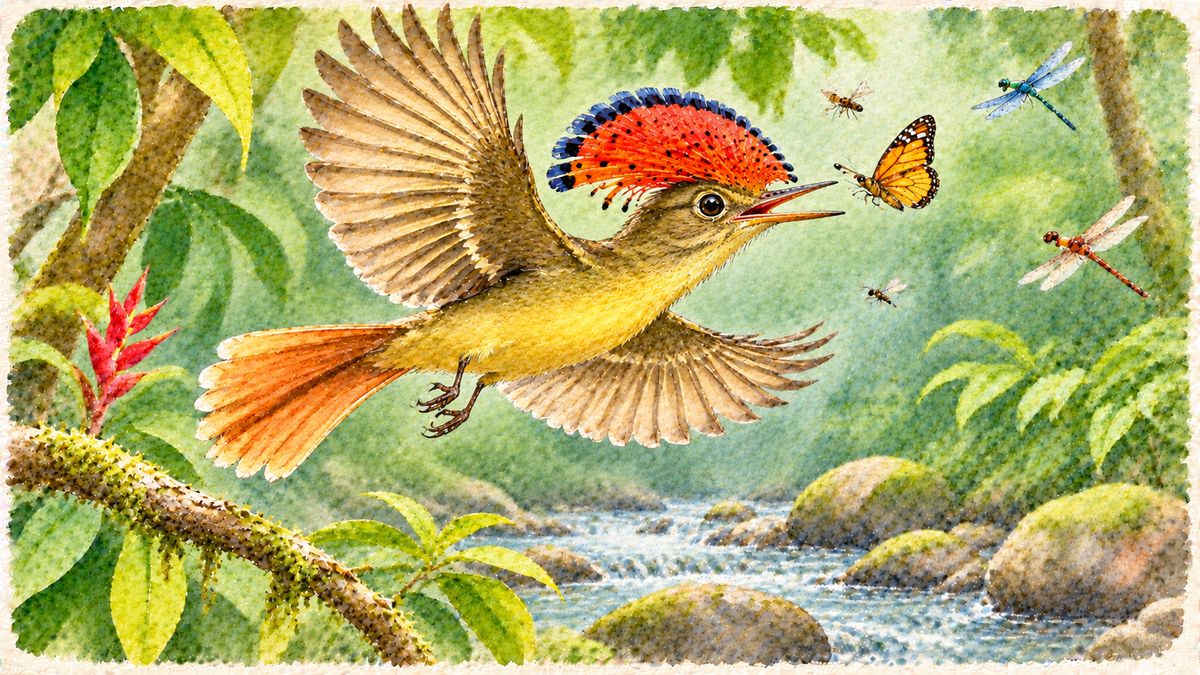
The Amazonian royal flycatcher is insectivorous. It feeds mainly on flying insects and other small invertebrates.
Typical Prey
- Flies, mosquitoes and other small flying insects
- Beetles and bugs
- Moths and butterflies
- Dragonflies and similar insects
- Spiders and other small arthropods
How It Hunts
Royal flycatchers perch quietly on a thin branch in the shade, often low over a stream. They watch for passing insects, then dart out, snap their wide bill shut and fly back, often to the same perch. They may also glean insects from leaves and twigs. Because the bird is quiet and still, it is easy to overlook.
Amazonian Royal Flycatcher Behavior and Lifestyle
Solitary or in Pairs
Royal flycatchers are usually seen alone or in pairs. They do not join large flocks, though they may sometimes follow mixed-species flocks of birds moving through the forest.
Shy and Quiet
This is a secretive bird. It sits still for long periods, and its brown color helps it blend in. It often calls with a soft, whistled or sharp note, but it is not a loud singer.
The Crest Display
When the crest opens, the bird often also moves its head from side to side or sways. This display may be linked to courtship or aggression, or to scaring predators. Because the display is so rare in the wild, scientists have much to learn about its meaning.
Daily Life
Most of the day is spent hunting insects from a perch, preening and resting in shaded spots. Breeding pairs spend a lot of time near their nest, which is usually next to water.
Amazonian Royal Flycatcher Nest, Eggs and Babies
The nest is one of the most distinctive features of the species.
The Hanging Nest
The nest is a long, untidy, pendant structure, made of plant fibers, twigs, dead leaves, rootlets and other materials. It hangs from a thin branch or vine, commonly over a stream or other water. The nest can be up to about a meter (3 feet) long, though most are somewhat shorter. It looks like a clump of debris trapped in a tree, which is the point: it is camouflaged to look like flood trash. A small chamber near the bottom holds the eggs.
Eggs and Chicks
The female typically lays two eggs, which are speckled and brown or reddish. Both parents may help raise the chicks, which hatch blind and helpless and are fed insects. The exact details of incubation and fledging time vary in different studies and are not perfectly known for every population.

How Long Do Amazonian Royal Flycatchers Live?
The lifespan of this bird has not been well studied. Small forest birds of this type often live several years in the wild, but there is no firm figure for this species. Predation, weather and habitat quality all affect survival.
Predators and Threats
Natural Predators
Eggs, chicks and adults can be eaten by:
- Snakes, including tree-dwelling species
- Monkeys and other climbing mammals
- Small hawks and falcons
- Larger birds such as toucans, which sometimes raid nests
The hanging nest, camouflaged as debris, probably helps hide the family from predators.
Human Threats
- Deforestation: Clearing forest for farms, cattle, roads and mining removes habitat.
- Habitat fragmentation: Isolated forest patches cannot support this shy species.
- River changes: Dams and altered waterways may reduce suitable nesting areas.
- Climate change: Shifts in rainfall and flooding can affect insects and nesting sites.
Why Amazonian Royal Flycatchers Are Important
- Insect control: By eating large numbers of insects, they help keep populations balanced.
- Forest indicators: Birds that need mature forest can tell scientists about habitat quality.
- Ecotourism: Birdwatchers travel long distances for a chance to see one, supporting local guides and lodges.
- Scientific interest: The crest and the nest are fascinating subjects for studies of evolution and behavior.
Is the Amazonian Royal Flycatcher Endangered?
At present, the Amazonian royal flycatcher is listed as Least Concern by the IUCN. It has a very large range, and the overall population is not thought to be falling quickly enough to count as threatened. However, it is naturally uncommon, and local numbers may be dropping where forests are cut. Some related royal flycatchers are in a more difficult position. For example, the Atlantic royal flycatcher of Brazil's coastal forest has suffered heavy habitat loss and is a conservation concern, so the whole group needs attention.
Protecting large blocks of intact rainforest and reserves along rivers is the best way to keep this species secure.
Fun Facts About the Amazonian Royal Flycatcher
- A hidden crown: The crest is usually folded and is shown only on rare occasions.
- Hammerhead look: The folded crest makes the head look like a hammer.
- Different crests: Males have red-orange crests, and females have yellow-orange ones.
- Long nest: The nest can be up to about a meter long.
- Disguised as trash: The hanging nest looks like a clump of debris.
- Flycatcher family: It belongs to the tyrant flycatchers, the largest bird family in the Americas.
- Birdwatcher's dream: Seeing the crest open is a highlight for many bird enthusiasts.
- Several species: What was once one royal flycatcher has been split into several.
- Wide bill: The flat bill is ideal for catching insects.
- Quiet hunter: It sits still and darts out to catch prey.
Frequently Asked Questions
What is the crest of the royal flycatcher for? Nobody knows for sure. It may be used for courtship, to startle predators or to signal aggression. It is displayed only rarely.
Where does the Amazonian royal flycatcher live? It lives in lowland rainforest across the Amazon basin, often near streams and swamps.
What does the Amazonian royal flycatcher eat? It eats insects such as flies, beetles, moths and butterflies, which it catches by darting from a perch.
How big is the Amazonian royal flycatcher? It is about 16 to 17 cm (6.5 in) long and weighs roughly 13 to 20 g.
What kind of nest does it build? It builds a long, hanging nest of plant fibers and debris, often over water, that looks like a bundle of flood trash.
Is the Amazonian royal flycatcher endangered? No, it is Least Concern, but it relies on intact forest and may decline as deforestation continues.
Final Thoughts
The Amazonian royal flycatcher is a bird of surprises. At rest it looks like an ordinary brown flycatcher, but when it unfurls its crest it becomes one of the most extraordinary small birds in the world. Its dangling nest, its quiet habits and its hidden crown remind us how much remains to be learned about the Amazon rainforest. By protecting that forest, we protect not only this bird but also the countless hidden wonders that share its home.