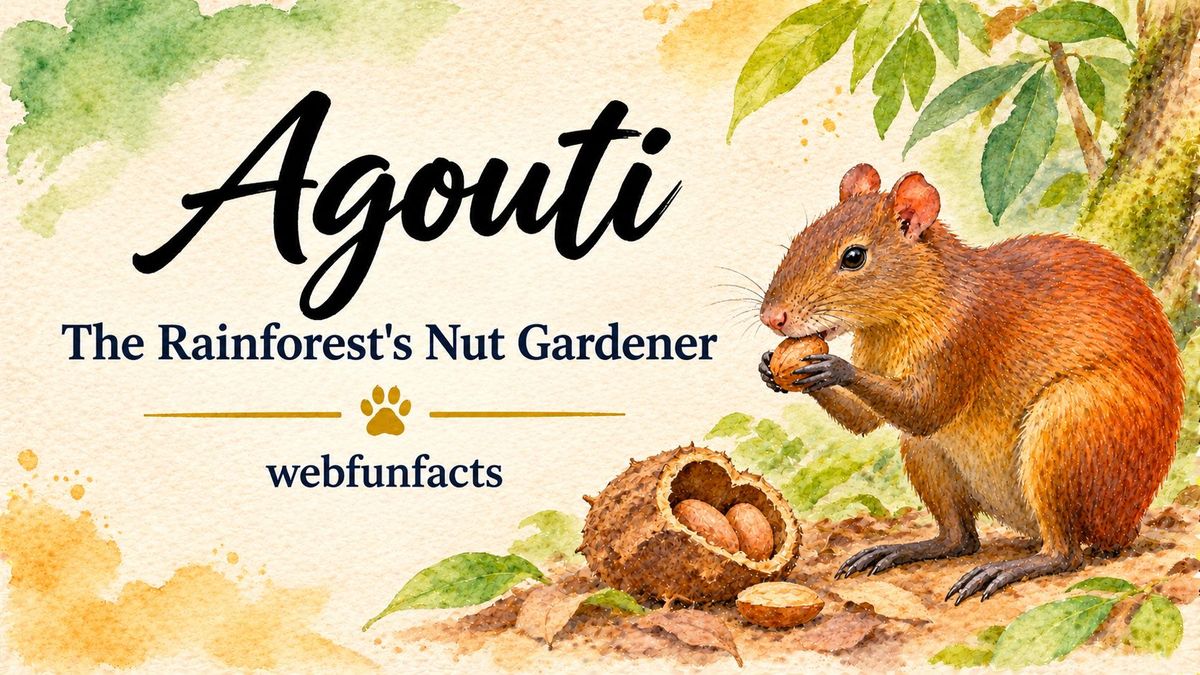
The agouti is one of the most important small animals of the Neotropical rainforest, even though most people have never heard of it. Resembling a long-legged guinea pig crossed with a tiny deer, this fast, shy rodent trots through the forests of Central and South America, collecting fruit and nuts and burying them for later. Many of those buried seeds are forgotten, and they grow into new trees.
Agoutis belong to the genus Dasyprocta, a group of roughly a dozen species of large rodents. They are active in the daytime, quick to bolt at the first hint of danger and famous for being one of the few animals able to crack open the rock-hard shell of a Brazil nut pod. In this complete guide, you will learn what an agouti is, what it looks like, where it lives, what it eats, how it raises its babies and why the rainforest depends on it.
Quick answer: The agouti (genus Dasyprocta) is a rabbit-sized rodent found from southern Mexico through Central and South America and on some Caribbean islands. It weighs roughly 2.5 to 6 kg (5.5 to 13 lb), eats fruit, nuts and seeds, and buries surplus seeds that grow into new trees. Most agouti species are Least Concern, though a few island and regional species are threatened.
Agouti at a Glance
| Feature | Details |
|---|---|
| Scientific name | Dasyprocta (for example, Dasyprocta punctata, the Central American agouti) |
| Class | Mammalia |
| Order | Rodentia |
| Family | Dasyproctidae |
| Body length | About 16 to 24 inches (40 to 62 cm) |
| Tail | Tiny, often hidden; about 0.4 to 1.2 inches (1 to 3 cm) |
| Weight | About 5.5 to 13 pounds (2.5 to 6 kg) |
| Lifespan | Often 3 to 5 years or more in the wild; up to about 20 years in captivity |
| Diet | Fruit, nuts, seeds, roots and leaves |
| Habitat | Tropical forests, forest edges, woodland and plantations |
| Range | Southern Mexico, Central America, northern and central South America, parts of the Caribbean |
| Activity | Mostly active by day (diurnal) |
| Conservation status | Varies by species; most are Least Concern (IUCN), a few are threatened |
What Is an Agouti?
An agouti is a medium-to-large rodent native to the Americas. The word is thought to come from a Tupi-Guarani name used by Indigenous peoples of South America. There are around a dozen recognized species, and the exact number changes as scientists study their genetics and appearance. The best known is the Central American agouti, Dasyprocta punctata, which is common from southern Mexico to northern Argentina in various forms.
Agoutis are related to other South American rodents, including pacas, guinea pigs, capybaras and chinchillas. Together these animals belong to a branch called caviomorph rodents, which arrived in South America millions of years ago and diversified into a huge variety of shapes and sizes. The agouti is the sleek, leggy runner of the family.
People sometimes mistake agoutis for rabbits, small deer or giant guinea pigs. In truth they are a unique group. Their body shape is an excellent example of a rodent that has taken on a hoofed-animal lifestyle, running on long thin legs through the forest floor, much like a tiny antelope.
What Does an Agouti Look Like?
Agoutis are built for speed and for life on the forest floor. Their appearance varies slightly by species, but the main features are consistent.
Size and Shape
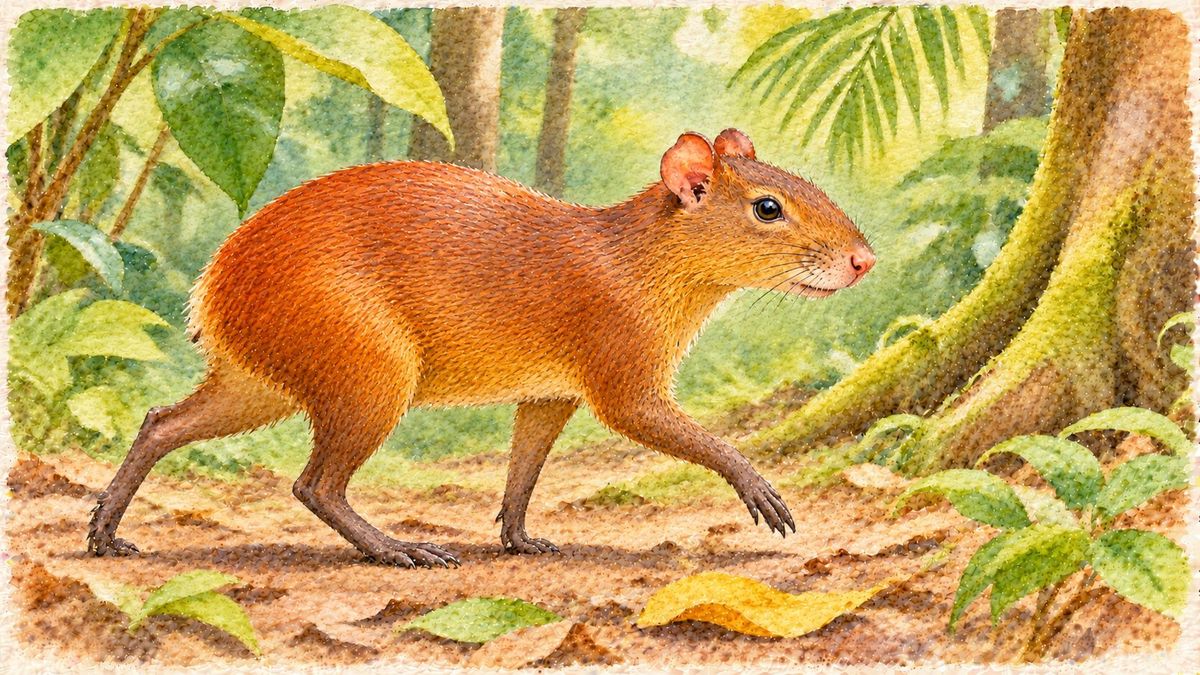
A typical agouti measures about 16 to 24 inches (40 to 62 cm) in body length and weighs roughly 5.5 to 13 pounds (2.5 to 6 kg), depending on the species. The body is rounded and slightly arched, with the rump sitting higher than the shoulders, which gives the agouti its characteristic bouncy trot. The tail is so short it is often barely visible.
Legs and Feet
The legs are long and slender. The front feet have five toes, but the hind feet have only three, each tipped with a hoof-like nail. These flat, blunt nails give the agouti good grip and speed on soft, leafy ground. An agouti can sprint away from danger and leap surprisingly high from a standing start.
Fur and Color
The coat is coarse and glossy. Colors range from reddish brown, orange and golden to dark brown or grayish, often with a paler belly. The fur on the rump is longer than elsewhere, and the animal can raise it dramatically when excited or alarmed. The word "agouti" is even used in genetics to describe hair in which each strand has bands of different colors, a pattern named after this animal's fur.
Head, Teeth and Senses
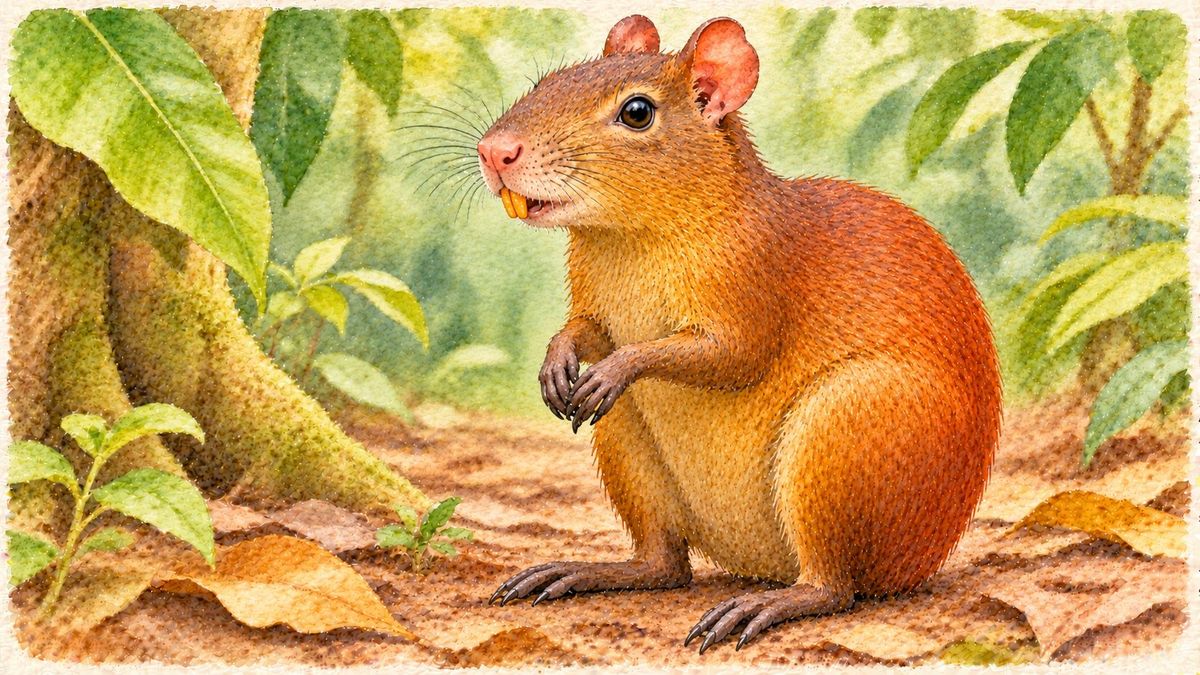
The head is small with a blunt snout, large dark eyes and short, rounded ears. Like all rodents, the agouti has four large, orange-tinted incisors at the front of the mouth that never stop growing. These chisel-like teeth are strong enough to gnaw through the thick shell of a Brazil nut pod. Agoutis have a keen sense of smell for finding buried food and sharp hearing for spotting predators.
Where Do Agoutis Live?
Agoutis live across a wide area of the Neotropics. Depending on the species, their range stretches from southern Mexico through Central America and down through northern and central South America, including the Amazon Basin, the Guianas and parts of Brazil. Some species also live in the Caribbean, including islands of the Lesser Antilles, where some populations may have been introduced by people long ago.
Their favorite habitats include:
- Lowland tropical rainforests with plenty of fruiting trees
- Forest edges, clearings and secondary growth
- Dry and moist woodlands
- Plantations, gardens and farmland close to forest cover
- Riverbanks and areas near water
Agoutis need cover to hide from predators and trees that produce fruit and nuts. They often shelter in hollow logs, among tree roots, in dense vegetation or in shallow burrows, sometimes ones dug by other animals. Each individual or pair tends to stay within a regular home range and knows the area well, which is how they find their buried food again.
What Do Agoutis Eat?
Agoutis are mostly herbivores. Their diet is built around fruit, nuts and seeds, and they also eat roots, leaves, flowers and occasionally small invertebrates.
Fruit, Nuts and Seeds
Agoutis love fallen fruit. They follow monkeys and birds through the forest, collecting fruit and seeds that drop from the canopy. They also eat palm nuts, legumes and the seeds of many large rainforest trees.
The Brazil Nut Specialist
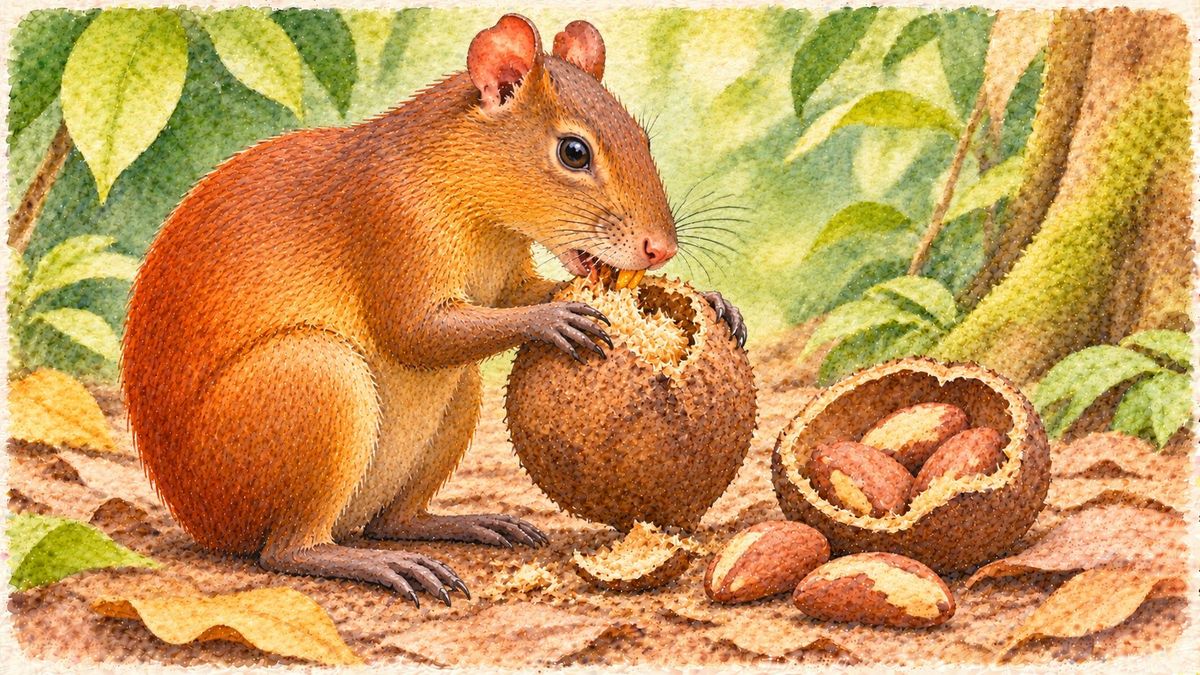
Agoutis are famous for their relationship with the Brazil nut tree (Bertholletia excelsa). The tree's large, round fruit pod has a woody shell so hard that few animals can open it. The agouti is one of the few able to gnaw through it with its powerful incisors. Once inside, the agouti removes the nuts. It eats some right away and carries others off to bury.
Scatter-Hoarding
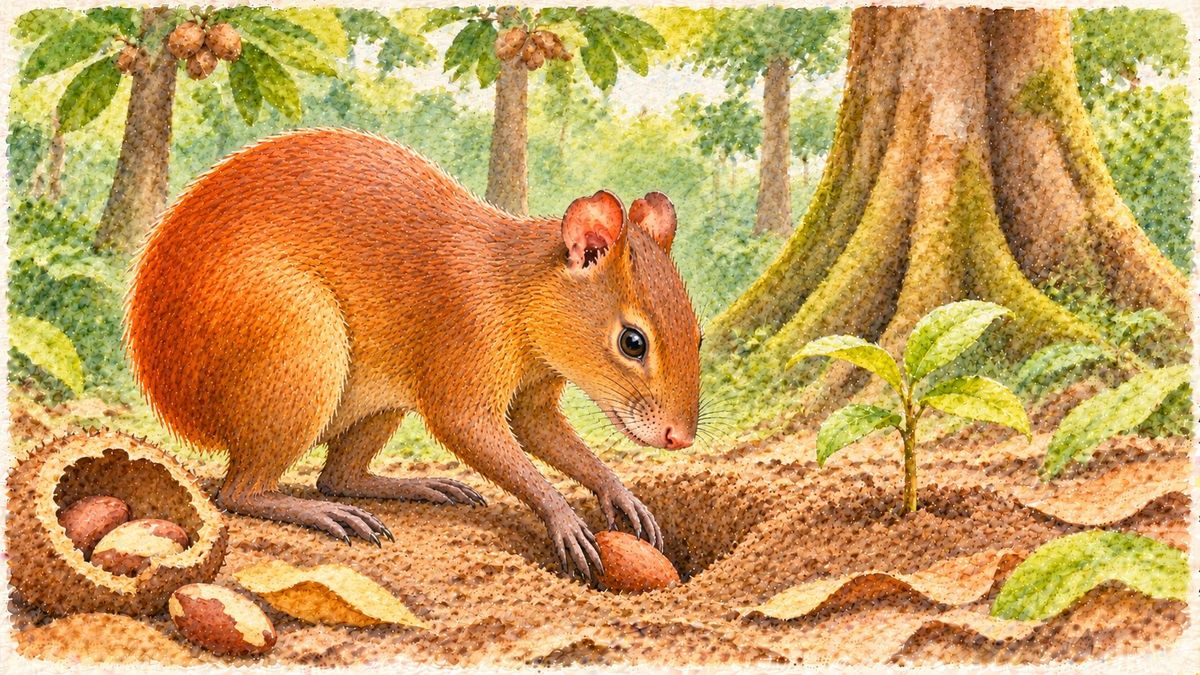
Agoutis are scatter-hoarders. They collect more seeds than they need and bury them one at a time in many separate spots across the forest floor. This protects their food from thieves and from rotting in one place. Later, when fruit is scarce, they use their sharp sense of smell and memory to dig up many of their stashes.
Not every seed gets found. Forgotten seeds can sprout and grow into new trees, which means the agouti is effectively a gardener of the rainforest. Studies of Brazil nut trees suggest that, without agoutis, many seeds would stay trapped in their pods and the trees would struggle to spread.
How Do Agoutis Eat?
An agouti often sits upright on its hind legs and holds food in its front paws like a squirrel, rotating it carefully while it nibbles. It may strip away husks, peel fruit and rasp at hard shells for long periods.
Agouti Behavior and Lifestyle
Daytime Activity
Unlike many forest rodents, agoutis are mostly active during the day. They tend to forage in the early morning and late afternoon, resting in shelter during the hottest hours. In areas where people hunt them or where predators are numerous, agoutis may become more active at night or at dusk to stay safe.
Pairs and Territories
Many agoutis live alone or in pairs. Some species form long-lasting pairs that defend a small territory together. They mark their area using scent glands and sometimes chase away intruders. Neighbors usually settle their differences with chases, standing up and sparring rather than serious fights.
Alarm Calls and Warning Signals
Agoutis are alert animals. When a predator approaches, an agouti may freeze, bark sharply or stamp its feet. It may raise the long hairs on its rump, which makes it look larger and warns nearby agoutis. After the alarm, it dashes away in a zigzag run, often to a hiding place in dense vegetation or a hollow log.
Communication
Besides barks and foot-stamping, agoutis communicate with squeals, grunts and chirps. Scent marking tells other agoutis who owns an area.
Swimming and Jumping
Agoutis can swim when needed and are agile jumpers. They can leap well over a meter into the air, a handy trick for escaping predators.
Agouti Reproduction and Babies
Agoutis can breed several times a year in areas with plenty of food. Pairs usually mate on the ground, and the gestation period is about 100 to 120 days, which is long for a rodent of this size. A mother typically gives birth to one to four young, called pups, with two being the most common litter size.
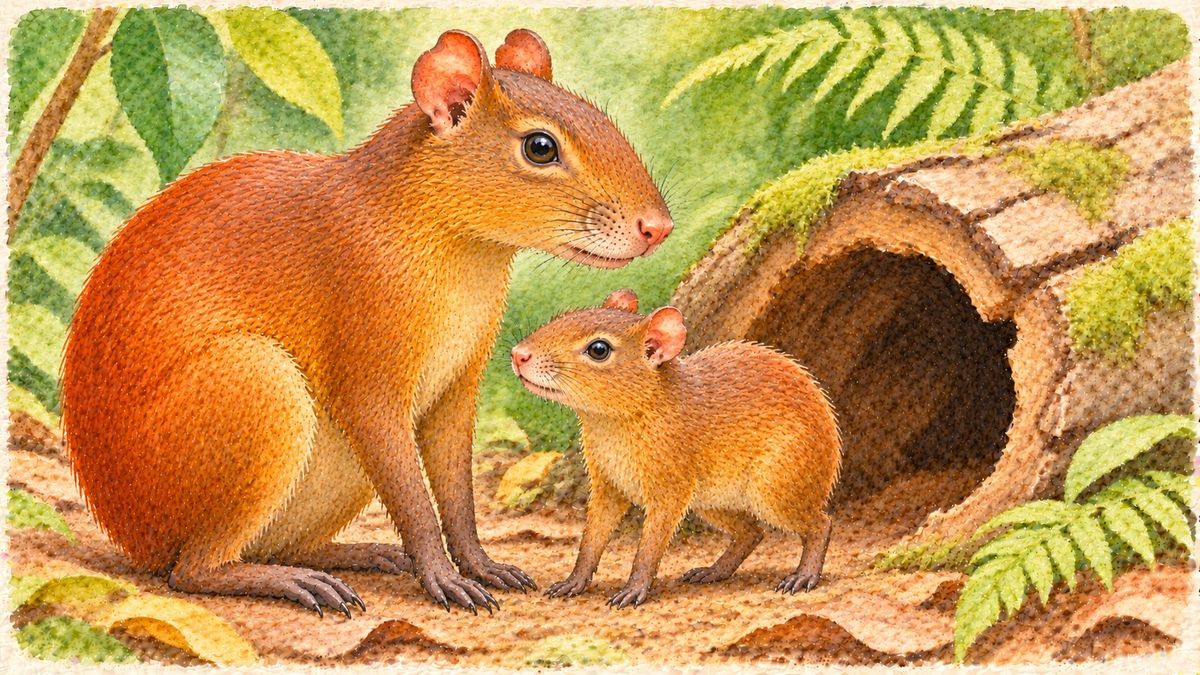
Agouti pups are born precocial, which means they are well developed from the start. They arrive with fur, open eyes and the ability to move around almost immediately. Within an hour or so, a pup may already be able to run beside its mother. Pups are usually born in a nest of leaves and roots inside a hollow log, burrow or other sheltered spot.
The mother nurses her young for several weeks, though pups start eating solid food very early. Young agoutis grow quickly and are often ready to breed within the first year of life. In some pairs the father stays close by and helps watch for danger.
How Long Do Agoutis Live?
In the wild, agoutis often live for several years, although many do not survive long because of predators and hunting. In captivity, agoutis may live up to roughly 15 to 20 years when well cared for. Exact lifespans differ between species and habitats, and reliable wild data is limited.
Predators and Threats
Because agoutis are meaty and abundant, many animals eat them. Natural predators include:
- Jaguars and pumas
- Ocelots and other small wild cats
- Harpy eagles and other large birds of prey
- Large snakes such as boa constrictors
- Tayras and other carnivores
People are also a major predator. Agoutis are hunted for meat across much of their range and are an important source of food in some rural communities. To survive, agoutis rely on speed, alertness, camouflage in the leaf litter and the ability to disappear into thick vegetation.
Why Agoutis Are Important
Agoutis are often called keystone seed dispersers for the Neotropical forests. Their habits have effects that ripple through the whole ecosystem.
- Planting trees: By burying seeds and forgetting some of them, agoutis help many large trees reproduce, including Brazil nut trees and various palms.
- Opening nuts for others: After an agouti chews open a Brazil nut pod, other animals can reach nuts that would otherwise stay locked away.
- Feeding predators: As a common prey animal, agoutis provide food for jaguars, ocelots, eagles and other top predators.
- Forest regeneration: Seed dispersal supports forest regrowth, which helps store carbon and protect biodiversity.
Scientists studying forests where agoutis have disappeared have noticed that the pattern of tree growth can change. This is one reason conservation groups pay attention to the health of agouti populations.
Are Agoutis Endangered?
The situation depends on the species. Many agoutis, including the widespread Central American agouti, are listed as Least Concern by the IUCN because they have large ranges and healthy numbers. However, a few species are in much worse shape. Some are limited to small islands or restricted regions, and one or two are classed as threatened or endangered.
Agoutis face several threats:
- Hunting for meat, especially in places with little regulation
- Deforestation and habitat loss from farming, logging and roads
- Forest fragmentation, which isolates small populations
- Invasive species and small-island vulnerability for island forms
Protecting large areas of rainforest and managing hunting are the most effective ways to keep agoutis, and the forests they plant, healthy.
Fun Facts About Agoutis
- Brazil nut cracker: The agouti is one of the few animals able to gnaw open a Brazil nut pod.
- Forgetful gardener: Forgotten buried seeds grow into new trees.
- Fur with a name: The genetics term "agouti pattern" for banded hairs comes from this animal's coat.
- Born ready: Agouti pups are born with open eyes and can move around within hours.
- Hoof-like nails: The hind feet have three toes with blunt, hoof-like nails.
- Spring-loaded jumpers: Agoutis can leap high into the air to escape trouble.
- Warning flash: The rump hair stands on end when an agouti is alarmed.
- Good memory: Agoutis can remember many of their buried food stashes using smell and spatial memory.
- Squirrel manners: They often hold food in their front paws while sitting upright.
Frequently Asked Questions
What is an agouti? An agouti is a rabbit-sized rodent from Central and South America. It has long legs, a short tail and a glossy coat, and it lives in forests where it eats fruit, nuts and seeds.
What do agoutis eat? Agoutis eat fruit, nuts, seeds, roots and leaves. They are especially known for gnawing open Brazil nut pods and burying nuts for later.
Where do agoutis live? Agoutis live in tropical forests and woodlands from southern Mexico through Central America and into northern and central South America. Some live on Caribbean islands.
Are agoutis related to rabbits? No. Agoutis are rodents, not rabbits. Their closest relatives include pacas, guinea pigs and capybaras. They look a little like rabbits because they are about the same size and have long hind legs.
Why are agoutis important to the rainforest? Agoutis bury seeds and forget some of them, helping trees such as the Brazil nut tree to spread. They also open hard pods for other animals and serve as prey for predators.
Are agoutis endangered? Most agouti species, including the Central American agouti, are Least Concern. A few species with small ranges, especially on islands, are threatened and need protection.
Final Thoughts
The agouti may look like a modest little rodent, but its habits make it one of the rainforest's quiet heroes. By cracking open nuts that most animals cannot reach and burying seeds across the forest floor, the agouti helps plant the next generation of towering trees. Protecting this speedy, bright-eyed gardener means protecting the forests of Central and South America, and all the other life that depends on them.