Iran is a country rich in history and cultural heritage. In fact, many historians consider it one of the most fascinating nations in the world. Known as Persia in ancient times, Iran’s story stretches back thousands of years. As a result, its legacy continues to inspire historians, travelers, and curious minds alike. Moreover, as one of the oldest continuous civilizations on Earth, Iran blends ancient traditions with diverse landscapes and deep cultural roots.
Located in the heart of Western Asia, Iran ranks as the 18th largest country in the world. Its landscape includes rugged mountains, vast deserts, fertile plains, and beautiful coastlines. In addition, the country borders both the Persian Gulf and the Caspian Sea. Because of this geographic diversity, Iran experiences a wide range of climates. For example, you can find snowy peaks and ski resorts in one region, while other areas feature sunbaked plateaus and lush forested valleys.
Iran’s cultural influence is equally significant. Throughout history, the nation has shaped global development through art, architecture, poetry, philosophy, and science. For instance, major cities such as Tehran, Isfahan, and Shiraz proudly showcase this legacy. These cities feature stunning palaces, grand mosques, historic gardens, and world-class museums. Furthermore, Iran ranks among the leading countries for UNESCO World Heritage Sites. Therefore, these landmarks highlight its lasting impact on human civilization.
Beyond its history and geography, modern Iran continues to captivate visitors and scholars. Today, the country celebrates vibrant traditions and a strong sense of hospitality. Meanwhile, festivals and cultural events connect the present generation with centuries-old customs. From poetry and cuisine to music and architecture, Iran offers countless fascinating discoveries. Ultimately, it remains a destination where history and modern life blend seamlessly.
Ancient History and the Rise of the Persian Empire
01. Iran is located in the Middle East, in Western Asia. It was historically known as Persia until 1935. Today, Iran remains one of the most culturally and historically significant countries in the world. Its legacy spans thousands of years.
02. Archaeological evidence shows that humans have lived in Iran since the prehistoric era. Some discoveries date back nearly 100,000 BC. These early settlements confirm Iran’s role as one of the earliest centers of human civilization.
03. Iran is recognized as one of the world’s oldest continuous civilizations. Organized communities existed on the Iranian plateau as early as 6000 BC. This long cultural continuity makes Iran a cornerstone of ancient world history.
04. Persia gained global prominence with the rise of the First Persian Empire, also called the Achaemenid Empire. It was founded around 550 BC by Cyrus the Great. The empire became one of the most powerful forces in the ancient world. It united three major civilizations — Mesopotamia, Egypt’s Nile Valley, and India’s Indus Valley — under one government.
05. At its height under Darius the Great, the Persian Empire covered vast territories. It stretched from parts of modern-day Bulgaria, Romania, and Ukraine to the Indus River Valley in northwest India. The empire also extended south into Egypt. This expansion made it one of the largest empires in ancient history.
Iran’s UNESCO World Heritage Sites and Archaeological Wonders
06. The ancient city of Persepolis is now a renowned UNESCO World Heritage Site. It once served as the ceremonial capital of the Achaemenid Empire. Built in the 6th century BC, Persepolis is considered one of the world’s greatest archaeological sites. Its monumental staircases, detailed stone carvings, and towering columns showcase the architectural brilliance of ancient Persia.
07. Iran holds an important position in global heritage conservation. The country has 27 sites officially listed as UNESCO World Heritage Sites. Dozens more remain on the Tentative List for future nomination. These landmarks highlight Iran’s deep historical roots and rich architectural traditions.
08. Persia faced several major invasions that shaped its political and cultural history. In 330 BC, Alexander the Great of Macedonia conquered the empire. In 1220 AD, the Mongol ruler Genghis Khan invaded the region. Earlier, in 636 AD, Arab forces entered Persia and introduced Islam. This event deeply influenced Iran’s culture, government, and national identity.
09. Modern Iran changed dramatically in 1979. The monarchy was overthrown during the Iranian Revolution. The country was declared an Islamic republic. Ayatollah Ruhollah Khomeini returned from 14 years of exile to lead the new system of governance.
10. Later in 1979, an international crisis began when Iranian revolutionaries seized the United States Embassy in Tehran. Sixty-six diplomats and staff members were taken hostage. The event became known as the Iran Hostage Crisis. Fourteen hostages were released early, but 52 were held for 444 days. The crisis ended after negotiations, following the death of the former Shah and the release of frozen Iranian assets.
Geography and Natural Landscapes of Iran
11. The Iran-Iraq War was a devastating conflict between neighboring countries Iran and Iraq. It lasted from 1980 to 1988. This eight-year war became one of the longest conventional wars of the 20th century. Nearly one million Iranians lost their lives. Between 250,000 and 500,000 Iraqis were also killed. The war deeply affected Iran’s economy, infrastructure, and political landscape.
12. Iran is home to one of the hottest places on Earth, the Lut Desert. This UNESCO-recognized site recorded a surface temperature of 70.7°C (159.3°F) in 2005. It remains one of the most extreme environments ever measured. The desert’s dramatic sand formations attract researchers and adventure travelers alike.
13. Despite its intense desert heat, Iran also offers winter sports. The Alborz Mountains in northern Iran host several high-altitude ski resorts. These mountains receive heavy snowfall each winter. Skiers from across the region visit for excellent conditions. This contrast shows Iran’s remarkable climate diversity.
14. Cultural gestures vary around the world. In Iran, the thumbs-up sign can be offensive. While it signals approval in many Western countries, it carries a vulgar meaning locally. Visitors should be aware of this difference to avoid misunderstandings.
15. Iran is often called the “nose job capital of the world.” Rhinoplasty is one of the country’s most popular cosmetic procedures. In 2022, about 320,000 people underwent plastic surgery. This placed Iran among the global leaders in cosmetic procedures. The trend reflects evolving beauty standards and social influences.
Unique Cultural Traditions and Social Customs in Iran
16. In 2007, an unusual story made headlines. Iranian officials reportedly detained 14 squirrels on suspicion of espionage. Reports claimed the animals carried small recording devices. The incident gained international attention. It remains one of the most bizarre modern facts about Iran.
17. Iran is the second-largest country in the Middle East, after Saudi Arabia. It ranks as the 17th-largest country in the world. The country covers about 1.65 million square kilometers. Its vast territory includes mountains, deserts, forests, and coastlines.
18. Iran is also one of Asia’s most populous nations. It ranks among the top 10 in the region. Globally, it is the 17th-most populous country. Its large population influences its economy, education system, and regional role.
19. Polo originated in ancient Persia. The game dates back to between 600 BC and 100 AD. It began as military training for elite cavalry units. Some matches involved up to 100 players per side. Over time, polo became a national sport and spread worldwide.
20. Iran is the world’s largest producer of saffron. The country supplies more than 90% of global production. Each year, about 250 tons are harvested. Known as “red gold,” saffron is the most expensive spice in the world. Its careful harvesting process makes it highly valuable in global cuisine.
Iran’s Political System and Modern Historical Events
21. Since the 1979 Islamic Revolution, wearing the hijab has been mandatory for women in Iran. The law was introduced after the Islamic Republic was established. It has remained in place for decades. In recent years, public debates and campaigns have called for changes to the dress code regulations.
22. Iran is the last natural habitat of the critically endangered Asiatic cheetah. Fewer than a dozen are believed to survive in the wild. This makes conservation efforts in Iran extremely important. The Asiatic cheetah has become a national symbol of wildlife protection.
23. Isfahan, historically known as Esfahan, is considered Iran’s top tourist destination. The city is home to the UNESCO-listed Naqsh-e Jahan Square, also called Meidan Emam. Shah Abbas I built the square in the 17th century. It is surrounded by grand mosques, royal palaces, and traditional bazaars. These landmarks showcase the brilliance of Persian architecture.
24. Iran is one of the world’s largest refugee-hosting countries. It currently shelters more than 3.4 million displaced people. Its geographic location makes it a key destination for those fleeing regional conflicts.
25. This large refugee population contributes to Iran’s positive net migration rate. In 2024, the figure was estimated at around 190,000 people. Migration continues to shape the country’s population and economy.
Wildlife, Climate, and Environmental Extremes in Iran
26. Iran ranks among the world’s top energy producers. It holds the fourth-largest proven oil reserves globally. It also has the second-largest natural gas reserves. Energy exports play a major role in the country’s economy and global influence.
27. The national flag of Iran features three horizontal stripes: green, white, and red. A red emblem sits in the center. The colors represent faith, peace, and courage. Arabic script decorates the borders of the stripes.
28. The phrase “Allāhu Akbar,” meaning “God is Great,” appears 22 times on the flag. This honors the 22nd day of the Iranian month of Bahman. The date marks the victory of the 1979 Revolution.
29. Iran is part of the historic Fertile Crescent. This region is often called the “Cradle of Civilization.” It played a key role in the rise of early agriculture and human societies.
30. Iran has a long tradition of producing Persian rugs. These carpets are famous for their detailed patterns and fine craftsmanship. In 2007, the Iran Carpet Company created the world’s largest handwoven carpet. It measured more than 5,600 square meters and was made for a mosque in Dubai.
Iran’s Economy, Oil Reserves, and Global Influence
31. According to global press freedom rankings, Iran is among the countries with the lowest levels of media freedom. Only Eritrea, Syria, China, and North Korea rank lower. Media laws and government regulations strongly influence the country’s information landscape.
32. Under Iranian law, homosexual acts are illegal and may carry severe penalties. However, gender reassignment surgery is legal. Iran has become one of the leading countries in the region for sex-reassignment procedures. This legal contrast makes Iran’s gender policies unique and widely debated internationally.
33. Iran has also taken part in major public health initiatives. The Keyhan Bod factory became the Middle East’s first large-scale condom manufacturer. It was established to address rapid population growth. Today, the facility produces millions of condoms each year as part of national family planning programs.
34. The Supreme Leader is the highest political and religious authority in Iran. The position includes control over the armed forces. It also holds significant influence over the Islamic Revolutionary Guard Corps, formed after the 1979 Islamic Revolution. More than 99% of Iran’s population identifies as Muslim. Around 90–95% follow Shia Islam.
35. Cultural gestures can have different meanings around the world. In Iran, the thumbs-up gesture may be considered offensive. In many Western countries, it signals approval. Travelers should understand this difference to avoid misunderstandings.
Surprising and Lesser-Known Facts About Iran
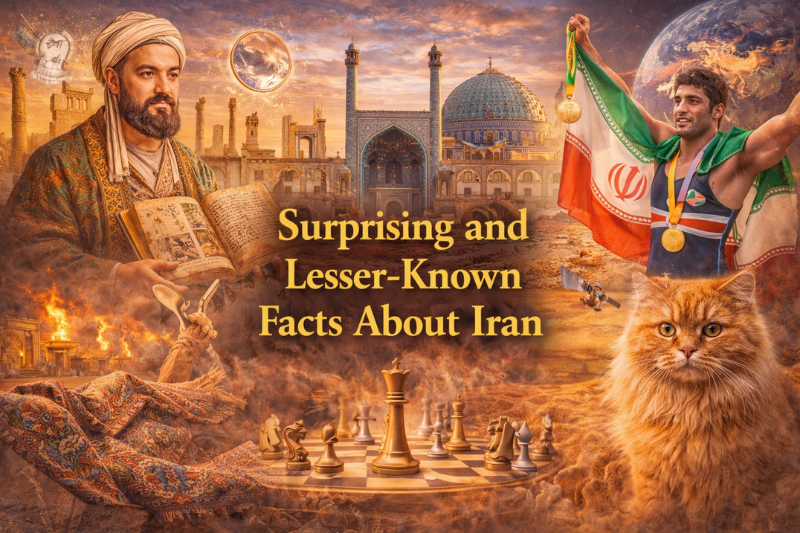
36. The Achaemenid Empire, also known as the Persian Empire, ruled from 559 BC to 331 BC. It was one of the most powerful empires in ancient history. Cyrus the Great founded the empire. At its peak, it stretched across Egypt, parts of modern-day Turkey, Iran, Afghanistan, and Pakistan. The empire united Mesopotamia, Egypt’s Nile Valley, and India’s Indus Valley. It eventually fell to Alexander the Great.
37. Persepolis was the ceremonial capital of the Persian Empire. It remains one of Iran’s most important archaeological sites. Located in southwestern Iran, the ruins date back to 518 BC. The site offers a glimpse into the grandeur of ancient Persian civilization.
38. Iran ranks among the top countries in the world for UNESCO World Heritage Sites. The country has 27 registered sites. These locations highlight its deep cultural and historical legacy.
39. The English word “assassin” comes from the Hashishin. This secretive group operated in Iran during the 11th and 12th centuries. They carried out targeted killings rather than open warfare. Their methods influenced the modern words “assassin” and “assassination.”
40. One of the most visually stunning destinations in Iran is Hormuz Island. It is often called “Rainbow Island.” The island lies in the Strait of Hormuz near the Persian Gulf. It is famous for its colorful geological formations and unique architecture.
Red Beach: This beach is known for its bright red sand. The crimson shore contrasts sharply with the deep blue waters of the Hormuz Strait.
Rainbow Valley: The valley is surrounded by striped, multi-colored mountains. The scenery resembles Peru’s Rainbow Mountain. It offers incredible photo opportunities.
Salt Goddess Cave: The cave looks simple from the outside. Inside, it reveals beautiful mineral formations in shades of white, red, and orange. Local folklore says a goddess lives within the cave.
Majara Residence: ZAV Architects, based in Tehran, designed these dome-shaped eco-friendly buildings. The structures serve as visitor accommodations. They also provide stunning views of the Persian Gulf.
Portuguese Castle: This red-stone fortress dates back to the Portuguese colonial era in the Persian Gulf. It is also known as the Fort of Our Lady of the Conception. Today, it remains one of Hormuz Island’s most important historical landmarks.
Why Iran’s History, Culture, and Geography Make It Unique
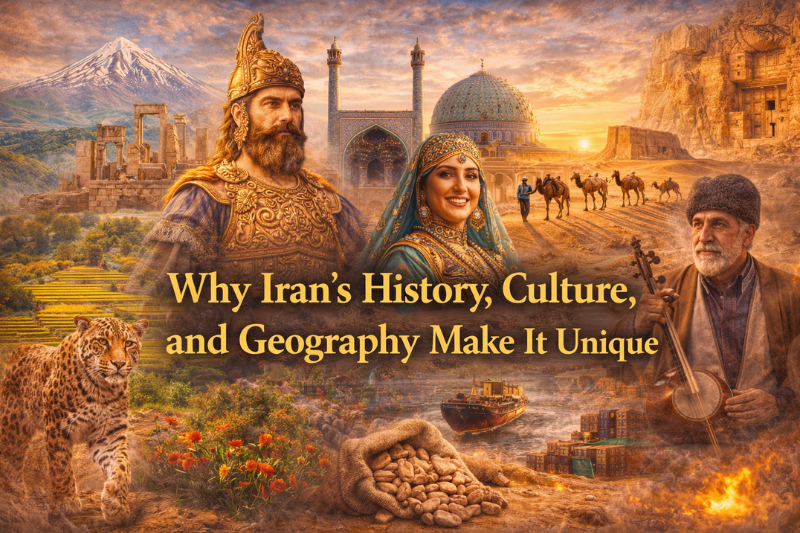
41. The Persian cat has strong ties to Iran’s history. Some accounts claim its ancestors traveled from the Khorasan region to Italy in the 1600s. However, most historians believe long-haired Persian cats were exported from Iran and Afghanistan in the 19th century. Despite debate over its early origins, the Persian cat is now one of the world’s most popular breeds.
42. Since the 1979 Islamic Revolution, alcohol has been illegal in Iran. The sale and consumption of alcoholic beverages are banned. However, demand still exists in some parts of society. This has led to underground production and smuggling. Because it is unregulated, unsafe alcohol has sometimes caused serious health issues.
43. Iran uses the Solar Hijri calendar. This system differs from the Gregorian calendar used in most Western countries. The Iranian year begins at midnight closest to the spring equinox in the northern hemisphere. It is based on precise astronomical observations from Tehran. This makes it one of the most accurate calendars in the world. However, it can be difficult for outsiders to understand without a converter.