Synopsis
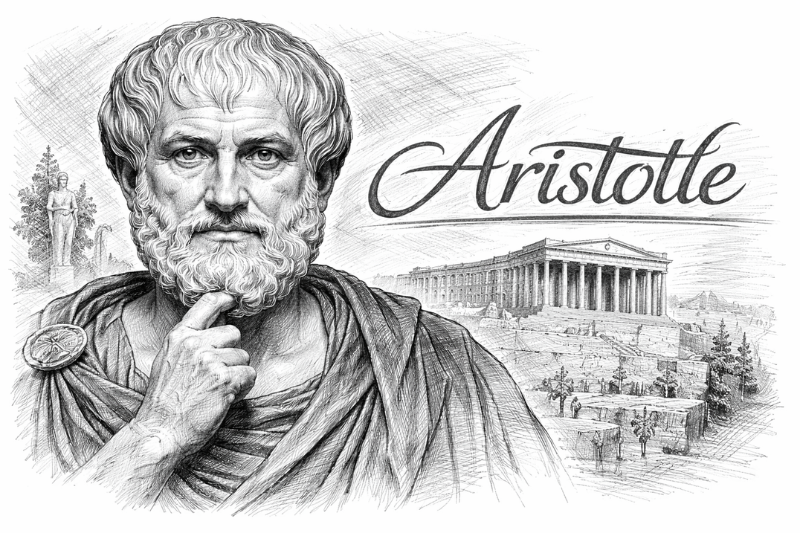
Ancient Greek philosopher Aristotle’s quote “Knowing yourself is the beginning of all wisdom” emphasizes the importance of self-awareness and personal understanding. Aristotle was one of the greatest thinkers of ancient Greece and a student of Plato. His teachings influenced philosophy, science, ethics, and politics for centuries. The quote encourages people to reflect on themselves as the foundation of knowledge and wisdom.
Quote of the Day
A meaningful Quote of the Day often reflects ideas that continue to inspire people across generations. Many of history’s most influential thinkers expressed powerful insights about life, knowledge, and human behavior through simple but profound words. One such reflection comes from the ancient Greek philosopher Aristotle, whose ideas still shape philosophy, science, and education today.
His famous words, “Knowing yourself is the beginning of all wisdom,” highlight the importance of self-awareness in human life. Understanding our strengths, weaknesses, values, and motivations helps people make wiser decisions and live more meaningful lives. As a Quote of the Day, Aristotle’s statement reminds us that true wisdom begins with honest reflection about who we are.
Quote of the Day Today
The Quote of the Day by Aristotle — “Knowing yourself is the beginning of all wisdom” — expresses a timeless philosophy centered on self-understanding. Instead of seeking knowledge only from external sources, the quote encourages individuals to begin by examining their own character, thoughts, and actions.
Aristotle was born in 384 BCE in Stagira, Greece. His father, Nicomachus, served as a physician to the Macedonian royal family. Aristotle later studied at Plato’s Academy in Athens, where he spent nearly twenty years learning philosophy and developing his own ideas.
Over time, Aristotle became one of the most influential thinkers in Western history. His work covered a wide range of subjects including logic, ethics, politics, metaphysics, biology, and rhetoric. His teachings would shape intellectual thought for centuries and continue to influence modern education and philosophy.
Early Life and Education
Aristotle’s intellectual journey began at a young age. At seventeen, he moved to Athens to study at Plato’s Academy, one of the most famous centers of learning in the ancient world. Under Plato’s guidance, Aristotle studied philosophy, mathematics, and science.
Although he deeply respected Plato, Aristotle eventually developed his own philosophical approach. While Plato focused on abstract ideals and forms, Aristotle emphasized observation and practical knowledge of the natural world.
After Plato’s death, Aristotle left Athens and later became the tutor of Alexander the Great, the future Macedonian king who would go on to build one of the largest empires in history.
Expanding Intellectual Influence
Aristotle eventually returned to Athens and founded his own school known as the Lyceum. There, he taught students while conducting research and writing extensively.
His writings covered a vast range of disciplines. Some of his most influential works include:
- Nicomachean Ethics, which explores the nature of happiness and moral virtue
- Politics, which analyzes different forms of government and society
- Metaphysics, which examines the nature of reality and existence
- Poetics, a foundational work on literary theory and drama
Aristotle’s method of studying the world through observation and reasoning laid the groundwork for the scientific method. His influence spread throughout Europe, the Middle East, and later the modern academic world.
Personal Philosophy and Legacy
Aristotle believed that the ultimate goal of human life was eudaimonia, often translated as happiness or flourishing. According to his philosophy, people achieve this by practicing virtue, cultivating knowledge, and living a balanced life.
His teachings encouraged people to develop critical thinking, ethical behavior, and intellectual curiosity. Even today, Aristotle’s ideas remain central to philosophy, politics, and education.
Quote of the Day Meaning
The meaning behind the quote “Knowing yourself is the beginning of all wisdom” lies in the idea that self-awareness forms the foundation of understanding.
Before individuals can fully understand the world around them, they must first understand themselves. Self-knowledge helps people recognize their values, motivations, and limitations. It allows them to grow, improve, and make thoughtful decisions.
The quote also reflects a broader philosophical message: wisdom does not simply come from external knowledge but from deep reflection and personal insight. By examining our own thoughts and actions, we become more capable of learning, improving, and living meaningful lives.
Other Iconic Quotes by Aristotle
Beyond the Quote of the Day, Aristotle expressed many ideas that continue to inspire thinkers and readers around the world:
- “We are what we repeatedly do. Excellence, then, is not an act, but a habit.” – Aristotle
- “Happiness depends upon ourselves.” – Aristotle
- “Educating the mind without educating the heart is no education at all.” – Aristotle
- “Pleasure in the job puts perfection in the work.” – Aristotle
- “Quality is not an act, it is a habit.” – Aristotle
- “The roots of education are bitter, but the fruit is sweet.” – Aristotle
- “Patience is bitter, but its fruit is sweet.” – Aristotle
- “The energy of the mind is the essence of life.” – Aristotle
As a Quote of the Day, Aristotle’s reflection on self-knowledge serves as a reminder that wisdom begins within. By understanding ourselves more deeply, we gain the clarity needed to grow, learn, and navigate life with greater purpose.