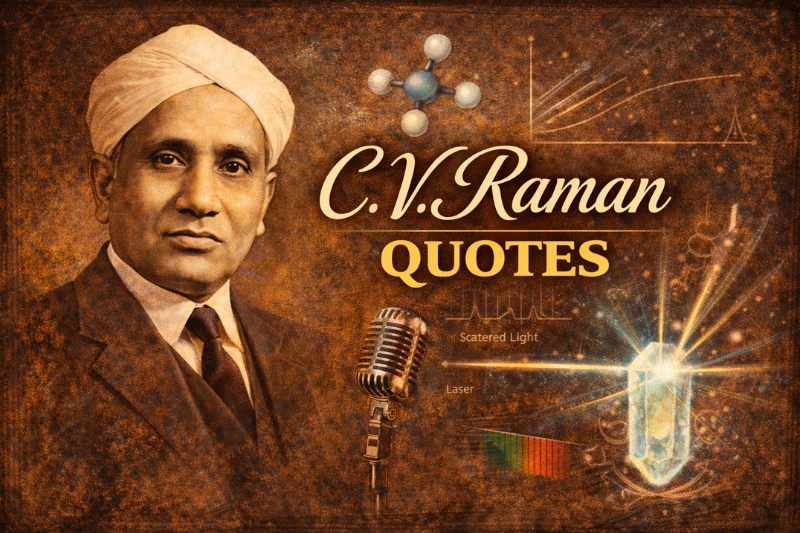
Sir C. V. Raman stands among the most influential scientists in modern history. His discoveries shaped the understanding of light and matter. Many students admire his curiosity and determination. His work continues to inspire researchers across the world. Therefore, his life remains a powerful example for anyone who loves science and learning.
Chandrasekhara Venkata Raman was born on November 7, 1888, in Tiruchirappalli, India. His family valued education and intellectual growth. His father worked as a lecturer in physics and mathematics. As a result, young Raman grew up in an environment full of books and ideas. Soon, curiosity became a natural part of his personality.
Raman showed remarkable talent during his school years. He studied with great focus and enthusiasm. Consequently, he completed his studies with outstanding results. Later, he joined Presidency College in Madras to study physics. There, his interest in scientific research grew stronger each day.
However, Raman first worked in the Indian Finance Department. The job required discipline and responsibility. Nevertheless, his love for science never weakened. After office hours, he spent long evenings reading research papers and performing experiments. Gradually, his dedication guided him toward major discoveries.
In 1928, Raman discovered an important change in light scattering. He observed how light interacts with molecules in different materials. This discovery later became known as the Raman Effect. Because of this breakthrough, scientists gained a powerful method to study molecular structures.
Soon, researchers around the world recognized the value of his work. In 1930, Raman received the Nobel Prize in Physics. Thus, he became the first Asian scientist to win a Nobel Prize in science.
Meanwhile, Raman continued to teach and encourage young scientists. Moreover, he believed curiosity leads to every great discovery. Today, C. V. Raman quotes inspire students to explore science with courage, creativity, passion, and determination.
Famous C. V. Raman Quotes on Science, Curiosity, and Discovery
“The essence of science is independent thinking, hard work, and not equipment. When I got my Nobel Prize, I had spent hardly 200 rupees on my equipment.” – C. V. Raman
“It seemed, indeed, that the study of light-scattering might carry one into the deepest problems of physics and chemistry, and it was this belief which led to the subject becoming the main theme of our activities at Calcutta from that time onwards.” – C. V. Raman
“We must teach science in the mother tongue. Otherwise, science will become a highbrow activity. It will not be an activity in which all people can participate.” – C. V. Raman
“We have, I think, developed an inferiority complex. I think what is needed in India today is the destruction of that defeatist spirit.” – C. V. Raman
“It was my great good fortune, while I was still a student at college, to have possessed a copy of an English translation of his great work ‘The Sensations of Tone.’ As is well known, this was one of Helmholtz’s masterpieces.” – C. V. Raman
“Towards the end of February 1928, I took the decision of using brilliant monochromatic illumination obtained by the aid of the commercially available mercury arcs sealed in quartz tubes.” – C. V. Raman
“It will soon be 25 years from the date of publication of my first research work. That the scientific aspirations kindled by that early work did not suffer extinction has been due entirely to the opportunities provided for me by the great city of Calcutta.” – C. V. Raman
“I would like to tell the young men and women before me not to lose hope and courage. Success can only come to you by courageous devotion to the task lying in front of you.” – C. V. Raman
Inspirational C. V. Raman Quotes to Motivate Students and Scientists
“It is generally believed that it is the students who derive benefit by working under the guidance of a professor. In reality, the professor benefits equally by his association with gifted students working under him.” – C. V. Raman
“I feel it is unnatural and immoral to try to teach science to children in a foreign language They will know facts, but they will miss the spirit.” – C. V. Raman
“In the first English class I attended, Prof. E. H. Elliot, addressing me, asked if I really belonged to the Junior B. A. class, and I had to answer him in the affirmative. He then proceeded to inquire how old I was.” – C. V. Raman
“I have always thought it a great privilege to have as my colleague in the Palit Chair of Chemistry such a distinguished pioneer in scientific research and education in Bengal as Sir Prafulla Ray. It has been invariably my experience that I could count on his cooperation and sympathy in every matter concerning my scientific work.” – C. V. Raman
“The whole edifice of modern physics is built up on the fundamental hypothesis of the atomic or molecular constitution of matter.” – C. V. Raman
“A voyage to Europe in the summer of 1921 gave me the first opportunity of observing the wonderful blue opalescence of the Mediterranean Sea. It seemed not unlikely that the phenomenon owed its origin to the scattering of sunlight by the molecules of the water.” – C. V. Raman
“It was the late Dr. Mahendra Lal Sircar who, by founding the Indian Association for the Cultivation of Science, made it possible for the scientific aspirations of my early years to continue burning brightly.” – C. V. Raman
“From Calcutta has gone forth a living stream of knowledge in many branches of study. It is inspiring to think of the long succession of scholars, both Indian and European, who have lived in this city, made it their own, and given it of their best.” – C. V. Raman
Best C. V. Raman Quotes About Knowledge, Research, and Innovation
“We need a spirit of victory, a spirit that will carry us to our rightful place under the sun, a spirit which can recognize that we, as inheritors of a proud civilization, are entitled to our rightful place on this planet. If that indomitable spirit were to arise, nothing can hold us from achieving our rightful destiny.” – C. V. Raman
“The fundamental importance of the subject of molecular diffraction came first to be recognized through the theoretical work of the late Lord Rayleigh on the blue light of the sky, which he showed to be the result of the scattering of sunlight by the gases of the atmosphere.” – C. V. Raman
“When we consider the fact that nearly three-quarters of the surface of the globe is covered by oceanic water, we begin to realise that the molecular scattering of light in liquids may possess an astronomical significance, in fact contribute in an important degree to the observed albedo of the earth.” – C. V. Raman
“All the instruments of percussion known to European science are essentially nonmusical and can only be tolerated in open air music or in large orchestras where a little noise more or less makes no difference.” – C. V. Raman
“In the history of science, we often find that the study of some natural phenomenon has been the starting point in the development of a new branch of knowledge.” – C. V. Raman
“It is not often that idealism of student days finds adequate opportunity for expression in the later life of manhood.” – C. V. Raman
“I strongly believe that fundamental science cannot be driven by instructional, industrial, governmental or military pressures. This was the reason why I decided, as far as possible, not to accept money from the government.” – C. V. Raman
“Is there any more encouraging sign than to see an Indian, who has never been to a university, like our friend Mr. Asutosh Dey here, for example, carrying out original work and finding it recognized by the foremost societies of the world?” – C. V. Raman
“To an observer situated on the moon or on one of the planets, the most noticeable feature on the surface of our globe would no doubt be the large areas covered by oceanic water. The sunlit face of the earth would appear to shine by the light diffused back into space from the land and water-covered areas.” – C. V. Raman